
Table of Contents >> Show >> Hide
- Who Is The Creative Artist Behind These Cloud Stories?
- Why We See Stories In Clouds In The First Place
- Why These 22 New Pics Feel More Like Tiny Stories Than Simple Doodles
- The Real Artistic Skill Is Not Drawing. It Is Seeing.
- Why Cloud Art Feels So Good To Look At
- More Than Viral Visuals: What This Series Says About Art Now
- The Experience Of Seeing Secret Stories In The Clouds
- Conclusion
Some people doomscroll. Some people daydream. And then there are the rare, wonderful humans who look up at a cloud and think, “That one is clearly a poodle hugging her puppies, and I am prepared to prove it.” That, in a delightfully fluffy nutshell, is the magic behind Secret Stories Hidden In The Clouds, Revealed By This Creative Artist (22 New Pics).
The artist at the center of this charming visual rabbit hole is Monse Ascencio, known for her Rayando nubes series, where she transforms ordinary cloud photos into playful illustrations. The result is more than a clever doodle project. It is a reminder that imagination is not just for children, art school graduates, or people who own suspiciously expensive sketchbooks. It is a human reflex. Give us a soft cloud, a little light, and five uninterrupted seconds, and we will absolutely invent a story.
That is why these 22 new pictures land so well. They do not simply show cloud art. They reveal how the brain loves patterns, how the eye hunts for meaning, and how visual storytelling can bloom out of something as temporary as a passing patch of sky. In a digital world crowded with filtered perfection and hyper-polished design, Ascencio’s work feels refreshingly loose, funny, and alive. The clouds are fleeting. The drawings are simple. The emotional effect is surprisingly sticky.
This article takes a closer look at why these hidden stories in the clouds are so satisfying, what makes Monse Ascencio’s art so shareable, and why cloud illustrations, pareidolia, and creative storytelling continue to capture our attention. Yes, this is an art feature. But it is also a small love letter to the old-fashioned thrill of looking up.
Who Is The Creative Artist Behind These Cloud Stories?
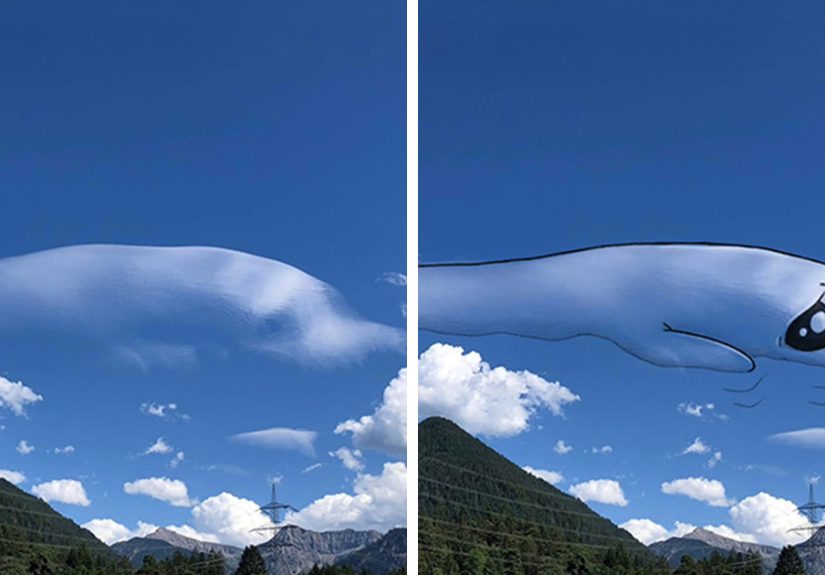
Monse Ascencio has built a distinctive style around a simple but irresistible idea: photograph clouds, study their shapes, and draw over them to reveal the characters hiding inside. In her Rayando nubes series, she turns sky shapes into creatures, tiny narratives, and visual jokes that feel immediate and oddly inevitable. Once she outlines them, the illusion snaps into focus. Suddenly, the cloud that looked random a second ago becomes a dog, a bird, a whale, or a cuddly little scene with its own mini-plot.
That is a huge part of the appeal. Her work does not feel forced. It feels discovered. Ascencio has said that imagining figures in the clouds is something she has done since childhood, and that sense of playful memory still pulses through the series. The tone is not grand, heavy, or determined to impress you with ten paragraphs of artist-statement fog. It is generous, lighthearted, and welcoming. The art says, in effect, “Come look at this weird little miracle I found in the sky.”
And people do. Because the project taps into something nearly universal. Almost everyone has, at some point, stared at the sky and spotted an animal, a face, a ship, or a dragon-shaped puff doing its best impression of performance art. Ascencio simply finishes the sentence our brains were already starting to write.
Why We See Stories In Clouds In The First Place
Pareidolia: The Brain’s Favorite Party Trick
If you have ever seen a face in a cloud, a rabbit in a moon shadow, or a suspiciously judgmental expression in your toaster, congratulations: your brain is working as designed. The phenomenon is called pareidolia, which is the tendency to perceive meaningful images or patterns in ambiguous visual information.
This is not a bug in the system. It is a feature. Human brains are exceptionally good at recognizing patterns, especially faces and familiar forms. From an evolutionary perspective, it is smarter to notice a pattern too quickly than to miss something important. That is part of why people can detect animals, eyes, mouths, and bodies in clouds, rocks, wood grain, and all sorts of visual chaos. The mind would rather guess early than stay clueless.
What makes Ascencio’s work so satisfying is that it sits right on top of this natural tendency. She is not inventing meaning out of nowhere. She is partnering with the viewer’s brain. The cloud offers ambiguity. The viewer begins to suspect a shape. The drawing confirms it. That tiny moment of recognition is pure candy for the mind.
Clouds Are Basically Nature’s Rorschach Test
Clouds are perfect material for visual imagination because they are soft-edged, unstable, and constantly changing. Unlike a chair, which stubbornly insists on being a chair, a cloud can suggest three different animals in the same minute. Depending on the light, the angle, and your mood, one person sees a whale while another sees a dragon having an identity crisis.
Cloud science makes them even more fascinating. Different cloud types already carry distinct personalities. Puffy cumulus clouds often look playful and sculptural. Wispy cirrus clouds feel delicate and dramatic. Darker storm formations can look theatrical, moody, even cinematic. Add the fact that visible light and shifting atmospheric conditions constantly change how clouds appear, and you get a natural canvas that never repeats itself. In other words, the sky is doing half the art direction for free.
Why These 22 New Pics Feel More Like Tiny Stories Than Simple Doodles
The title promises secret stories hidden in the clouds, and that is exactly what makes this series stronger than a random batch of visual gags. Ascencio’s images are not merely “Look, this cloud resembles a dog.” They often contain mood, interaction, and implied movement. A poodle hugging its puppies is not just a shape match; it is a scene. A turtle and whale hovering above mountains feel like a surreal migration. A manta ray gliding through the sky has the elegance of a fantasy postcard. A cartoon bird perched in cloud form feels like the opening panel of a children’s book.
Several of the new works lean into tenderness. One image reads as a cute creature hugging a cloud, which sounds ridiculous on paper and somehow feels emotionally correct in practice. Others lean into humor and surprise, especially the dog-like shapes and animal transformations that make the sky look less like weather and more like a pet parade with excellent altitude control.
This storytelling quality matters. Viewers do not connect to shapes alone; they connect to relationships, gestures, and emotional cues. The difference between “a cloud that looks like a whale” and “a cloud that becomes a whale floating over a mountain ridge like it owns the place” is the difference between observation and narrative. Ascencio consistently chooses narrative.
The Real Artistic Skill Is Not Drawing. It Is Seeing.
At first glance, projects like this can look deceptively simple. People see the finished image and think, “Oh, I could do that.” Maybe. But the harder part is not tracing lines over a photo. The harder part is noticing the hidden form in the first place, selecting the right image, resisting overworking it, and preserving the cloud’s original personality.
Good cloud art depends on restraint. If the drawing is too heavy, the magic disappears. If it is too vague, the joke falls flat. Ascencio’s work succeeds because the line between reality and invention stays visible. The cloud remains a cloud. The illustration simply nudges our perception. That balance is what gives the images their charm.
There is also a deeper creative skill at work here: divergent seeing. Creativity researchers often describe imagination as the ability to generate multiple possibilities from a single stimulus. In plain English, creative people are often better at seeing what else something could be. Studies on ambiguous, cloud-like images suggest that highly creative individuals can perceive recognizable forms more quickly and in more varied ways. That does not mean the rest of us are doomed to spend our lives seeing only “large blob, medium blob, suspicious blob.” It simply means artists like Ascencio are especially practiced at turning ambiguity into story.
Why Cloud Art Feels So Good To Look At
It Revives Childlike Imagination Without Feeling Childish
One reason this series spreads so easily online is that it invites viewers back into a familiar mental state: playful interpretation. Many adults spend their days solving practical problems, answering messages, clicking tabs, and pretending they enjoy passwords. Cloud art interrupts that machinery. It asks for a softer kind of attention.
That shift matters. Research on daydreaming and spontaneous thought suggests that imagination can support creativity, idea generation, and mental flexibility. Looking up, slowing down, and letting the mind wander are not always wasted time. Sometimes they are the warm-up act for insight.
It Mixes Calm With Discovery
There is something inherently soothing about clouds. They are tied to open space, shifting light, and the simple act of lifting your gaze. Even environmental psychology has pointed to the mental effect of looking upward and taking in larger visual space. Pair that calming backdrop with the small delight of recognition, and you get a lovely emotional combo: serenity plus surprise.
That may help explain why this kind of artwork feels almost therapeutic. It is low-stakes, accessible, and quietly participatory. You do not need specialized art knowledge to enjoy it. You just need a functioning imagination and a willingness to be briefly charmed by the atmosphere.
More Than Viral Visuals: What This Series Says About Art Now
In the age of algorithmic feeds, a lot of visual content shouts for attention. Ascencio’s cloud stories do something smarter. They whisper. They make people pause. They reward close looking. And they prove that compelling internet art does not always need spectacle, controversy, or giant conceptual machinery. Sometimes it just needs a strong idea executed with consistency and warmth.
The project also speaks to a larger trend in contemporary visual culture: audiences love art that feels both skillful and human. Cloud drawings work because they are polished enough to satisfy and playful enough to invite. They live in that sweet spot between craft and spontaneity. Nothing feels overly corporate, overexplained, or trapped in theoretical concrete.
That is why Secret Stories Hidden In The Clouds, Revealed By This Creative Artist (22 New Pics) resonates beyond the headline. It is not simply a gallery of cute images. It is a reminder that stories are everywhere, waiting for someone observant enough to pull them into view.
The Experience Of Seeing Secret Stories In The Clouds
There is a very specific feeling that comes from seeing a hidden story in the sky, and it is hard to fake. It begins with nothing. You are outside, maybe walking home, maybe sitting in traffic, maybe pretending to be productive while staring out a window like the lead in an indie film. Then a cloud catches your eye. At first it is just shape and brightness. Then, all at once, it becomes something else. A sleepy bear. A fish with opinions. A giant bird doing an awkward midair turn. The cloud has not changed, not really. You have. Your perception has clicked into place.
That moment is tiny, but it feels strangely rich. It is part recognition, part invention, and part private joke between you and the world. Even when two people look at the same cloud, they often see different things. That is what makes the experience feel personal. The cloud becomes a mirror for mood, memory, and imagination. Someone who grew up with dogs may spot a floppy-eared puppy first. Someone else sees a whale, a rabbit, or a character from a childhood cartoon they have not thought about in years. The sky turns into a collaborative sketchbook.
What Monse Ascencio’s work does so beautifully is capture that fleeting mental experience before it evaporates. Most of us see a cloud-creature, smile for two seconds, and then lose it as the wind rearranges everything. Her illustrations preserve the almost-story that would normally disappear. They make the temporary feel shareable. More than that, they validate a kind of seeing that adults are often encouraged to outgrow. We are praised for being efficient, realistic, and focused, but cloud-watching asks for a different intelligence. It asks for looseness. It asks for wonder. It asks us to tolerate ambiguity long enough for meaning to arrive wearing a ridiculous little face.
There is also something democratic about the whole thing. You do not need a museum ticket, a fancy camera, or a graduate seminar in visual theory to enjoy hidden stories in clouds. The raw material is overhead and free. That matters. In a culture where attention is monetized from every direction, the act of looking up and imagining something playful in the sky feels almost rebellious. It is delight without a subscription fee.
And then there is the emotional afterglow. Cloud stories tend to stay with you not because they are monumental, but because they interrupt routine. They remind you that perception is flexible, that the world is not always as fixed as it looks, and that humor and tenderness can appear in unexpected places. A manta ray in the sky is absurd, yes, but it is also liberating. It suggests that not everything beautiful needs to be permanent, and not every story needs a heavy plot. Sometimes a hidden story can be enough: a poodle, a bird, a whale, a soft shape becoming a character for one perfect second before the whole scene drifts apart.
Maybe that is why cloud art continues to resonate. It gives form to something many people already feel but rarely articulate: that imagination is not an escape from reality, but one of the ways we fully experience it. The clouds are still meteorology. The stories are still ours. And somewhere between those two truths, art happens.
Conclusion
Secret Stories Hidden In The Clouds, Revealed By This Creative Artist (22 New Pics) works because it blends observation, humor, tenderness, and a dash of brain science into something instantly lovable. Monse Ascencio’s cloud illustrations are visually simple, but they unlock a surprisingly deep response. They remind us that creativity often begins with paying attention, that storytelling can grow from the most temporary materials, and that the sky is still one of the best places to practice wonder.
In a world that constantly asks us to look down at screens, this series offers a better suggestion: look up. There might be a whale over the mountains, a bird tucked into a drifting puff, or a tiny secret story waiting in the clouds for someone imaginative enough to see it.






 Close
Close