
Table of Contents >> Show >> Hide
- Table of Contents
- What “tattoo trapping” looks like (and why it’s not cute)
- Why copying tattoos feels so personal
- Matching tattoos vs. copying tattoos: where the line is
- The psychology: mirroring, love bombing, and control
- If you’re the boyfriend: what to do next (without turning into a villain)
- The tattoo reality check: health risks and aftercare basics
- Ethics (and a little law): can someone copy your tattoo designs?
- If you’re the one tempted to copy: better ways to build closeness
- If it already happened: how people recover from tattoo regret
- of real-world experiences & lessons
- Final thoughts
There are “matching outfits” couples, “matching playlists” couples… and then there’s the
“I went to a tattoo artist with a photo album of your skin and asked for the Greatest Hits tour” couple.
If that sentence made your eyebrows climb your forehead like they’re trying to escapegood. They’re listening to your instincts.
Copying someone’s tattoos to fast-track a casual fling into a serious relationship isn’t romantic. It’s not even “bold.”
It’s the relationship equivalent of moving into someone’s house by slowly replacing their furniture one chair at a time.
And because tattoos are permanent (and because people are complicated), this story sits right at the crossroads of
identity, boundaries, and “please stop using my body as your Pinterest board.”
What “tattoo trapping” looks like (and why it’s not cute)
The headline version goes like this: a guy thinks he’s in a casual, low-pressure situation. Then his girlfriend shows up with
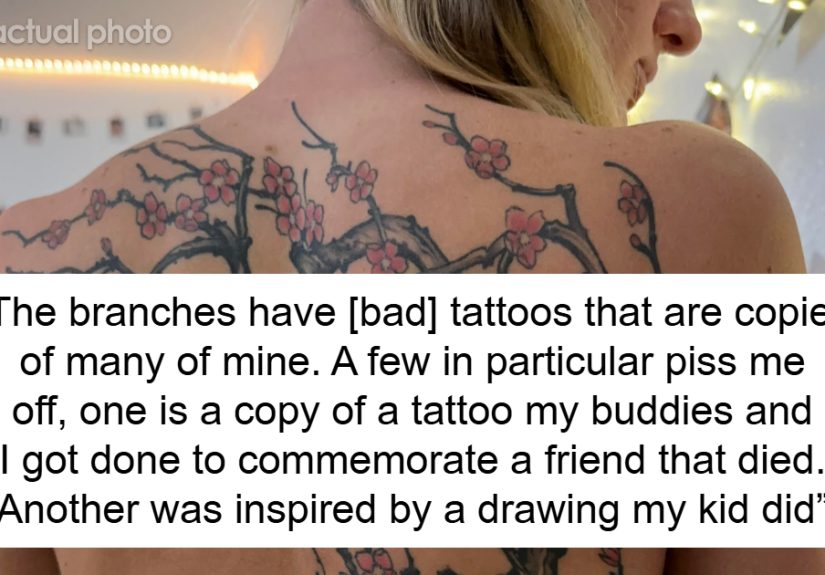
fresh inkbig inkmirroring the tattoos he already has. Not “similar vibe.” Not “same artist.” Not “we both like roses.”
We’re talking copy-and-paste territory: same placement, similar themes, a deliberate attempt to look like they “belong” together.
The idea behind the move is usually the same: If I look like him, he’ll feel bonded to me. If our bodies match, our relationship must be serious.
It’s a shortcutone that tries to replace mutual agreement with permanent symbolism.
And here’s the rub: commitment is not a scavenger hunt where the final clue is “get eight hours of needle time.”
Commitment is a conversation. It’s mutual. It’s voluntary. Tattoos are artsometimes sentimental artbut they are not a consent form.
Why copying tattoos feels so personal
Tattoos aren’t just decoration. For many people, they’re tied to identity, milestones, grief, pride, belonging, or a specific chapter of life.
Even when a tattoo is “just because it looks cool,” it’s still a choice you made about your body.
So when someone copies your tattoosespecially without askingit can feel like:
- Identity hijacking: like your personal story got duplicated without permission.
- Boundary testing: “If I can do this, what else can I push?”
- Public pressure: friends will assume you’re serious (“You don’t get matching tattoos with a fling!”).
- Forced intimacy: using permanence to manufacture closeness.
It can also trigger a primal alarm: if someone is willing to make a permanent change to control how you feel,
what will they do when the stakes are highermoving in, money, pregnancy, social pressure, threats, self-harm talk, or smear campaigns?
Not everyone escalates, but the pattern (big gesture → pressure → expectation) is worth taking seriously.
Matching tattoos vs. copying tattoos: where the line is
Let’s be fair: plenty of healthy couples get tattoos. Some do matching designs. Some do complementary pieces (sun/moon, lock/key).
Some just like the same style and end up in the same shop a lot. That’s not the issue.
Green-flag tattoo behavior
- Mutual planning: both people discuss meaning, timing, placement, and expectations.
- Consent is explicit: nobody is surprised by a “ta-da” tattoo meant to pressure the other person.
- Designs are complementary, not identical: they represent the relationship without cloning a person.
- No leverage: the tattoo isn’t used as proof, guilt, or a bargaining chip.
Red-flag tattoo behavior
- Surprise permanence: “I did this for you, so now you owe me.”
- Exact copying: placement and motifs that mimic someone’s existing body art.
- Rushing: early relationship pressuretalking future, rings, moving inpaired with dramatic gestures.
- Public narrative control: using the tattoo to influence how others judge the relationship.
A simple test: if the tattoo’s purpose is to express love, it can coexist with “no.” If its purpose is to create obligation,
it falls apart the second you set a boundary.
The psychology: mirroring, love bombing, and control
Humans mirror each other. It’s normal. We pick up phrases, laugh at the same jokes, adopt similar routines.
Mirroring can be a sign of closenessor a sign someone is trying to manufacture closeness quickly.
When mirroring turns into manipulation
In early dating, some people use intense affection, constant contact, and fast “future talk” to accelerate attachment.
This pattern is often described as love bombingover-the-top attention meant to pull someone into a relationship before trust is earned.
It can look flattering at first, but it often comes with pressure, boundary-pushing, and a sense that you can’t slow things down without consequences.
Where “tattoo trapping” fits
Copying a partner’s tattoos can function like a physical form of love bombing: “Look how committed I am!”
The problem isn’t commitmentit’s unilateral commitment used as leverage. When the gesture is designed to control the other person’s choices,
it starts to resemble coercive dynamics: pressure, obligation, and attempts to shape your behavior through guilt or fear.
Not every dramatic gesture equals abuse. But patterns matter. If the tattoo copying comes alongside isolating behavior, jealousy,
monitoring your time, punishing you for boundaries, or rewriting reality (“You’re cruel if you don’t commit after what I did”),
those are serious warning signs.
If you’re the boyfriend: what to do next (without turning into a villain)
Your goals here are simple: be clear, be kind, and be safe. You don’t need a courtroom speech. You need boundaries.
Think of it as “adult communication,” not “winning the breakup Olympics.”
Step 1: Name the behavior, not the person
Try: “Copying my tattoos feels like a boundary violation to me. It makes me uncomfortable.”
Avoid: “You’re insane,” “You’re a psycho,” or anything that turns the conversation into a debate about her character.
You’re describing impact.
Step 2: State the relationship reality
If you want casual: “I’m not looking for a serious relationship. That hasn’t changed.”
If you want out: “This crossed a line for me, and I’m ending the relationship.”
Step 3: Do not negotiate your boundary
A boundary isn’t a proposal. It’s information. If she argues, cries, or escalates, you can repeat:
“I hear you. My decision is still the same.”
Step 4: Watch for escalation and protect yourself
If there are threats, stalking, retaliation, or harassment, prioritize safety: document messages, involve trusted friends,
and consider professional support. If you ever feel unsafe, treat it like a safety issuenot a relationship issue.
The tattoo reality check: health risks and aftercare basics
Even if we ignore the relationship chaos for a second, there’s a practical truth: a tattoo is an intentional wound.
Most heal fine, but risks are realespecially when someone gets big pieces impulsively or tries to “keep up” with someone else’s tattoo pace.
Common risks people underestimate
- Infection: can occur early or sometimes show up later; risk increases with poor hygiene or contaminated ink.
- Allergic reactions: certain pigments can trigger itching, swelling, rashes, or delayed reactions.
- Scarring/keloids: some people develop raised scars; placement and genetics matter.
- Granulomas or inflammation: the immune system can react to ink in unpredictable ways.
Signs a tattoo may be infected
Mild redness and soreness can be normal at first. What’s not normal: increasing redness that spreads,
worsening pain, thick pus, fever, red streaks, or swelling that keeps getting worse.
If those show up, it’s time to contact a medical professionalsooner is better.
Aftercare basics that actually matter
- Wash gently with clean hands and a mild cleanser.
- Keep it lightly moisturized (not drowning in ointment like a glazed donut).
- Avoid picking scabs and avoid soaking (pools/hot tubs/lakes) until fully healed.
- Protect from sunfresh tattoos and UV are not friends.
Bottom line: if someone got a massive tattoo “for the relationship,” and now the relationship is shaky,
they may also be dealing with the physical and emotional stress of healing plus regretan intense combo that can amplify conflict.
Ethics (and a little law): can someone copy your tattoo designs?
Ethically, copying someone’s tattoos is usually a foul. Not “call-the-police” foulmore like “this is why we can’t have nice things” foul.
Tattoo culture often values originality, and many artists won’t copy someone else’s work exactly, especially if it’s custom.
What about legal rights?
In the U.S., tattoo designs can be treated as creative works, and copyright disputes have popped up in public casesespecially
when tattoos appear in video games, ads, or media. The details get messy: who owns what, what permissions exist, and how a tattoo
on a body interacts with licensing and likeness rights. The big takeaway for everyday life is simpler:
tattoos aren’t automatically “free to copy” just because they’re visible.
In a relationship context, the bigger issue usually isn’t a lawsuitit’s consent and respect.
If someone is willing to “borrow” your permanent art without asking, that’s often part of a larger pattern of overstepping.
If you’re the one tempted to copy: better ways to build closeness
If you felt a sting reading this because you’ve thought, “Maybe if I prove I’m serious, they’ll choose me,” you’re not alone.
That fearof being “not enough”can make big gestures feel like a solution.
But here’s the truth: gestures don’t create security. agreements create security.
Try these instead of copying tattoos
- Ask for clarity: “What are we? What do you want? What do I want?”
- Set a pace: decide what commitment would look like and what timeline feels healthy.
- Keep your identity: invest in friendships, hobbies, and goals that exist outside the relationship.
- Consider support: therapy can help if anxiety or abandonment fears drive impulsive choices.
If someone only becomes serious because you made a permanent sacrifice, you didn’t gain a partneryou bought a hostage situation.
And that’s not love. That’s a subscription service you can’t cancel.
If it already happened: how people recover from tattoo regret
Sometimes the tattoos are done, the relationship is awkward, and everyone is googling “cover-up ideas” at 2 a.m.
If you’re in that phase, you’re not doomed. You just need a plan.
Options people commonly choose
- Reframe the meaning: “This is a chapter, not a life sentence.” (Not always emotionally easy, but possible.)
- Cover-up work: a skilled artist can transform copied designs into something original.
- Laser removal: often multiple sessions; cost and results vary by ink color and skin.
- Boundaries + distance: sometimes the healthiest “aftercare” is relational, not dermatological.
The real lesson: permanence doesn’t guarantee permanence. You can’t staple commitment to someone’s heart with needlework.
Healthy relationships are built with honesty, mutual choice, and respectnone of which require matching forearms.
of real-world experiences & lessons
Below are composite, real-to-life experiences drawn from common themes people share in advice columns, relationship discussions, and tattoo communities.
Names and details vary, but the lessons are painfully consistent: when someone uses ink to control an outcome, the ink rarely ages well.
1) “The Matching Tattoo That Wasn’t”
One couple planned “matching” tattoos after a few months of dating. The plan was cute: small symbols with shared meaning.
The day before the appointment, one partner quietly upgraded the design to something bigger and more specifican inside joke that
only made sense if the relationship stayed forever. The other partner felt cornered: say yes and you’re in deeper; say no and you’re the villain.
They got the tattoo, but the resentment showed up like clockwork. Six months later, they broke upless because of the tattoo and more because
the tattoo revealed a pattern: big gestures used to avoid hard conversations. Lesson: if you can’t say “no” without consequences,
you’re not choosing; you’re complying.
2) “The Copycat Spiral”
Another story: a casual relationship where one person started mirroring everythingmusic taste, clothing style, slang, even friend groups.
At first it was flattering. Then it got suffocating. The tattoo copy was the peak: similar placement, similar imagery, a clear attempt to signal,
“We’re a unit.” When confronted, the copier insisted it was “proof of love.” But love doesn’t need proof that violates boundaries.
The relationship ended, and the copier later admitted the real driver was fear: fear of being replaced, fear of not being memorable.
Lesson: insecurity needs reassurance and supportnot permanent body edits that turn a partner into a project.
3) “The Tattoo Artist Who Hit Pause”
A bright spot: a tattoo artist noticed a client brought in multiple photos of another person’s tattoos and requested near-identical work.
The artist asked gentle questions: “Are these your designs? Are you sure you want the same placement? What’s your personal meaning here?”
The client got irritated (“Just do it”), which told the artist everything. The artist refused the copy and offered to create a new piece inspired by
the same themessomething original. The client stormed out…and later came back to thank the artist. Lesson: a good artist doesn’t just tattoo skin;
they protect stories. If an artist is willing to clone someone else’s work without blinking, consider what else they’re careless about.
4) “The Health Wake-Up Call”
One person got a huge tattoo quickly, partly out of emotional urgency. Healing was rough: swelling, irritation, and then a scare that required a doctor visit.
The relationship drama made it worsestress can make everything feel heavier. Their takeaway wasn’t “tattoos are bad.”
It was “don’t make medical decisions in an emotional hurricane.” Lesson: if your nervous system is screaming, slow down.
No relationship milestone should come with a risk you didn’t calmly choose.
The throughline: people recover. They get cover-ups, they get therapy, they rebuild boundaries, they learn to ask for clarity early.
And many of them end up gratefulnot for the chaos, but for the unmistakable signal it provided:
if someone tries to force permanence, your best move is to choose freedom.




 Close
Close