
Table of Contents >> Show >> Hide
- What Makes a Sphinx Riddle So Memorable?
- The Original Sphinx in Myth: Egypt, Greece, and a Very Different Personality
- The Classic Sphinx Riddle from Oedipus
- Why the Oedipus Riddle Still Works Today
- Sphinx Riddles in Video Games: From Ancient Symbol to Interactive Puzzle Boss
- Myth vs. Video Games: How the Sphinx Changed Without Losing Its Soul
- Why We Keep Coming Back to Sphinx Riddles
- Experiences That Make Sphinx Riddles Stick With You
- Conclusion
- SEO Tags
Note: The video-game riddle examples below are paraphrased rather than quoted word-for-word.
The sphinx has always had impeccable timing. Just when a traveler thinks the road ahead looks manageable, a lion-bodied mystery machine appears, asks one impossible question, and turns a simple commute into a philosophy exam with claws. That mix of danger, wit, and symbolism is exactly why sphinx riddles have lasted for centuries. They are not just puzzles. They are tests of identity, perception, memory, and, occasionally, whether a hero can keep calm while being judged by a mythical cat with a superiority complex.
In myth, the sphinx is one of the oldest gatekeepers in storytelling. In video games, it has become one of the smartest ways to slow players down and force them to think instead of swing a sword at everything that blinks. From the ancient story of Oedipus to modern titles like Assassin’s Creed Odyssey and Dragon’s Dogma 2, sphinx riddles keep evolving while staying true to one big idea: brains matter, and sometimes they matter more than brute force.
This article explores the most famous sphinx riddle from mythology, explains its solution, and then follows the creature into video games, where its questions become more playful, more interactive, and sometimes far more annoying in the best possible way. If you have ever loved a good riddle, hated a bad hint, or muttered “Oh, come on” at your screen before suddenly solving a puzzle two minutes later, welcome. You are among friends.
What Makes a Sphinx Riddle So Memorable?
A great sphinx riddle works because it is never just about the answer. It is about perspective. The question usually sounds simple, but the wording nudges you in the wrong direction. It tempts you to think literally when you should think symbolically, or to chase the biggest explanation when the simplest one is sitting right in front of you waving politely.
That structure makes sphinx riddles perfect for storytelling. A hero who solves one proves more than intelligence. The hero proves patience, imagination, and the ability to see through fear. In other words, the sphinx does not merely ask, “Are you smart?” It asks, “Can you understand how the world is speaking to you?” That is much cooler than a multiple-choice quiz, and dramatically more stressful.
It also helps that sphinx riddles sit at the intersection of mystery and consequence. Get the answer right and you move forward. Get it wrong and, in myth at least, things go spectacularly badly. Modern games are often kinder, but the emotional design is the same. The sphinx stands on the threshold between one stage and the next. Solve the puzzle, and you earn passage. Fail, and you learn that the door was not decorative.
The Original Sphinx in Myth: Egypt, Greece, and a Very Different Personality
One of the most useful things to understand is that the sphinx does not mean exactly the same thing in every tradition. In ancient Egypt, the sphinx was generally a protective and royal figure. The most famous example, the Great Sphinx of Giza, is associated with kingship, power, and guardianship. Egyptian sphinxes were not primarily puzzle hosts. They were symbols of authority and divine protection, which is a much more official job description.
Greek tradition took that visual form and gave it a much darker vibe. The Greek sphinx became a dangerous creature, usually female, winged, and linked to destruction, judgment, and the testing of travelers. This is the version that entered the story of Oedipus and became one of the most famous monsters in Western mythology. If the Egyptian sphinx was a royal guard, the Greek sphinx was a lethal examiner with no sympathy for bad guesses.
That shift matters because it explains why sphinx riddles are so strongly tied to Greek myth in popular culture. When people hear “sphinx riddle,” they are usually thinking of Thebes, Oedipus, and the question that has been recycled in classrooms, books, and puzzle collections for generations. The Greek sphinx is the one that turned a mythological creature into a symbol of mental trial.
The Classic Sphinx Riddle from Oedipus
The best-known riddle in sphinx lore is the one posed to Oedipus outside Thebes. The wording varies a little depending on the source and translation, but the heart of it is this: What creature walks on four legs in the morning, two legs at noon, and three legs in the evening?
The solution is a human being. As a baby, a person crawls on all fours. As an adult, a person walks on two legs. In old age, a person may use a cane, which creates the image of a third leg.
It is a beautiful riddle because it compresses an entire human life into one day. Morning stands for infancy, noon for adulthood, and evening for old age. The answer is simple once you know it, but that is the point. The sphinx does not reward obscure trivia. It rewards insight. The question is about time, mortality, and human change. The answer is not just “man” or “person.” The answer is really the human condition, which is a very ambitious payload for one roadside monster.
In the myth, Oedipus solves the riddle, defeats the sphinx’s challenge, and gains entry into Thebes. Of course, this being Greek tragedy, the story does not exactly turn into a relaxing vacation after that. Still, the riddle scene remains iconic because it captures a hero winning not through force but through understanding.
Why the Oedipus Riddle Still Works Today
The classic sphinx riddle survives because it does three jobs at once. First, it is catchy. You can remember it after hearing it once. Second, it creates an “aha” moment that feels satisfying instead of cheap. Third, it connects a puzzle to a deeper theme. That last part is what separates a famous riddle from a throwaway brain teaser found on the back of a cereal box.
Good riddles create a little drama in the mind. They make you picture one thing, then pivot. When the answer lands, it feels earned. The Oedipus riddle does exactly that. It sounds like a zoology question, but it is actually about humanity. It sounds like a logic problem, but it becomes a miniature poem about life and aging. That layered design is why modern storytellers and game developers still borrow from it. The sphinx never really left; it just upgraded platforms.
Sphinx Riddles in Video Games: From Ancient Symbol to Interactive Puzzle Boss
Video games love the sphinx because the creature naturally fits challenge design. A sphinx can guard treasure, gate progress, test player knowledge, and create memorable tension without relying on a standard combat encounter. That is especially useful in games built around exploration, mythology, or role-playing, where variety matters. After the tenth bandit camp, a giant riddle cat starts to sound refreshing.
Modern games use sphinx riddles in two major ways. Some games keep the classic model and present literal verbal puzzles. Others expand the idea and turn the “riddle” into a broader test of observation, memory, navigation, or world knowledge. In other words, the modern sphinx does not always ask what walks on four legs. Sometimes it asks whether you remember where you found your first collectible 30 hours ago, which is honestly much crueler.
Assassin’s Creed Odyssey and the Return of the Verbal Riddle
Assassin’s Creed Odyssey gives players one of the cleanest modern takes on the Greek sphinx tradition. Instead of turning the creature into a typical boss fight, the game makes the encounter a contest of wit. That decision is smart for both gameplay and theme. A sphinx should feel different from a cyclops or a minotaur. One smashes. One charges. One judges your reading comprehension.
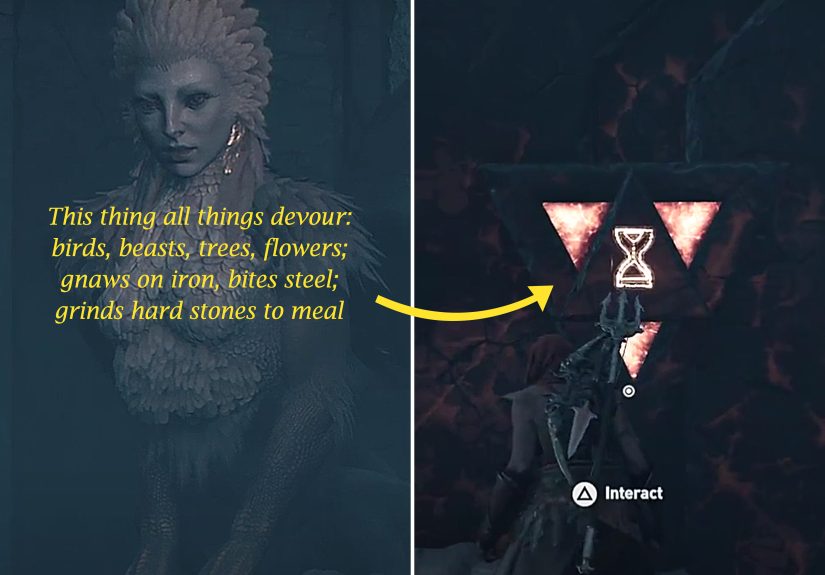
In the game, the Sphinx presents a set of riddles chosen from a larger pool. You do not get every possible question in one run, which adds suspense and replay value. After answering, you must also activate the matching symbols around the ruins, so the challenge is not just about knowing the solution. It is about remembering what you answered and linking thought to action. That small extra step is classic sphinx energy: “You knew the answer? Cute. Prove it.”
Several of the game’s riddles echo the old style of mythic wordplay. One paraphrased example asks what has a head, mouth, and bed, yet never speaks or sleeps. The answer is a river. Another asks what devours birds, trees, iron, kings, and mountains alike. The answer is time, which is delightfully dramatic and annoyingly correct. Another puzzle points to something that is always old, sometimes full, sometimes blue, and always pulling rather than pushing. The answer is the moon. There is also a clever seasonal riddle whose answer is a tree, and a cold, breathless one whose answer is a fish.
What makes these good game riddles is that they are readable under pressure. They sound poetic enough to feel mythical, but not so vague that players feel cheated. They preserve the theatrical flair of the ancient sphinx while still functioning as gameplay. Better yet, they reinforce the game’s broader fascination with Greek legend. The Sphinx is not just an Easter egg dropped into the world. It is a reminder that mythology in Odyssey is something you must engage with mentally as well as physically.
Dragon’s Dogma 2 and the Evolution of the Sphinx Puzzle
If Assassin’s Creed Odyssey revives the classic verbal sphinx, Dragon’s Dogma 2 evolves the idea into a full questline built around many kinds of puzzle thinking. Its Sphinx is less interested in a single famous riddle and more interested in testing how well you understand the game itself. That makes the whole encounter feel less like answering a poem and more like being audited by a mystical professor with a lion body.
The game’s Sphinx presents a multi-part challenge involving ten riddles across two stages. Some are verbal, but many are really tests of attention, memory, trust, and player behavior. One puzzle points you toward a cave treasure but expects you to notice the correct item early rather than assume the deepest route is best. Another asks for your “beloved,” which can be solved in a surprisingly practical way. Another requests a “parent,” pushing players toward a very specific pawn-related solution. Another rewards you for surrendering a prized item by duplicating it. And one especially evil challenge asks you to remember where you found your first Seeker’s Token, which is the sort of request that makes seasoned players suddenly stare into the middle distance.
This is where sphinx riddles in video games become truly interesting. The puzzle is no longer just language. The puzzle is your relationship with the world. Have you paid attention? Do you understand the systems? Can you interpret weird instructions without panicking? Can you recognize that the answer might involve moving an NPC, using fast travel cleverly, counting prior successes, or revisiting your own history in the game?
That design is both brilliant and slightly evil. The brilliance lies in how the Sphinx becomes a living summary of the game’s identity. Dragon’s Dogma 2 is a game about curiosity, experimentation, and occasional confusion delivered with confidence. Its riddles reflect that. They ask players to think like adventurers rather than quiz contestants. The downside is that some solutions are so specific that they can feel obscure without outside help. Even so, the encounter is memorable precisely because it dares to be strange.
Myth vs. Video Games: How the Sphinx Changed Without Losing Its Soul
The ancient Greek sphinx asked one unforgettable question about human life. Modern video games took that formula and stretched it in exciting directions. The core remains the same: the sphinx stands at a threshold and demands understanding. What changes is the definition of understanding.
In myth, understanding means symbolic insight. In Assassin’s Creed Odyssey, it means verbal reasoning with a theatrical Greek flavor. In Dragon’s Dogma 2, it means literacy in the game’s systems, map, habits, and hidden logic. Across all versions, though, the sphinx still functions as a judge of the traveler. It asks, in one form or another, “Do you truly know what kind of journey you are on?”
That is why sphinx riddles feel timeless. They adapt. They move from oral tradition to tragedy, from literature to pop culture, from museum discussions to game walkthroughs, and they still work. The monster remains recognizable because the underlying drama remains recognizable. Every generation wants stories where cleverness opens the gate.
Why We Keep Coming Back to Sphinx Riddles
Part of the appeal is obvious: riddles are fun. They make us feel smart, or at least mildly less confused after a dramatic pause. But sphinx riddles offer something extra. They package a challenge inside atmosphere. You are not merely solving a puzzle; you are facing judgment from a legendary creature that represents mystery itself.
They also flatter the audience in a good way. A sphinx story tells us that knowledge matters. Pattern recognition matters. Paying attention matters. In a world full of noise, there is something deeply satisfying about a challenge that can be overcome by thinking carefully and seeing clearly. Also, it is nice to win an argument with a monster once in a while.
Experiences That Make Sphinx Riddles Stick With You
There is a particular feeling that comes with sphinx riddles, and it is not quite the same as solving a crossword or finishing a math problem. A sphinx riddle feels theatrical. It arrives with atmosphere. You are not just looking for an answer; you are standing at the edge of something important, and the puzzle becomes a test of whether you deserve to continue. That emotional framing changes everything.
Think about the experience of hearing the Oedipus riddle for the first time. Even if you already know the answer, the structure still works on you. “Morning,” “noon,” and “evening” sound so ordinary, but then your brain starts turning the idea over. The answer clicks, and for a second the world feels neater than it did a moment earlier. That little rush is part of why people remember old riddles for years. They do not just inform you. They reorganize your perspective.
Video games recreate that sensation in a more interactive way. In Assassin’s Creed Odyssey, the best moment is not only choosing the correct answer. It is the tiny pulse of panic that follows, when you have to find and activate the matching symbols. Suddenly the riddle is no longer floating in your head; it has entered the environment. You are translating thought into movement. That is an elegant kind of game design, and it makes the victory feel physical.
Dragon’s Dogma 2 creates a different experience, one closer to a long, strange conversation with a creature that seems smarter than you and knows it. Its Sphinx can make players laugh, groan, experiment, and second-guess every choice. One minute you feel brilliant for noticing a trick. The next minute you are trying to remember some tiny detail from hours earlier and wondering whether the game has declared personal war on your short-term memory. Oddly enough, that emotional roller coaster is part of the charm. The Sphinx feels alive because her puzzles affect your behavior long after the dialogue ends.
That is the real magic of sphinx riddles across myths and games: they linger. A sword fight is thrilling in the moment, but a great riddle follows you around. You keep replaying the wording. You keep admiring the structure. You keep wanting to tell someone else about it so you can watch their face when the answer lands. The experience becomes social, memorable, and strangely intimate. It turns knowledge into a story you can share.
In the end, sphinx riddles endure because they give us a rare blend of tension and delight. They challenge us without reducing everything to force. They let stories pause and ask a deeper question. And when they are done well, they leave us with that delicious feeling every puzzle lover chases: the moment when confusion suddenly turns into clarity, and the gate swings open because we finally understood what was being asked.
Conclusion
From the tragedy of Oedipus to the clever set pieces of modern fantasy games, sphinx riddles remain some of the most effective puzzles in storytelling. They work because they do more than block progress. They reveal character. The classic Greek riddle about the stages of human life still resonates because it is elegant, symbolic, and hauntingly simple. Modern games keep the spirit alive by turning the sphinx into a judge of language, memory, observation, and player behavior.
So whether you meet the sphinx in myth, in a sprawling open world, or in a puzzle sequence that makes you question your life choices, the lesson stays the same: sometimes the smartest way forward is not to attack the problem, but to understand it. The sphinx would probably approve. Or at least nod in a smug, lion-shaped way.







 Close
Close