
Table of Contents >> Show >> Hide
- What Exactly Did Astronomers Discover?
- Meet Sagittarius A*: The Milky Way’s Central Black Hole
- How Chandra Spotted the Hidden X-Ray Vent
- Shock Waves: Why the Vent Glows
- The Bigger Picture: Fermi Bubbles and eROSITA Bubbles
- What This Discovery Tells Us About Galaxy Evolution
- What Scientists Still Do Not Know
- Why This Discovery Captures the Imagination
- Experience: Following the Discovery of a Hidden X-Ray Chimney
- Conclusion
The Milky Way has a plumbing problemexcept this one is 26,000 light-years away, glows in X-rays, and may be powered by the supermassive black hole at the center of our galaxy. Astronomers using NASA’s Chandra X-ray Observatory have found evidence of a hidden “exhaust vent” connected to a chimney of hot gas rising from the region around Sagittarius A*, the supermassive black hole that anchors the Milky Way.
That sentence sounds like it escaped from a sci-fi movie with an excellent special effects budget, but the discovery is real. The newly identified X-ray structure helps explain how hot gas, energy, and possibly rejected material from the black hole can move away from the Galactic Center. In simple terms, scientists have spotted what may be part of the Milky Way’s cosmic ventilation system.
What Exactly Did Astronomers Discover?
Researchers found bright X-ray ridges near the top of a previously known chimney-like structure. These ridges appear to form the walls of a tunnel or cylindrical channel that helps funnel hot gas away from the center of the galaxy. The vent sits roughly 700 light-years from Sagittarius A*, which is close in galactic terms but still a spectacularly inconvenient commute.
The feature is connected to a chimney of hot gas that rises roughly perpendicular to the Milky Way’s spiral disk. Earlier observations from Chandra and ESA’s XMM-Newton had already revealed the broader chimney. The newer Chandra data sharpened the picture, showing the likely exhaust vent where gas escapes after traveling upward through this magnetic tunnel.
The Discovery in Plain English
Imagine a fireplace. Sagittarius A* is the firebox, the chimney is the pathway that channels smoke upward, and the newly discovered X-ray vent is the opening where the hot material finally blasts out. Of course, this “smoke” is not smoke at all. It is extremely hot plasma, energetic particles, and gas shaped by gravity, magnetic fields, and shock waves.
The comparison is imperfect, but it helps. Black holes are famous for pulling material inward, yet their environments can also launch material outward. Sagittarius A* may be a relatively quiet eater today, but it is not silent. It flares, burps, throws tantrums, and occasionally behaves like a toddler with a bowl of spaghettisome goes in, some goes everywhere else.
Meet Sagittarius A*: The Milky Way’s Central Black Hole
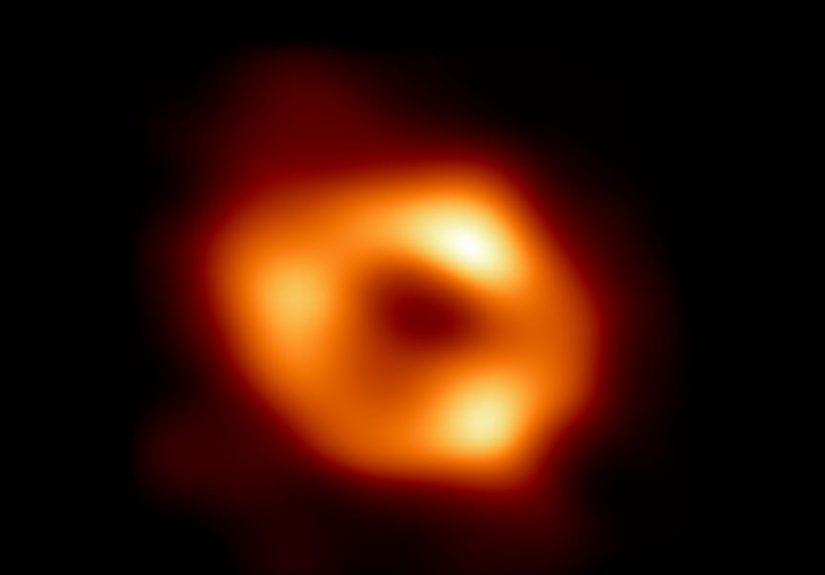
Sagittarius A*, often shortened to Sgr A*, is the supermassive black hole at the heart of the Milky Way. It has a mass of about four million suns and lies around 26,000 light-years from Earth. Despite its intimidating size, Sgr A* is modest compared with some monster black holes in active galaxies. It is more of a cosmic slow cooker than a roaring furnacemost of the time.
Still, “quiet” does not mean inactive. Gas, dust, magnetic fields, stars, and stellar remnants crowd the Galactic Center. When material falls toward Sgr A*, it can heat up, glow in X-rays, and sometimes be redirected before crossing the event horizon. That rejected or redirected material may help feed the chimney-and-vent system detected by Chandra.
Why Black Holes Are Messy Eaters
A black hole does not simply vacuum up everything nearby like a cosmic cleaning appliance. Material spiraling toward it forms turbulent flows. Magnetic fields twist and stretch. Gas heats to extreme temperatures. Some matter may plunge inward, while some is flung outward in winds, jets, or broader outflows.
That is why this hidden X-ray chimney matters. It gives scientists a nearby example of black hole feedbackthe process by which black holes affect their surroundings. Feedback can heat gas, shape star formation, inflate giant bubbles, and influence how galaxies evolve. In other words, even when a black hole is not eating much, it may still be rearranging the furniture.
How Chandra Spotted the Hidden X-Ray Vent
The Chandra X-ray Observatory is designed to detect X-rays from extremely hot regions of the universe, including exploded stars, clusters of galaxies, and matter near black holes. X-rays from space do not reach the ground easily because Earth’s atmosphere absorbs them, which is fantastic for living things and inconvenient for astronomers. Chandra solves that problem by observing from orbit.
In the Galactic Center observations, Chandra detected several bright X-ray ridges. These ridges appear roughly perpendicular to the plane of the Milky Way and may outline the walls of a tunnel. Scientists interpret the structure as a vent connected to the larger chimney of hot gas rising from the region around Sagittarius A*.
Why X-Rays Are So Useful
X-rays are a powerful tool because they reveal high-energy environments that ordinary visible light cannot show. Hot plasma near black holes can reach temperatures of millions of degrees. At those temperatures, gas emits X-rays, allowing telescopes like Chandra to trace structures that would otherwise stay hidden.
Radio observations from the MeerKAT telescope add another layer to the story. The radio data show how magnetic fields appear to enclose and shape the gas in the chimney. When X-ray and radio observations are combined, scientists get a more complete view of the Galactic Center’s invisible architecture.
Shock Waves: Why the Vent Glows
The X-ray vent likely formed when hot gas traveling upward through the chimney collided with cooler gas in its path. That collision can create shock waves, similar in principle to sonic booms produced by supersonic aircraft. In space, these shock waves compress and heat gas, causing the vent walls to shine more brightly in X-rays.
One side of the vent appears brighter than the other, and researchers think that may be because the upward-moving gas strikes that side more directly and with greater force. This asymmetry is useful. It gives astronomers clues about the direction, speed, and geometry of the outflow.
The result is not just a pretty cosmic picture. It is a diagnostic tool. By studying the brightness, temperature, and shape of the X-ray ridges, scientists can infer what happened in a region that no spacecraft could visit, no astronaut should approach, and no insurance company would cover.
The Bigger Picture: Fermi Bubbles and eROSITA Bubbles
The hidden X-ray chimney may also connect to much larger structures surrounding the Milky Way’s center. The Fermi Bubbles are enormous gamma-ray features extending above and below the Galactic Center. The eROSITA Bubbles, detected in X-rays, are even larger and may trace ancient energy injections from the inner galaxy.
These bubbles are among the biggest clues that the Milky Way’s center was more active in the past. They suggest that energy from the Galactic Centerpossibly from Sagittarius A*, intense star formation, or bothhas been pushed into the galaxy’s halo over vast distances.
A Small Vent With Giant Implications
The newly discovered vent is tiny compared with the Fermi and eROSITA bubbles, but it may help explain how energy starts its journey from the Galactic Center into the wider galaxy. If the chimney keeps hot gas focused, it could act like a nozzle, helping shape larger bubble-like structures over time.
This is why astronomers care about what looks like a narrow feature near the center of the Milky Way. Small structures can reveal the machinery behind huge galactic events. A vent only hundreds of light-years from Sagittarius A* may help explain bubbles tens of thousands of light-years across.
What This Discovery Tells Us About Galaxy Evolution
Galaxies are not static star collections. They breathe, churn, heat, cool, collide, and recycle material. Supermassive black holes play a major role in that cycle. When they release energy into surrounding gas, they can prevent some gas from cooling enough to form stars. In other cases, outflows may compress gas and trigger new star formation.
The Milky Way gives astronomers a rare close-up laboratory for studying these processes. Faraway galaxies may host brighter and more dramatic active galactic nuclei, but they are also harder to examine in detail. Sagittarius A* is close enough that scientists can map its environment with remarkable precision.
By studying the hidden X-ray chimney and exhaust vent, astronomers can better understand how a relatively quiet supermassive black hole still influences its host galaxy. The discovery shows that black hole feedback does not always require a blazing quasar. Sometimes it looks like a faint, structured, shock-lit tunnel in X-ray light.
What Scientists Still Do Not Know
The discovery answers one question and immediately opens several more, because astronomy enjoys keeping its mystery subscription active. Researchers still do not know exactly how often material falls toward Sagittarius A* or how frequently the black hole drives outbursts strong enough to feed the chimney.
Previous studies suggest that dramatic X-ray flares may occur near the Galactic Center every few hundred years. Astronomers also estimate that the Milky Way’s central black hole may tear apart and swallow a star every 20,000 years or so. Both types of events could inject energy into the chimney system.
Big Meal or Many Snacks?
One important question is whether the chimney is powered by rare, dramatic feeding events or by many smaller episodes. Did Sagittarius A* receive one large dump of material, like logs tossed onto a fire? Or is the system kept warm by many smaller loads, like kindling added over time?
The answer matters because it changes how scientists model the Galactic Center. A single explosive event would tell one story about the black hole’s past. A sequence of smaller outbursts would suggest a more continuous feedback cycle. Either way, Sagittarius A* appears to be less dormant than its quiet reputation suggests.
Why This Discovery Captures the Imagination
Part of the appeal is the language. A hidden X-ray chimney attached to a supermassive black hole sounds dramatic because it is dramatic. Yet the discovery is not just a catchy headline. It is a reminder that the Milky Way is an active, structured, energetic system.
We live far from the Galactic Center, in a relatively calm neighborhood of the galaxy. From Earth, the Milky Way often appears as a soft band of light across a dark sky. But deep inside that glowing band is a dense, turbulent core where gas moves at extreme speeds, magnetic fields sculpt invisible pathways, and a four-million-solar-mass black hole occasionally vents its frustration into space.
Experience: Following the Discovery of a Hidden X-Ray Chimney
Learning about the supermassive black hole’s hidden X-ray chimney is a strange experience because it makes the universe feel both enormous and oddly familiar. The science involves plasma physics, high-energy radiation, magnetic fields, and galactic-scale structures. But the image in the mind is surprisingly domestic: a chimney, a vent, hot gas, pressure, and release. Suddenly, the center of the Milky Way feels less like an abstract point on a star chart and more like a house with complicated heating problems.
For many readers, the most exciting part is realizing that black holes are not simple cosmic drains. Popular culture often treats them as one-way traps where everything disappears forever. This discovery tells a more interesting story. Around Sagittarius A*, material can fall inward, heat up, collide, glow, and then escape through structured pathways shaped by magnetic fields. It is not neat. It is not quiet. It is more like a cosmic kitchen during a holiday dinner: energy everywhere, invisible forces doing the heavy lifting, and something definitely boiling over.
The discovery also changes how people experience images from space telescopes. At first glance, an X-ray and radio composite of the Galactic Center may look like a beautiful storm of blue, red, orange, and white. Without context, it is easy to admire it as space art. With context, the image becomes a map of motion. The bright ridges are no longer just pretty streaks. They may be tunnel walls. The glow is not decoration. It is evidence of shock waves. The shape is not random. It is a clue.
This is the joy of modern astronomy: the best discoveries often turn invisible processes into readable stories. No one can stand beside Sagittarius A* and watch hot plasma rush through a magnetic chimney. No probe can safely fly into that region and send back a cheerful postcard. Instead, scientists collect X-rays, radio waves, and years of data, then slowly reconstruct the hidden machinery. The result feels almost detective-like. The suspect is a supermassive black hole. The fingerprints are X-ray ridges. The crime scene is the center of the galaxy.
There is also a humbling personal experience in this topic. The vent sits about 700 light-years from the Galactic Center, and the entire system is roughly 26,000 light-years from Earth. These numbers are so large that they flatten ordinary intuition. Yet humans built instruments precise enough to notice the structure, compare wavelengths, study plasma behavior, and ask whether the Milky Way’s black hole feeds in bursts or in smaller repeated snacks. That is delightful. A species that misplaces car keys has also mapped a black hole’s possible exhaust vent.
Finally, the discovery makes the night sky feel more alive. The Milky Way is not merely a background for camping trips and poetic captions. It is a dynamic galaxy with a central engine, old outbursts, giant bubbles, magnetic tunnels, and hot gas moving through hidden channels. The next time someone looks up at the faint band of the Milky Way, they can imagine far beyond the visible stars. Somewhere in that direction, Sagittarius A* is quietly shaping its surroundings, one flare, one shock wave, and one mysterious X-ray chimney at a time.
Conclusion
The discovery of a hidden X-ray chimney connected to Sagittarius A* gives astronomers a new way to understand how the Milky Way’s central black hole interacts with its environment. Chandra’s observations reveal bright X-ray ridges that likely mark the walls of an exhaust vent, while radio data help show the role of magnetic fields in shaping the hot gas.
This finding matters because it links small-scale structures near the Galactic Center to larger questions about black hole feedback, galactic outflows, and the enormous bubbles surrounding the Milky Way. Sagittarius A* may be quieter than many supermassive black holes, but it is not inactive. It eats, rejects, heats, vents, and leaves evidence behind.
In the end, the hidden X-ray chimney is more than a spectacular space headline. It is a glimpse into the Milky Way’s engine roomand proof that even our home galaxy still has secrets tucked behind the cosmic drywall.







 Close
Close