
Table of Contents >> Show >> Hide
- Why We Treat Wood in the First Place
- From Creosote to Copper: A Quick History Lesson
- Decoding the Alphabet Soup of Modern Wood Preservatives
- What Those Cryptic Stamps on the Board Actually Mean
- Safety: What’s Myth and What’s Real
- Choosing the Right Wood Treatment for Your Project
- “Natural” and DIY Wood Treatment Options
- Handling, Fasteners, and Long-Term Care
- Lessons From the Shop: Real-World Wood Treatment Experiences
- Bringing It All Together
Walk into any home center and the lumber aisle feels less like a building supply
section and more like a chemistry exam. ACQ, CA, MCQ, UC4A, “ground contact,”
“above ground,” brown treated, green treated and that’s before you get to
creosote-soaked poles that smell like a railroad museum. No wonder a lot of
DIYers grab whatever looks sturdy and hope for the best.
The truth is, wood preservation treatments aren’t mysterious magic potions.
They’re carefully regulated pesticides designed to keep fungi, insects,
and moisture from turning your project into compost before its time.
Once you understand why treatments exist, what the main types are, and how to
read the stamps on a board, the “confusing world” suddenly becomes pretty
manageable.
Why We Treat Wood in the First Place
Wood is amazing: renewable, strong for its weight, easy to work with, and
downright beautiful. Unfortunately, nature would prefer that your fence posts
return to the earth as quickly as possible. Fungi, termites, carpenter ants,
beetles, and plain old moisture attack wood relentlessly, especially anywhere
it stays damp or touches soil.
Only a handful of tree species have high natural durability, and they’re
usually expensive or not available in the dimensions you want. That’s where
wood preservation treatments come in. By loading the outer shell of the wood
with protective chemicals, you can turn fairly ordinary softwood into
long-lasting deck framing, utility poles, pilings, and retaining walls.
In the U.S., wood preservatives are treated as pesticides, which means they’re
regulated by the Environmental Protection Agency (EPA). Products must be
registered, tested, and approved for specific uses for example, residential
decking versus industrial pilings.
From Creosote to Copper: A Quick History Lesson
Early wood preservation had a very “mad scientist” vibe. Creosote (a tar-like
distillate from coal) and pentachlorophenol were widely used for railroad
ties, utility poles, and heavy-duty structures because they were extremely
effective at blocking decay and pests. The downside: both are pretty nasty to
people and the environment, so their use is now limited mostly to
industrial applications with strict controls.
For decades, the star of the show in residential construction was CCA
(chromated copper arsenate). It’s a waterborne preservative that uses copper
(to kill fungi), chromium (to lock everything into the wood), and arsenic
(to smack down insects). It works extremely well but arsenic and chromium
are not substances you want to snack on.
Concerns about children’s exposure on decks and playgrounds led regulators and
industry to phase out CCA for most residential uses in the early 2000s. CCA
is still allowed for certain industrial and some structural applications, but
not for things like new backyard decks or picnic tables.
Modern “big-box” treated lumber is typically preserved with copper-based
systems that are less acutely toxic to humans, along with a few other
ingredients to keep bugs and rot at bay. That’s where all those alphabet
soups ACQ, CA, MCQ come in.
Decoding the Alphabet Soup of Modern Wood Preservatives
ACQ: The Post-CCA Workhorse
ACQ (alkaline copper quaternary) is one of the most common modern
preservatives. It’s water-based and uses copper oxide to fight fungi and a
quaternary ammonium compound (a “quat”) to add extra insect-killing power.
ACQ-treated lumber is approved for both residential and industrial uses you
’ll see it in decks, fences, landscaping timbers, and even marine pilings, as
long as it meets the right “use category” rating. It’s effective, widely
available, and familiar to building inspectors, which is why it shows up in so
many project plans.
CA and Micronized Copper Systems
CA (copper azole) and its micronized cousins (MCQ, MCA) are alternatives that
also rely on copper, usually in combination with an organic co-biocide.
Micronized systems grind copper into teeny particles that stay suspended in
water instead of fully dissolving, which can reduce corrosion of metal
fasteners and sometimes improve appearance.
Functionally, these products aim to do the same job as ACQ: keep rot and bugs
out of the wood long enough for your deck or fence to live a full, happy
life. They differ mainly in chemistry, performance tweaks, and how they’re
marketed.
Borate Treatments: Great Indoors, Not So Great in the Rain
Borate-treated lumber uses boron-based compounds to control insects and
fungi. Borates are relatively low in human toxicity (you’ll find boron in some
household cleaners), which makes them attractive in places like wall studs,
sill plates, crawlspaces, and framing that may face termite pressure but won’t
be constantly soaked.
The catch is that borates can leach out when exposed to flowing water. That’s
why borate-only treatments are not used for ground-contact or fully exposed
exterior applications unless additional barriers are in place.
Oil-Borne Systems: Heavy-Duty, Heavy-Smelling
Oil-borne preservatives like creosote, pentachlorophenol, and copper
naphthenate shine in the most demanding conditions: utility poles, pilings,
bridges, and guardrails that face constant moisture and physical abuse.
These treatments soak the wood in an oily preservative under heat and
pressure, deeply impregnating the fibers. The result is extremely durable
wood but also sticky, strongly scented, and not remotely suitable for your
backyard picnic table. Most of these products are restricted to professional
or industrial use with safety protocols.
What Those Cryptic Stamps on the Board Actually Mean
If you look along the edge of a treated board, you’ll usually find an ink
stamp or tag. That label is your Rosetta stone for figuring out what you’re
actually buying.
-
Preservative type: ACQ, CA, MCQ, MCA, borate, or something
similar. This is the chemistry. -
Retention level: How much preservative (pounds per cubic
foot) the wood contains. Higher retention usually means more severe service
conditions. -
Use category (UC): A system defined by the American Wood Protection Association (AWPA) that maps conditions like “interior, dry”
vs. “ground contact, fresh water” to minimum treatment levels.
Common use categories you’ll see in residential projects:
- UC1/UC2: Interior, dry or occasionally damp locations.
-
UC3B: Exterior, above ground, exposed to weather (e.g.,
deck railings). -
UC4A: Ground contact, general use (e.g., fence posts, deck
posts set in concrete). -
UC4B/UC4C: Ground or fresh water contact in high-decay areas
or critical structural applications.
When in doubt, choose the category that matches the harshest conditions your
project will see. Using “above ground” rated lumber for buried posts is
basically volunteering to rebuild everything in a few years.
Safety: What’s Myth and What’s Real
A lot of the fear around wood preservation treatments comes from the era of
arsenic-loaded CCA and scary headlines about kids playing on pressure-treated
playgrounds. Those concerns weren’t imaginary arsenic is highly toxic, and
dermal and ingestion exposure had to be taken seriously.
Modern copper-based systems are generally considered lower risk for typical
consumer exposure, but “lower risk” does not mean “lick the deck rail and call
it a snack.” You still don’t want to inhale dust, get splinters full of
preservative, or use treated wood in direct contact with drinking water or
food-growing soil without a proper liner.
Safety basics that apply to all treated wood:
-
Don’t burn it: Burning treated wood especially legacy
CCA-treated lumber can release arsenic and other metals into smoke and
ash. That’s a hard “no” for fire pits and stoves. -
Control the dust: Wear a dust mask or respirator, eye
protection, and gloves when cutting or sanding. Wash exposed skin afterward. -
Dispose properly: Follow local rules for treated wood
disposal; in many areas it must go to a landfill, not a mulch pile or
compost heap. -
Use it only where intended: Check labels for restrictions
like “do not use for cutting boards, countertops, or beehives.”
Choosing the Right Wood Treatment for Your Project
Decks and Outdoor Living Spaces
For typical residential decks, you’ll usually want lumber rated for at least
UC3B for joists and beams above ground, and UC4A for posts that touch soil or
concrete. ACQ or CA are common choices here.
If you live in a very wet or termite-heavy area, it’s often worth stepping up
to a higher use category for critical structural members. You might not see
the extra preservative, but you’ll definitely notice the difference when your
deck is still solid a decade later.
Fences and Landscaping
Fence posts, retaining walls, and landscape timbers should almost always be
ground-contact rated (UC4A or higher). These components are buried, stay
damp, and are termite magnets. Using above-ground rated wood here is asking
for rapid rot.
For raised garden beds, things get trickier. Modern treated lumber is far less
concerning than CCA-era products, but many gardeners still prefer to line the
inside with heavy plastic or use naturally durable species to minimize
potential leaching into soil. Check local guidance and weigh your own comfort
level.
Indoor and Structural Framing
Indoors, moisture control is your primary defense. Where bugs or intermittent
dampness are a concern say, sill plates against concrete borate-treated
or conventional pressure-treated lumber can be appropriate, as long as it’s
protected from ongoing wetting.
In historic structures or high-end builds, designers sometimes opt for a mix
of improved detailing (big roof overhangs, good drainage) and targeted
treatments rather than soaking everything in preservatives. Design can do a
lot of the heavy lifting.
“Natural” and DIY Wood Treatment Options
Not every project needs industrial-grade preservatives. For outdoor furniture,
garden benches, or decorative pieces, traditional finishing systems still have
a place especially when you want to avoid heavy-duty pesticides.
One classic formula that pops up in woodworking circles (and in the comments
of the Hackaday article that inspired this title) is a mix of boiled linseed
oil, pine tar, and turpentine. Applied warm and repeatedly until the wood is
saturated, it leaves a rich, water-resistant surface with a very “old-world”
vibe.
You’ll also see:
-
Oil finishes: Linseed, tung, and specialty exterior oils
that penetrate and repel water. -
Film finishes: Exterior paints and spar varnishes that form
a protective shell (as long as you keep up with maintenance). -
Thermally modified wood: Wood baked at high temperature to
change its chemistry and improve durability, often with little or no added
chemicals.
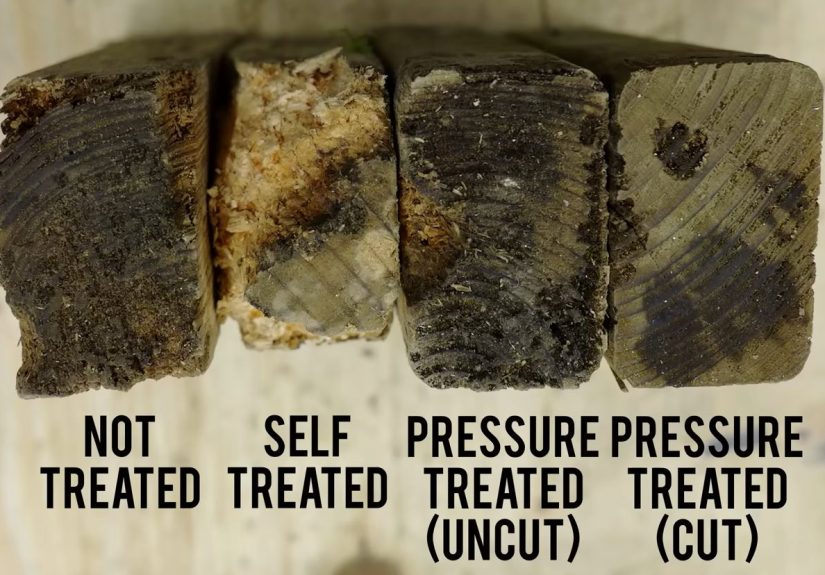
These options typically don’t match the decay resistance of fully
pressure-treated lumber in ground contact, but they can be more than adequate
for furniture, cladding, and decorative projects where you’re willing to do
periodic re-coating.
Handling, Fasteners, and Long-Term Care
Even the best preservative can’t rescue bad detailing. To get the full life
out of treated wood, you still need smart construction and a little
maintenance.
-
Use compatible fasteners: Copper-based preservatives can be
corrosive to bare steel. Use hot-dip galvanized or stainless-steel nails,
screws, and hangers specifically rated for treated wood. -
Seal cut ends: When you cut treated lumber, you expose
untreated inner wood. Brush on a suitable end-cut preservative to keep that
weak spot from becoming a rot magnet. -
Keep water moving: Design joints so water can drain, not
pool. A small gap between deck boards, a slope away from the house, and
flashing at critical connections pay huge dividends. -
Inspect occasionally: Poke suspect areas (especially at
ground contact) with a screwdriver. Soft spots mean it’s time to replace or
reinforce before a failure.
Think of preservative treatment as armor, not immortality. If you combine the
right wood treatment with good design and occasional upkeep, you can easily
double or triple the life of your outdoor projects.
Lessons From the Shop: Real-World Wood Treatment Experiences
All of this chemistry and regulation talk is interesting, but the confusion
really hits when you’re standing in a muddy backyard with a stack of lumber
and a weekend to get things built. Here are a few hard-earned lessons that
tend to convert “wood treatment skeptics” into believers.
The deck that sagged before the paint dried. One DIYer
proudly framed a small deck using untreated spruce because it was cheaper and
“going to be painted anyway.” The joists sat only a few inches above damp
soil, with poor drainage. Within two seasons, the deck boards were spongy,
joists had fungal decay, and the whole thing bounced like a trampoline. The
fix? Tear it out and rebuild using UC3B and UC4A treated lumber, proper
footings, and better airflow under the structure.
The fence that looked fine…until it didn’t. Another common
story involves fence posts that snap off at ground level. Above the soil,
everything looks good. Below, the post has rotted through. In many cases the
installer used “above ground” rated treated lumber for posts because the
boards were conveniently located or the tags were tossed before anyone
checked. By the time the first big storm hits, the posts are quietly failing
right where moisture and oxygen meet.
On the flip side, when people do use proper ground-contact rated posts, they
’re usually shocked by how long they last. It’s not unusual to pull out
decades-old treated posts and find the wood still structurally sound, even if
the top few inches look rough.
The garden bed compromise. Many homeowners wrestle with the
idea of treated lumber around vegetables. One practical compromise is to use
modern treated boards for the structure (because they’re strong and affordable)
and line the interior with heavy plastic or a pond liner. That keeps soil from
contacting the wood while still giving you robust framing. Others choose
naturally durable species like cedar or black locust and accept that the bed
may need rebuilding sooner. Neither choice is “wrong” it’s about matching
risk tolerance, budget, and maintenance appetite.
The old barn with modern upgrades. In historic buildings,
preservation-minded carpenters often mix strategies. They might repair a
rotten sill with a naturally durable species, treat the new member with a
borate solution, improve drainage outside the foundation, and add a discreet
flashing detail to keep splashback down. No single step is dramatic, but
together they dramatically slow future decay. That kind of holistic thinking
is just as valuable on a suburban deck as it is on a century-old barn.
Experimenting with “natural” finishes. Hobbyists who love the
look of oiled wood sometimes experiment with traditional recipes: linseed oil,
pine tar, citrus solvent, or turpentine blends. Used on benches, shed doors,
or tool handles, these finishes can be surprisingly durable if you accept that
they’re maintenance items. The key is to understand their limits: they’re
great for shedding water and slowing surface checking, but they won’t protect a
buried post the way a full pressure treatment will.
The bigger pattern across all these stories is simple: the projects that last
are the ones where someone matched the treatment to the job, understood the
local environment, and respected both the power and the limits of preservatives.
Once you get comfortable reading tags, checking use categories, and thinking
about water flow, wood preservation stops being confusing and starts feeling
like just another tool you know how to use.
Bringing It All Together
Wood preservation treatments can look intimidating, but under the hood it’s
just chemistry plus common sense. A century ago, we drenched wood in whatever
toxic brew got the job done. Today, we have more refined, better-understood
systems, clear standards, and practical safety guidance for everyday builders.
If you remember three things, remember these: pick the right use category, use
compatible fasteners and smart detailing, and don’t burn or misuse treated
wood. Do that, and your deck, fence, or pergola will likely outlast your
enthusiasm for staining it every few years which is a pretty good problem to
have.





 Close
Close