
Table of Contents >> Show >> Hide
- Why Art About Jesus Never Stays “Just Art”
- Top 10 Intriguing Cases Involving Art About Jesus
- 1. Salvator Mundi and the $450 Million Mystery
- 2. Caravaggio’s Ecce Homo and the Great Rediscovery Plot Twist
- 3. The “Monkey Christ” Restoration That Became a Tourism Miracle
- 4. Piss Christ and the American Culture-War Explosion
- 5. Leonardo’s Last Supper and the Restoration That Split the Room
- 6. Michelangelo’s Last Judgment and the Vatican Dress Code
- 7. Byzantine Iconoclasm and the Fight Over Whether Jesus Could Be Painted at All
- 8. Rembrandt’s Human Jesus and the Shock of Realism
- 9. Warner Sallman’s Head of Christ and the Making of the “Default Jesus”
- 10. The Black Gospel Window and the Debate Over Who Gets to See Themselves in Sacred Art
- What These Cases Reveal About Jesus in Art
- Experiences That Make Art About Jesus So Unforgettable
- Conclusion
Art about Jesus has a special talent for refusing to sit quietly in a frame. One minute it is a devotional image, the next it is the center of a courtroom-style argument about authenticity, censorship, race, restoration, money, or theology. That is part of what makes Jesus iconography so fascinating. These works are never just paint, plaster, glass, or ink. They carry belief, memory, politics, beauty, outrage, and, every now and then, a side helping of absolute chaos.
From masterpieces worth hundreds of millions to a tiny church fresco that accidentally became an international meme, the visual history of Jesus is packed with stories that are stranger than fiction and better documented than most family arguments at Thanksgiving. Below are ten of the most intriguing cases involving art about Jesus, each revealing how deeply religious art can affect culture far beyond church walls.
Why Art About Jesus Never Stays “Just Art”
Jesus art occupies a rare category in visual culture. It matters to believers, fascinates historians, attracts collectors, and irritates almost everybody who thinks sacred subjects should stay within a certain lane. That makes every major image of Christ a kind of cultural stress test. When a painting is restored, sold, attacked, rediscovered, or reinterpreted, people are not only debating aesthetics. They are debating what holiness should look like, who gets to represent it, and whether tradition is something to protect, question, or completely flip on its head.
Top 10 Intriguing Cases Involving Art About Jesus
1. Salvator Mundi and the $450 Million Mystery
If art history ever needed a blockbuster, Leonardo da Vinci’s Salvator Mundi delivered one with a crystal orb in hand. The painting, which shows Christ blessing the viewer, sold for an astonishing sum and immediately became less of an artwork and more of an international argument wearing Renaissance hair. The big question was simple: how much of it is really Leonardo?
That debate refuses to die. Supporters point to passages of extraordinary quality, especially the blessing hand and parts of the face and hair. Skeptics point to heavy restoration, awkward areas, gaps in provenance, and the strange fact that a painting sold as a near-miracle of rediscovery still leaves scholars muttering into their scarves. In other words, Salvator Mundi is not just famous because it is expensive. It is famous because it forces the art world to ask whether value comes from authorship, beauty, story, or pure market madness. The answer, predictably, is “yes.”
2. Caravaggio’s Ecce Homo and the Great Rediscovery Plot Twist
Every so often, art history pulls off a reveal worthy of a detective novel. That happened with Ecce Homo, a painting of Jesus presented to the crowd before the Crucifixion. What had once seemed like a minor work headed for auction eventually emerged as a newly authenticated Caravaggio. Suddenly, a painting that had drifted through history in relative obscurity became one of the art world’s hottest topics.
The intrigue here is not only that the painting resurfaced. It is that Caravaggio, a master of drama, somehow managed to produce more drama centuries after his death. The work was known in earlier centuries, then effectively vanished from serious notice, and then came roaring back into public view. The rediscovery reminded everyone that old master art is still capable of surprise. It also proved that a painting of Jesus can still trigger a modern frenzy when questions of attribution, value, and historical importance collide. Apparently, chiaroscuro is still a good way to light a fire under the news cycle.
3. The “Monkey Christ” Restoration That Became a Tourism Miracle
Some stories in religious art history are solemn. This one showed up wearing unintended comedy. In Borja, Spain, a modest fresco of Christ known as Ecce Homo was “restored” by local parishioner Cecilia Giménez after the image had deteriorated. The result looked less like a traditional Jesus and more like a bewildered furry creature having a very long week.
At first, the internet did what the internet does best: laughed loudly and internationally. But then something unexpected happened. The altered fresco became a tourist attraction. Visitors arrived in huge numbers, money flowed into the town, and what looked like an art disaster became a local economic engine. The case is intriguing because it flips the usual story upside down. Instead of a ruined sacred image ending in sorrow, it became a lesson in viral fame, public affection, and the weird resilience of religious imagery. It also raised a serious question beneath the jokes: when a devotional artwork is changed so dramatically, does it lose its meaning, or does it simply gain a new one?
4. Piss Christ and the American Culture-War Explosion
Andrés Serrano’s Piss Christ may be one of the most argued-about images of Jesus in modern American art. Visually, the photograph is strangely luminous, almost glowing like a devotional icon. Context, however, changed everything. The work involved a small crucifix immersed in the artist’s urine, and once that fact became public, the image detonated into controversy.
This was not just an art-world squabble. It became a national debate about blasphemy, taxpayer funding, decency, and the limits of artistic freedom. Politicians weighed in. Religious groups protested. The National Endowment for the Arts found itself dragged into the argument. What makes the case so enduring is that the image itself does not shout. It glows. It is the title, the material, and the symbolic collision between the sacred and the profane that created the firestorm. Piss Christ remains a landmark case because it showed how a work about Jesus could become a referendum on public morality in the United States.
5. Leonardo’s Last Supper and the Restoration That Split the Room
Leonardo’s Last Supper is one of the most recognizable images of Jesus ever made, which is great for art history and terrible for the painting’s blood pressure. Because Leonardo experimented with technique rather than using a more durable traditional fresco method, the work began deteriorating early. Over centuries, it suffered damage, repainting, grime, and enough interference to make conservators break into a nervous sweat.
The major restoration completed in 1999 was meant to stabilize and clarify the masterpiece. Instead, it reopened long-running arguments. Supporters praised the recovery of composition, expression, and spatial clarity. Critics argued that so much had been removed that viewers were now looking at a ghost of Leonardo’s original vision. This case is especially fascinating because both sides have a point. The restored work is clearer, yet also a reminder of how fragile masterpieces can be when genius experiments with chemistry like a Renaissance mad scientist. Even now, the painting survives in a state somewhere between triumph and warning label.
6. Michelangelo’s Last Judgment and the Vatican Dress Code
Michelangelo did not exactly do subtle. In The Last Judgment, Christ appears as a muscular, commanding cosmic judge surrounded by a storm of resurrected bodies, saints, angels, and the doomed. It was breathtaking. It was revolutionary. It was also controversial almost immediately, mainly because Michelangelo included an enormous amount of nudity in a chapel where church officials were not exactly expecting the visual equivalent of a divine anatomy lecture.
Critics within the Church complained that the fresco was inappropriate for such a sacred setting. Eventually, some of the figures were draped over by Daniele da Volterra, who earned the unforgettable nickname “the breeches-maker.” Later restoration removed much of that censorship, but not the memory of the argument. The case matters because it reveals how even a monumental Christian masterpiece can become a battleground over modesty, doctrine, and the body. Michelangelo’s Jesus was not the soft, passive Christ many expected. He was powerful, kinetic, and unnervingly physical. For some viewers, that was the point. For others, that was the problem.
7. Byzantine Iconoclasm and the Fight Over Whether Jesus Could Be Painted at All
Before people argued over restoration chemicals and auction prices, they argued over something even more basic: should Jesus be depicted in images at all? During the Byzantine iconoclastic controversy, religious images became the center of a massive theological and political dispute. Opponents of icons argued that God was beyond depiction and that images invited idolatry. Supporters argued that because Christ became human, he could be shown in human form.
This was not a niche academic quarrel. It shook the Christian world for generations. Icons were destroyed, defended, hidden, and restored. The eventual return of icons in 843 became a defining moment in Eastern Christian history. Why does this case still matter? Because nearly every later debate about art about Jesus echoes it in some way. Every time someone asks whether an image of Christ is reverent, accurate, offensive, or even permissible, they are walking back into a conversation that began well over a thousand years ago. Art about Jesus has always involved theology with sharp elbows.
8. Rembrandt’s Human Jesus and the Shock of Realism
Rembrandt changed the visual story of Jesus not by making Christ more glamorous, but by making him more human. His studies and related works presented a face of Jesus that felt lived-in, thoughtful, and believable rather than idealized in the polished, remote manner common in earlier Christian art. Scholars have long noted that Rembrandt likely drew from life and may have used models from Amsterdam’s Jewish community.
That mattered. It pulled Jesus away from inherited stereotypes and toward a more grounded Jewish identity. It also shifted the emotional tone of sacred art. Instead of a remote icon floating above human experience, Rembrandt offered a Christ who seemed capable of fatigue, compassion, sorrow, and attention. This case is intriguing because it was visually radical without being flashy. There was no scandal headline, no smashed frame, no viral meme. Yet the artistic move was profound. Rembrandt asked viewers to see Jesus not merely as an emblem, but as a person. Quiet revolutions are still revolutions.
9. Warner Sallman’s Head of Christ and the Making of the “Default Jesus”
Not all influential Jesus art hangs in elite museums. Warner Sallman’s Head of Christ became one of the most widely circulated images of Jesus in modern history, reproduced on prints, prayer cards, church walls, and devotional objects until it practically moved into the collective subconscious rent-free. For many Americans, this was simply what Jesus looked like.
That is precisely what makes the case so interesting. Sallman’s image was not just popular; it was formative. It helped standardize a soft-focus, European-looking Jesus in countless homes and sanctuaries. Its reach was enormous, and its influence on Christian visual culture can hardly be overstated. Yet the very success of the image has also invited criticism. In more recent conversations about race, history, and biblical context, Sallman’s Christ is often treated as evidence of how popular religious art can quietly reshape theology in people’s minds. The painting proves that mass reproduction is not neutral. Sometimes it turns one artist’s interpretation into a civilization-wide default setting.
10. The Black Gospel Window and the Debate Over Who Gets to See Themselves in Sacred Art
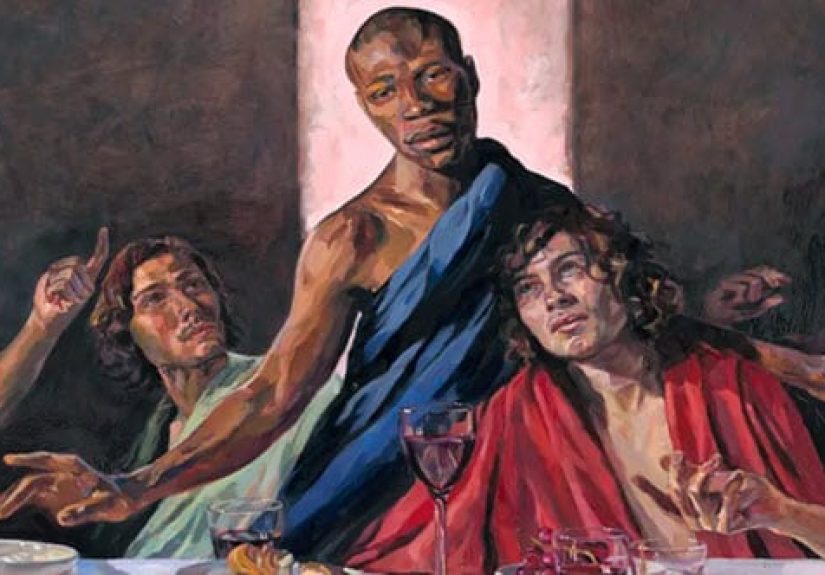
The so-called Black Gospel Window is a striking stained-glass work from 1878 that depicts Christ as a person of color interacting with biblical women. That alone would make it noteworthy. What elevates it into a major case is the way it reentered public attention and sparked wider conversations about race, biblical imagination, and the long visual habit of whitening Jesus in Western art.
The window is especially compelling because it is not a brand-new activist reinterpretation. It is a 19th-century work, which means the conversation is older, deeper, and more historically layered than many assume. It presents Christ and the women around him with dark skin and places them in scenes of dialogue and dignity. In a country still arguing over representation, the window feels both historical and contemporary at once. Its move to a museum setting ensures that more people will encounter it not as an isolated church artifact, but as part of a broader reconsideration of how Jesus has been pictured, and why those pictures matter so much.
What These Cases Reveal About Jesus in Art
Taken together, these cases show that art about Jesus is rarely passive. A Jesus image can be worshiped, doubted, mocked, sold, censored, restored, mass-produced, or rediscovered. It can comfort millions or offend them. It can sit quietly in a chapel for decades and then burst into the global spotlight because somebody cleaned it badly, priced it wildly, or looked at it with new historical questions.
That is why Jesus remains one of the most compelling subjects in visual culture. The image is never only about the artist. It is also about the viewer. Each generation brings its own fears, desires, and assumptions to the face of Christ. The result is a long, messy, fascinating history in which sacred art becomes a mirror, a battleground, and sometimes a very expensive mystery.
Experiences That Make Art About Jesus So Unforgettable
There is a particular feeling that comes with standing in front of art about Jesus, and it is not quite the same as looking at a landscape, a royal portrait, or a bowl of expertly painted fruit doing its very best. Images of Christ tend to arrive with emotional luggage. Some viewers bring faith. Some bring skepticism. Some bring childhood memories of church walls, prayer cards, Christmas pageants, or one very stern Sunday school teacher. Whatever the baggage, the encounter rarely feels neutral.
In a museum, the experience can be oddly split. One part of the brain says, “Observe the brushwork, the composition, the restoration choices.” The other part says, “This image has been loved, argued over, and prayed in front of for generations.” That double awareness is what makes Jesus art so powerful. You are not only seeing an object. You are walking into a relationship between image and belief that may be centuries old.
Church settings create a different atmosphere altogether. A painting of Christ in a sanctuary does not behave like it does in a gallery. In a museum, it is lit, labeled, and politely explained. In a church, it is part of a living space. It watches baptisms, funerals, weddings, candlelight vigils, sleepy children, and people trying to hold themselves together through grief. Even a modest image can feel charged because it has absorbed years of human attention. That is not magic exactly, but it is not nothing either.
Then there is the experience of surprise. Some Jesus images are famous because they are beautiful. Others are unforgettable because they refuse to match expectation. Maybe Christ looks severe when you expected tenderness. Maybe he looks vulnerable when you expected triumph. Maybe the image reflects a culture or ethnicity you were never taught to associate with biblical art. Those moments can be unsettling, but they are also useful. They remind viewers that every image of Jesus is an interpretation, not a photograph smuggled out of the first century.
Modern audiences also experience Jesus art through screens, which changes everything. A controversial work can travel from a chapel or museum to millions of phones in hours. That speed flattens context but multiplies reaction. People who would never visit an exhibition can still form strong opinions about a Jesus image in seconds. The upside is accessibility. The downside is that sacred art can get reduced to a meme before anyone asks what the artist was trying to say. Welcome to the digital age, where even theology can be scrolled past between lunch photos and weather updates.
Still, the most lasting experiences tend to be the quieter ones. A cracked fresco, a halo catching dim light, a stained-glass Christ glowing in late afternoon sun, a face painted with enough humanity to feel almost uncomfortably present: those moments linger. They linger because Jesus art does not merely illustrate a story. It asks a viewer where they stand in relation to suffering, mercy, judgment, beauty, and belief. No wonder these works keep generating debate. They are not only historical objects. They are emotional encounters waiting to happen.
Conclusion
The top intriguing cases involving art about Jesus are not fascinating simply because they are controversial. They matter because they show how one religious figure can keep reshaping visual culture across centuries. Whether the issue is authenticity, censorship, race, restoration, theology, or mass reproduction, the image of Christ continues to stir argument because it continues to carry meaning. And as long as artists keep returning to Jesus, the next strange, moving, or headline-grabbing case is probably already on its way.




 Close
Close