
Table of Contents >> Show >> Hide
- Dow Jones 101: The Index Behind Dow Futures
- So, What Exactly Are Dow Futures?
- The Main Types of Dow Futures Contracts
- When and How Dow Futures Trade
- Why Investors and Traders Watch Dow Futures
- How to Read a Dow Futures Quote
- Risks of Trading Dow Futures
- Dow Futures vs. ETFs and CFDs
- Who Should Consider Dow Futures?
- Real-World Lessons From Trading Dow Futures
- Conclusion: Understanding Dow Futures Without the Intimidation
If you’ve ever checked the markets before the opening bell, you’ve probably seen a headline like:
“Dow futures up 150 points” and wondered, “Wait… how can the Dow be moving when the stock market isn’t even open yet?”
That mysterious number is coming from Dow futuresa type of financial contract that lets traders and investors bet on (or protect themselves from) the future direction of the
Dow Jones Industrial Average. They’re powerful, flexible, and, yes, a little intimidating the first time you meet them.
In this guide, we’ll break down what Dow futures are, how they work, why professionals love them, and what regular investors should know before getting anywhere near the “Buy” or “Sell” button.
We’ll keep it practical, a bit fun, and jargon-light.
Dow Jones 101: The Index Behind Dow Futures
Dow futures are built on top of the Dow Jones Industrial Average (DJIA), one of the oldest and most famous stock indexes in the world. The Dow tracks 30 large U.S. companiesthink
blue-chip names across sectors like technology, finance, healthcare, and industrials.
A key detail: the Dow is a price-weighted index. That means higher-priced stocks have more influence on the index’s movements than lower-priced ones, regardless of the company’s
size. So a $400 stock in the Dow can move the index more than a $50 stock.
Dow futures don’t track the actual shares of those 30 companies. Instead, they track the value of the index itself. You’re trading the index level (like 35,000 or 38,500), not
individual stocks.
So, What Exactly Are Dow Futures?
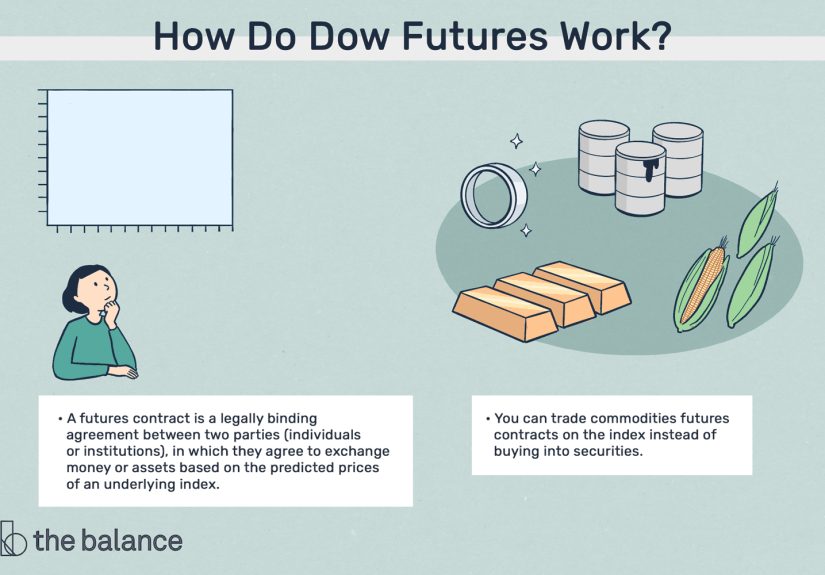
At their core, Dow futures are futures contracts tied to the Dow Jones Industrial Average. A futures contract is a standardized agreement to buy or sell something at a set price
on a future date. In this case, that “something” is the value of the Dow index.
A few important points about Dow futures:
- They’re derivatives. Their value is derived from the Dow index.
- They’re traded on exchanges. Specifically, on the CME Group’s electronic platform (CME Globex).
- They’re cash-settled. No one delivers “one unit of the Dow” to your house on expiration day. Profits and losses are settled in cash.
You can use Dow futures to:
- Speculate on where the Dow is headed.
- Hedge a portfolio of Dow-like stocks or ETFs.
- Gauge market sentiment before the stock market opens or after it closes.
Dow Futures vs. the Dow Index
It’s easy to confuse the two, but they’re not the same thing:
- The Dow (DJIA) is an index that tracks 30 companies. It’s a benchmark, not something you directly buy or sell.
- Dow futures are tradable contracts whose prices are based on expectations for where the Dow will be in the future.
Futures prices can trade slightly above or below the current index level, reflecting things like interest rates, expected dividends, and simple supply and demand. So if the Dow closed at 35,000,
Dow futures might be trading at 35,050 or 34,950 depending on what traders think will happen next.
The Main Types of Dow Futures Contracts
For most traders, there are two Dow futures contracts that matter the most:
E-mini Dow Futures (Symbol: YM)
The workhorse of Dow futures trading is the E-mini Dow, usually quoted under the ticker YM. Each E-mini Dow contract represents a fixed dollar value per
index point of the Dow.
Typical contract features include:
- Underlying index: Dow Jones Industrial Average (DJIA)
- Contract size: $5 per Dow point (so a Dow level of 35,000 represents a $175,000 notional contract value)
- Minimum tick: 1 index point (worth $5 per contract)
- Exchange: CME Group (CME Globex electronic platform)
Because the contract is sized at $5 per point, relatively small changes in the index can translate into meaningful profits or losses. A 50-point move in the Dow means a $250 swing on a single
YM contract.
Micro E-mini Dow Futures (Symbol: MYM)
Not everyone wants full-size E-mini exposure. That’s where Micro E-mini Dow futures, symbol MYM, come in.
Micro contracts are designed to be more accessible:
- Contract size: $0.50 per Dow point (one-tenth of the E-mini)
- At a Dow level of 35,000, one Micro contract represents about $17,500 in notional value.
Micro E-minis let traders:
- Use smaller position sizes.
- Scale in or out more gradually.
- Limit dollar risk per point move compared to the larger E-mini contract.
For newer futures tradersor for anyone fine-tuning riskMicro E-mini Dow contracts can be a more forgiving way to get familiar with Dow futures behavior.
When and How Dow Futures Trade
One big appeal of index futures is that they trade virtually around the clock. While the stock market has a standard 9:30 a.m. to 4:00 p.m. Eastern Time session, Dow futures have much longer
trading hours.
Almost 24-Hour Access
Dow futures typically trade from Sunday evening through Friday afternoon, with a short daily maintenance break. That means you can react to:
- Overnight news from Europe or Asia.
- Economic data released before the market opens.
- Company earnings coming out after the close.
That’s why financial media often reference Dow futures before the opening bellthose prices provide a live snapshot of investor sentiment even while the stock market is closed.
Margin and Leverage
Unlike buying $175,000 worth of stocks outright, you don’t pay the full notional value up front when you trade Dow futures. Instead, you post a portion of the contract value as
margin, which acts like a performance bond.
Key ideas:
- Initial margin: The minimum amount you must deposit to open a position.
- Maintenance margin: The minimum amount you must maintain to keep that position open.
- Leverage: Because your margin is only a fraction of the contract’s value, small price moves can lead to large percentage gainsor losses.
For example, if one E-mini Dow contract has a notional value of $175,000 but the exchange and your broker require only a few thousand dollars of margin, a 1% move in the Dow can produce a much
larger percentage change in your account balance. That’s great when you’re right… and brutal when you’re not.
Expiration and Rollover
Dow futures contracts don’t last forever. They have specific expiration months, usually the quarterly cycle: March, June, September, and December.
As expiration approaches, active traders typically “roll” their positions into the next contract monthclosing, for example, a June contract and opening a September one. Longer-term
investors and hedgers pay close attention to these rollover periods because volume and liquidity can shift quickly from one contract month to the next.
Why Investors and Traders Watch Dow Futures
A Real-Time Sentiment Indicator
Because Dow futures trade nearly 24 hours a day, they act as an early-warning system for the stock market. When you see headlines like:
“Dow futures slide 300 points after surprise economic data”, that’s the futures market reacting in real time.
Traders and investors use these moves to gauge whether the cash market (the actual stocks) might open higher or lower. It’s not a perfect predictor, but it gives a sense of where the pressure is:
buyers or sellers.
Hedging a Stock Portfolio
One of the classic uses of Dow futures is hedging. Imagine you:
- Own a diversified portfolio of large U.S. stocks that behaves similarly to the Dow.
- Are worried about a short-term pullbackmaybe because of a big economic announcement or geopolitical event.
Instead of selling all your stocks (and triggering taxes or transaction costs), you could:
- Sell Dow futures contracts to offset potential losses.
- If the market drops, your stock portfolio loses value, but your short Dow futures position gains.
- If the market rallies, your hedge may lose money, but your long stock portfolio gains even more.
Institutions and professional money managers rely on index futures for exactly this kind of portfolio protection, especially around key events.
Speculating on the Market Direction
Dow futures are also a favorite tool for short-term traders who want to express a view on the overall market:
- Think the Dow is going higher? Buy futures.
- Think it’s going lower? Sell futures.
Because the contracts are leveraged and highly liquid, traders can move in and out quickly. But with that speed comes significant riskDow futures are not a “set it and forget it” product.
How to Read a Dow Futures Quote
Let’s say you’re looking at a trading platform and you see this:
Here’s what that means:
- YM is the futures symbol for the E-mini Dow.
- 35,120 is the current futures price (the index level).
- +85 is how many points it’s up compared with the previous settlement.
- +0.24% is the percentage change.
Now translate that into dollars:
- Each point is worth $5 per contract.
- An 85-point move = 85 × $5 = $425 per contract.
If you own one YM contract and the price rises from 35,035 to 35,120, that 85-point move is a $425 gain. If it falls by 85 points instead, that’s a $425 loss. Micros work the same way, just
with $0.50 per point instead of $5.
Risks of Trading Dow Futures
Dow futures are powerful tools, but they can be unforgiving if you don’t respect the risk. Here are some of the big issues to keep in mind.
Leverage: Great Until It Isn’t
Leverage means you control a large notional amount with a relatively small amount of capital. This can magnify returnsbut also magnifies mistakes. A move that would be a mild annoyance in a
diversified stock portfolio can be a serious hit in a leveraged futures account.
Overnight and Weekend Gaps
Because Dow futures trade nearly around the clock, they can move significantly on news that hits when the stock market is closed. Economic data, political developments, central bank comments, or
global events can all trigger sharp reversals.
If you’re holding a position overnight without paying attention, you might wake up to a much larger profitor lossthan you expected.
Margin Calls and Forced Liquidations
If the market moves against you and your account balance drops below maintenance margin, your broker can issue a margin call. If you don’t add funds or close positions quickly
enough, the broker may close trades on your behalf, potentially at very unfavorable prices.
That’s why experienced traders monitor not just price, but also margin levels, volatility, and correlation with other positions.
Dow Futures vs. ETFs and CFDs
Dow futures are one way to trade the Dow. Two common alternatives are ETFs and CFDs (contracts for difference).
Dow Futures vs. Dow ETFs
A popular Dow-tracking ETF is DIA (the SPDR Dow Jones Industrial Average ETF). It’s often used by stock investors who want Dow exposure without picking individual companies.
Compared with ETFs:
- Futures are highly leveraged. You use margin instead of paying full price.
- Futures can have tax advantages for certain U.S. traders (such as 60/40 capital gains treatment).
- Futures trade nearly 24 hours a day. ETFs generally trade only during regular market hours.
ETFs, on the other hand, are typically simpler, more familiar, and suitable for many long-term investors who don’t need leverage or nearly 24-hour access.
Dow Futures vs. US30 CFDs
Outside the U.S., many brokers offer US30 CFDs, which track the Dow-like index. But CFDs are typically over-the-counter (OTC) products offered by brokers, not
exchange-traded products.
By contrast, Dow futures (YM and MYM) are:
- Traded on a centralized, regulated exchange (CME).
- Transparent in terms of price and volume.
- Standardized with well-defined contract specifications.
For many active U.S. traders, that transparency and regulation is a major reason to prefer futures over CFDs.
Who Should Consider Dow Futures?
Dow futures are not a beginner product. They tend to be used by:
- Active traders who understand leverage, volatility, and risk management.
- Institutional investors and hedge funds hedging portfolios or executing short-term strategies.
- Experienced individual investors using small position sizes or Micro contracts as part of a defined plan.
If you’re new to investing, it usually makes more sense to start with cash stocks or diversified ETFs, then gradually learn about futures using educational resources, paper trading, or very small
positions in Micro contracts.
Nothing here is financial advicejust education to help you understand what you’re seeing when someone says “Dow futures are up.”
Real-World Lessons From Trading Dow Futures
Theory is nice, but Dow futures feel very different when real money is on the line. Here are some practical, experience-style insights that traders often discover the hard way.
1. Start Smaller Than Your Ego Wants
When you first realize that one E-mini Dow contract can move hundreds of dollars in minutes, it’s tempting to think, “I’ll just catch a 50-point move and be done for the day.” The problem? Markets
don’t care about your plan.
Many traders find that Micro E-mini Dow (MYM) contracts are a much better training ground. You still experience real price action, order flow, and volatilitybut with a fraction
of the dollar risk. It’s like learning to drive in a parking lot instead of on the highway at rush hour.
2. Think in Dollar Risk, Not Just Points
New futures traders often say things like, “I’m just risking 40 points.” That sounds mild, but on an E-mini Dow contract, 40 points equals $200, and that’s per contract. Stack a
few contracts, and suddenly you’re dealing with serious swings.
A more grounded approach:
- Decide how many dollars you’re truly comfortable risking on a single trade.
- Convert that dollar risk into points based on the contract (E-mini or Micro).
- Size your position so a “normal” market wiggle doesn’t blow up your account.
Treat every point on the screen as real moneynot just abstract math.
3. Economic Calendar = Your Best Friend
Dow futures can be quiet one moment and absolutely wild the nextespecially around major economic reports like jobs data, inflation numbers, or Federal Reserve announcements.
Traders with battle scars usually:
- Check the economic calendar before placing trades.
- Avoid opening new positions right before high-impact news (unless that’s part of a deliberate strategy).
- Widen stops or reduce size if they plan to hold through a major announcement.
A 100-point swing in calm markets feels big; during news, a 300-point or 500-point surge can happen in minutes. If you’re not ready for that, it’s better to be safely on the sidelines.
4. Overnight = Different Personality, Different Rules
The character of Dow futures changes outside regular U.S. trading hours:
- Liquidity can be thinner, especially in the late U.S. evening.
- European and Asian markets can amplify moves based on local news.
- Spread and slippage risk can be higher.
Some traders choose to never hold overnight positions, treating Dow futures strictly as a day-trading product. Others do trade overnight but use smaller size, wider stops, and
extra caution.
The key is to have a clear rule: “I do” or “I don’t” hold positions overnightand stick to it. The worst decisions usually happen when rules are rewritten in the middle of a losing trade.
5. Technology Risk Is Real
Another lesson from real-world trading: it’s not just market risk; there’s infrastructure risk too. Exchanges, data centers, trading platforms, and internet connections are all
part of the ecosystem.
Major exchanges have occasionally experienced technical outages that halted futures trading for hours. When that happens, traders may not be able to close or adjust positions, even as related
markets or news continue to move. It’s rarebut when it occurs, it’s a vivid reminder that “100% control” is an illusion.
Experienced traders factor this into their risk management by:
- Avoiding over-leverage.
- Keeping emergency contact info for brokers handy.
- Accepting that, sometimes, the safest position is smaller than your confidence level would suggest.
6. A Written Plan Beats “Vibes” Every Time
Dow futures are fast enough that trading on emotionfear, greed, boredomis almost guaranteed to lead to trouble. That’s why seasoned traders rely on written plans:
- Entry criteria (what must be true before they click buy or sell).
- Exit rules (profit targets, stop-loss levels, time-based exits).
- Position sizing rules (how many contracts based on account size and volatility).
Futures markets reward discipline and punish improvisation. If your plan lives only in your head, you’ll be amazed how quickly it “changes” when a trade goes against you.
Conclusion: Understanding Dow Futures Without the Intimidation
Dow futures may sound complicated, but the big picture is straightforward:
- They’re futures contracts tied to the Dow Jones Industrial Average.
- They trade nearly 24 hours a day and are used to hedge, speculate, and measure market sentiment.
- They come in different sizesE-mini and Microso traders can match risk to their comfort level.
- They’re highly leveraged, which is both their greatest strength and their greatest danger.
Even if you never trade a single Dow futures contract, understanding what they are helps you read financial news, interpret pre-market moves, and appreciate how professional traders manage risk
behind the scenes.
And the next time you see “Dow futures up 150 points,” you’ll know it’s not magicit’s a real-time snapshot of how traders around the world are positioning for whatever comes next.





 Close
Close