
Table of Contents >> Show >> Hide
- It Was Built for One Job: Go Fast, Go High, Come Back
- The Secret Sauce Wasn’t Just PowerIt Was How It Used Air
- Materials Science on a Deadline: Titanium or Bust
- Heat Was the Real Boss Battle
- Stealth-ish Before Stealth Was a Household Word
- Reconnaissance at the Speed of “Good Luck Catching Me”
- So What Made the SR-71 Blackbird Such a Badass Plane?
- Experiences That Make the SR-71 Feel Real (and Even More Ridiculous)
- Conclusion
Some aircraft are “cool.” The SR-71 Blackbird is mythicalthe kind of machine that makes engineers grin,
pilots speak in reverent tones, and everyone else squint at the numbers like they’re a typo.
A jet that routinely cruised above 80,000 feet, lived at Mach 3+, and treated “air friction”
like a business partner? That’s not just an airplane. That’s a physics flex with landing gear.
But here’s the best part: the Blackbird wasn’t badass because it looked like a sci-fi dart (it did),
or because it was painted black (also yes). It was badass because its designers basically said,
“Let’s build a reconnaissance aircraft that turns the atmosphere into its own advantage,” and then they actually did it.
This is the story of how speed, heat, materials science, and Cold War urgency combined into the loudest
“don’t worry, we’ll be gone before you can aim” energy ever put on a runway.
It Was Built for One Job: Go Fast, Go High, Come Back
Those performance numbers still sound like bragging
The SR-71 wasn’t chasing speed records as a hobbyit was built to survive where threats couldn’t comfortably reach.
It was designed to cruise around Mach 3.2 at altitudes up to roughly 85,000 feet, which is basically
the “black sky is starting to look friendly” neighborhood of flight.
Even decades after retirement, it’s still famous for being the fastest and highest-flying operational jet aircraft of its era.
On July 28, 1976, an SR-71 set official records: 2,193.167 mph and 85,068.997 feet.
That’s not “fast for a plane.” That’s “fast enough to make time zones nervous.”
[1][2]
The key point: speed and altitude weren’t party tricks. They were the plane’s defensive system.
In a world of surface-to-air missiles, interceptors, and radar networks, the Blackbird’s strategy was simple:
be somewhere, collect intelligence, and leave before anybody finishes saying, “Wait, was that…?”
[3]
The Secret Sauce Wasn’t Just PowerIt Was How It Used Air
The inlets were basically part of the engine (and kind of the engine’s boss)
Here’s where the SR-71 gets hilariously unfair: at Mach 3, the “engine” isn’t just the engine.
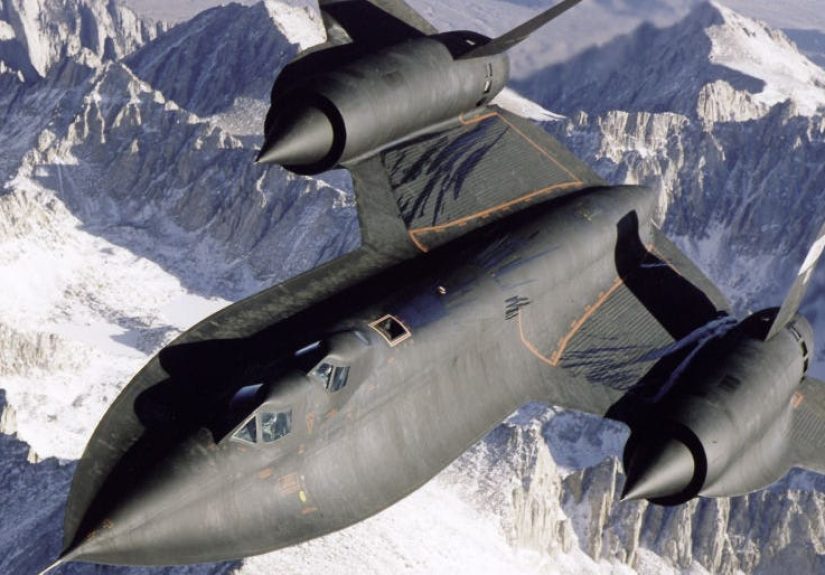
The Blackbird’s variable-geometry inlet system (those iconic spikes) managed shockwaves and compressed incoming air so efficiently
that a huge share of propulsion came from the inlet/ejector system rather than the core engine alone.
In fact, at high speed the inlet/ejector could contribute the majority of total thrustan almost cheating-level advantage.
[4]
Think of it like this: most jets swallow air and burn fuel to push exhaust out the back.
The Blackbird also did thatbut it first weaponized the airflow itself. By carefully positioning the inlet spike,
it created controlled shockwaves that slowed and compressed air before it entered the engine.
That meant more efficient compression, better stability at insane speeds, and a propulsion system that behaved like
a turbojet that learned some ramjet tricks and then started acting superior at parties.
[4]
The J58 engine: afterburner for hours, because subtlety is overrated
The SR-71 was powered by two Pratt & Whitney J58 engines, designed and qualified to operate at Mach 3,
and famously capable of extended afterburner usesomething that would be wildly impractical (and wildly expensive)
for most aircraft. Each engine produced on the order of tens of thousands of pounds of thrust with afterburner.
[5][4]
This matters because the Blackbird didn’t “sprint” to Mach 3. It lived there.
It was engineered to sustain that environment long enough to do real reconnaissance work,
not just make a thrilling flyby and then go home for a nap.
[5]
Materials Science on a Deadline: Titanium or Bust
93% titanium structurebecause aluminum would have had a very bad day
At sustained Mach 3 flight, aerodynamic heating is not a “minor concern.” It’s the villain.
So the Blackbird leaned hard into titanium alloysso hard that roughly 93% of its structural weight was titanium.
That choice was bold and brutal: titanium is strong, heat-resistant, and relatively light,
but it’s also notoriously difficult to machine and demands obsessive handling to avoid contamination and corrosion issues.
[4]
Building the SR-71 required inventing or refining manufacturing techniques, tooling practices, and quality controls
that simply weren’t common at the time. Even routine materials and shop habits could become a problem,
because titanium reacts badly with certain elements and compounds.
The Blackbird didn’t just advance aviationit advanced the entire industrial toolbox needed to make it possible.
[4]
It wasn’t “painted black to look cool” (though it did)
The SR-71 earned its nickname partly because it was coated with a high-emissivity black paint.
That paint helped radiate heat away more effectively, reducing thermal stress on the airframe.
Engineers explicitly leaned on the physics of heat absorption and emissionessentially using black-body radiation behavior
to help the aircraft manage its own heat load.
So yes, it looked intimidating. But it was also a thermal strategy wearing a dramatic outfit.
[4]
Heat Was the Real Boss Battle
When “air friction” becomes a design requirement
If you want to understand why the SR-71 is legendary, don’t start with the top speedstart with the temperature.
At high-speed cruise, the aircraft’s skin could reach temperatures around hundreds of degrees Fahrenheit,
with some external areas reported up to roughly 800°F.
That kind of heat changes everything: materials expand, tolerances shift, systems must be cooled,
and the airplane becomes a flying thermal engineering exam that never ends.
[6][4]
Even the cockpit environment needed serious help. Technical descriptions note that at cruise
the outer surfaces around the cockpit could reach several hundred degrees Fahrenheit,
while the crew compartment was kept comfortable only by aggressive cooling and insulation approaches.
The Blackbird didn’t merely carry peopleit protected them from the consequences of Mach 3 physics.
[4]
Yes, it leaked fuel on the ground (and no, that wasn’t “poor quality”)
One of the most repeated SR-71 facts is also one of the funniest when you understand it:
the plane could leak fuel on the ground, because at operating temperature the structure would expand and “tighten up.”
In other words, the Blackbird was designed for conditions it reached in flight.
On the ramp, before everything heated up and expanded, it could behave like a very expensive reminder that metals move.
[4]
Stealth-ish Before Stealth Was a Household Word
Not invisiblejust harder to deal with
The SR-71 wasn’t a modern stealth aircraft in the F-117/F-22 sense, but it did incorporate measures to reduce radar signature.
Sources describe the use of radar-absorbent structures and special materials in areas like chines, edges, tails, and inlet features,
plus design shaping that helped with radar “stealthiness” for the time.
The point wasn’t magic invisibilityit was making tracking and engagement harder, especially when combined with extreme speed and altitude.
[3][4]
The CIA’s own historical write-ups emphasize that these innovations were part of a larger toolkit
(materials, fuels, navigation, countermeasures, life support) needed to meet the requirement:
a very fast, very high reconnaissance aircraft designed to avoid air defenses.
[3]
Reconnaissance at the Speed of “Good Luck Catching Me”
Covering massive areas fast
At around 80,000 feet, the SR-71 could observe enormous swaths of terrain quickly.
Official museum and Air Force materials often cite that it could survey on the order of
100,000 square miles of Earth’s surface per hour.
That scale mattered: it meant timely intelligence without needing to linger over dangerous places.
[1][7]
The A-12 to SR-71 family tree: one idea, multiple legendary outcomes
The SR-71 didn’t appear out of nowhere. It evolved from the CIA’s A-12 OXCART program and shared core design DNA
with related Blackbird variants (including the YF-12 interceptor variant and other specialized versions).
The SR-71 became the Air Force’s two-seat follow-on, carrying additional systems and mission capability.
Cold War needs drove brutal requirements, and those requirements drove equally brutal engineering innovation.
[3][8]
Why it eventually retired: budgets, satellites, and the price of living at Mach 3
The SR-71 was astonishingbut it wasn’t cheap. Maintaining a titanium, high-temperature, Mach 3 reconnaissance platform
is the opposite of a bargain hobby. Over time, improvements in space-based reconnaissance, shifting priorities,
and funding decisions pushed the Blackbird toward retirement, with brief returns and final program termination in the late 1990s.
[3]
So What Made the SR-71 Blackbird Such a Badass Plane?
If you had to boil the Blackbird down into a few reasons, it looks like this:
- It treated Mach 3 as a workplace, not a stunt. Designed for sustained cruise around Mach 3.2 and extreme altitude. [2][6]
- Its inlets were an engineering superpower. Shock management and inlet/ejector effects contributed massively to high-speed thrust. [4]
- It was a titanium machine built for heat. A huge proportion of titanium structure and high-temperature design solutions. [4]
- It used black paint for thermodynamics. High emissivity coating helped radiate heat and reduce thermal stress. [4]
- It blended speed, altitude, and signature reduction. Not “invisible,” but intentionally harder to trackespecially when moving that fast. [3][4]
- It delivered strategic intelligence fast. Able to cover vast areas rapidly, providing timely reconnaissance during tense eras. [1]
The SR-71’s legend isn’t just that it was fast. It’s that it was a complete system:
aerodynamics, propulsion, materials, cooling, human factors, and mission design all aimed at one ruthless goal:
gather intelligence and survive in hostile conditions.
That’s why it still feels like a “badass plane” even in a world full of advanced aircraft.
Experiences That Make the SR-71 Feel Real (and Even More Ridiculous)
Reading specs is one thing. Experiencing the Blackbirdeven secondhandhits differently.
If you’ve ever stood under an SR-71 at a museum, you know the first sensation is scale:
it’s long, sharp, and strangely “tight,” like someone stretched an airplane into a spear.
You start noticing details that numbers don’t capturethe unusually thin-looking edges, the aggressive engine nacelles,
the cockpit that seems too small for how extreme the mission was.
Your brain does that little flip where it realizes: “Two humans sat in there… on purpose.”
[1]
The next thing you feel is respect for the people behind the scenes.
Blackbird operations weren’t “pilot and plane.”
They were pilot, reconnaissance systems officer, maintainers, planners, refuelers, photographers, and a logistics chain
that had to support a machine operating in a temperature-and-speed environment that normal aircraft never touch.
It’s the kind of program where the airplane is famous, but the teamwork is the real miracle.
[7]
Then you fall into the storiesthe kind that don’t need exaggeration because the baseline truth is already wild.
One pilot account describes a routine mindset that sounds almost casual: take off (or come off a tanker) and head for Mach 3.2,
as if that’s just “Tuesday.” Another anecdote paints a picture of the pace of life with these jets:
a morning that includes a drive, a flight that crosses huge distances at absurd speed, and then being back in time for lunch
like it’s a normal errandexcept the errand happens at the edge of the atmosphere.
[9]
If you’re the kind of person who likes to watch technical documentaries or deep-dive threads, the SR-71 experience becomes a chain reaction:
you start with “How fast was it?” and end up learning about shockwaves, high-temperature sealants, and why black paint can be a thermal tool.
You learn that what looks like a simple cone at the inlet is actually part of a carefully choreographed airflow system,
and that “going fast” isn’t a throttle positionit’s a full-time relationship with heat management.
[4][6]
And if you want a truly human moment, look at the physiology side.
Some Air Force accounts describe SR-71 crew selection and training as exceptionally demanding,
with specialized gear and pressure suits needed because the operating altitude is so extreme.
That detail re-frames everything: the Blackbird wasn’t just a fast airplaneit was closer to spaceflight than most jets will ever get.
When you picture the crew suited up, sealed in, climbing into a machine built around titanium and shockwaves,
you stop thinking “plane” and start thinking “system designed to keep humans alive while physics tries to evict them.”
[8][10]
Finally, there’s the emotional punch: the SR-71 feels like something we shouldn’t have been able to build when we did.
It’s a time capsule of urgency and ingenuity, born from Cold War pressure and realized by teams that were willing to invent
new ways of designing and manufacturing just to make the mission possible.
So when people call it “badass,” they’re not only talking about speed.
They’re talking about a rare moment when ambition, engineering, and necessity alignedand produced something that still makes us say,
“How is that real?”
[3][4]
Conclusion
The SR-71 Blackbird became legendary because it didn’t merely push boundariesit moved into them, set up furniture, and started paying rent.
Its Mach 3+ cruise wasn’t an occasional headline; it was the design point. Its inlets turned air into propulsion advantage.
Its titanium structure and thermal strategy made high-speed flight survivable. And its mission impact proved that sometimes
the best defense is being too fast and too high to handle.
In short: the SR-71 was a badass plane because it combined brutal performance with brutal engineering discipline
and then made it operational.







 Close
Close