
Table of Contents >> Show >> Hide
If you clicked this Yumi baby food review expecting me to say, “This changed my life, my kitchen, and possibly my personality,” let me save you some suspense: Yumi does a lot right, but it is not a magic wand. It is a convenience brand. A smart convenience brand, yes. A pretty thoughtfully designed convenience brand, also yes. But still convenience. And as both a dietitian and a mom of two kids who think breakfast is either a sacred ritual or a personal insult, depending on the day, I care a lot about where a product lands on the line between helpful and hypey.
Here is the first thing parents should know: the Yumi many people remember for fresh purées and baby meals is not exactly the Yumi most families are shopping right now. Today, the brand is much more snack-focused, with products like melts, rice-free puffs, snack bars, and breakfast bars. So this review is not a love letter to an old baby-food subscription fantasy. It is a practical look at the Yumi products parents can actually buy now, and whether they make sense nutritionally, developmentally, financially, and logistically for real families who sometimes feed their children in the car while negotiating over socks.
My overall take? Yumi is a solid option for busy parents who want organic baby snacks and toddler snacks made with recognizable ingredients, smart fortification, and flavors that are more produce-forward than sugar-bomb. But it works best as a helper, not a whole feeding plan. If you want full meals, protein-heavy options, or a replacement for homemade family food, Yumi will not do all the heavy lifting. If you want better-than-average grab-and-go support, though, it earns a spot in the diaper bag.
My Quick Verdict
Would I buy it? Yes, selectively.
Would I rely on it for every meal? No.
Would I recommend it to parents who need high-quality convenience foods? Absolutely.
Best for: busy families, travel days, daycare snacks, early finger-food practice, and toddlers who need a cleaner snack option.
Not best for: parents looking for a full fresh-meal subscription, budget-first shoppers, or families who need higher-protein meal replacements.
What Yumi Actually Is Right Now
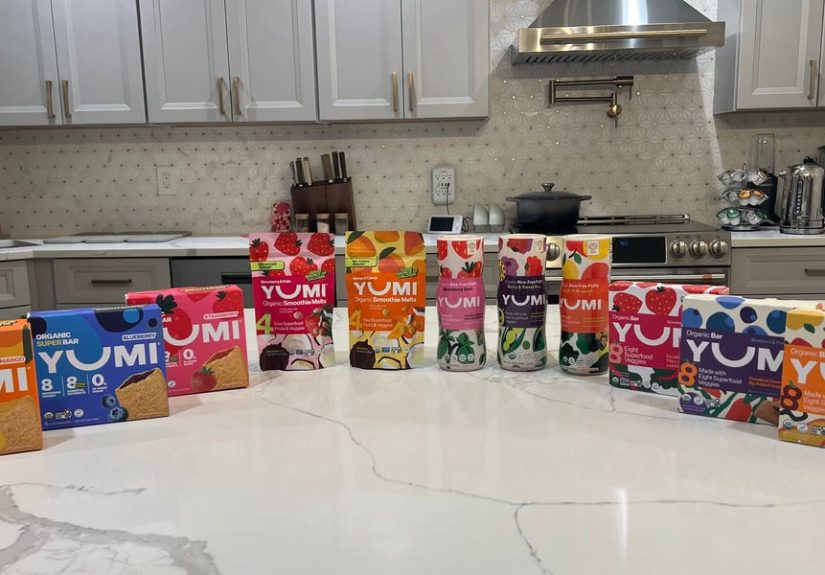
Let’s clear up the baby-food confusion right away. Yumi is currently best described as a baby and toddler snack brand with a nutrition-forward personality. Its core lineup includes smoothie melts, rice-free puffs, softer snack bars, and larger breakfast bars. The brand leans heavily into organic ingredients, plant-based recipes, and “school-safe” formulations that avoid many major allergens.
That matters, because a lot of older Yumi reviews online talk about chilled purées, stage-by-stage baby meals, and weekly deliveries of fresh blends. That was a real part of the company’s history. But if you are shopping for Yumi today, you are mainly looking at shelf-stable snack products rather than a fridge full of ready-made baby lunches. I actually appreciate knowing that upfront. Parents have enough surprises. The snack drawer should not be one of them.
What I Look for as a Dietitian and Mom of 2
Whenever I review a baby or toddler food product, I look at five things first.
1. Ingredient quality
I want to see real food ingredients, limited additives, and a nutrition profile that does not depend on a cloud of marketing fairy dust. If a product says “veggie-forward,” I want actual vegetables involved, not one lonely spinach molecule standing in the corner.
2. Developmental fit
Texture matters. A lot. Babies do not just “eat food”; they learn food. That means mouth feel, dissolvability, self-feeding practice, chewing skill, pacing, and readiness all count. A snack can look great on paper and still be the wrong fit for a younger baby.
3. Nutritional usefulness
For babies starting solids, I care a lot about iron, texture exposure, and a variety of flavors. For toddlers, I care about whether a snack offers something beyond empty crunch. Fiber, healthy fats, and useful micronutrients all help.
4. Safety and transparency
Parents are rightly concerned about heavy metals in baby food. No brand gets a gold star just for saying nice words online. I want to see actual testing practices, clear messaging, and products that are built with today’s safety concerns in mind.
5. Real-life convenience
If a food is so fussy that it creates more work than it saves, it has failed the parent test. I need packaging that reseals, textures that travel well, and products my kids will actually eat without acting like I served them roofing material.
What I Like About Yumi
The ingredient lists are generally stronger than average
This is one of Yumi’s biggest wins. The brand uses organic ingredients, keeps the flavor combinations interesting, and avoids turning every snack into a dessert wearing a broccoli costume. Many of the products lean on fruits, vegetables, oats, sorghum, cassava, coconut, and produce powders rather than a parade of artificial colors and mystery ingredients. That does not automatically make a snack perfect, but it does move it into the “I feel pretty good about this” category.
I also like that the puffs are rice-free. With ongoing concern about arsenic exposure from rice products, I think parents are wise to diversify grains and not make rice the default for everything tiny and snackable. Using alternatives like sorghum and cassava is a practical plus.
Yumi seems to understand that baby and toddler snacks should do more than just disappear
Some of the Yumi products include nutrients that matter in early childhood, including iron and choline in the puff line. That caught my attention immediately. Choline is not the trendy nutrient of the week, but it is genuinely important for brain development. Iron is another big one, especially once babies start solids and need more than milk alone can provide.
No, a puff is not suddenly equivalent to a balanced meal because it contains iron. Let’s not get carried away. But if I am comparing one convenience snack with another, I absolutely give extra points to the one that brings some nutritional substance to the party.
The textures make sense for on-the-go feeding
Yumi’s melts and puffs are useful stepping stones for families moving from spoon-fed foods toward self-feeding. The melts dissolve quickly, which can help nervous parents feel more comfortable when introducing first finger foods. The puffs are firmer and better for babies who are a little farther along. I still would not hand any product to a baby just because the package says so; developmental readiness matters more than the age number on the front. But within that framework, Yumi’s texture progression makes sense.
As a mom, I also appreciate that the packaging is resealable and generally portable. I can toss a container into my bag without feeling like I am carrying a glitter bomb made of crushed toddler snacks.
The brand is more allergen-friendly than many competitors
Yumi’s snack bars and puffs are marketed as free from many of the top allergens, which makes them easier for daycare, school, and mixed-family settings. That is a real advantage. Finding a convenient snack that is both nutritionally decent and less likely to trigger classroom restrictions can feel like a scavenger hunt designed by a raccoon.
That said, allergen-friendly does not mean allergen-introduction-friendly. For babies starting solids, parents still need intentional exposure to common allergens like peanut, egg, dairy, wheat, soy, and sesame in age-appropriate forms. Yumi can fit into a feeding plan, but it should not replace that bigger developmental and nutritional picture.
What I Don’t Love
It is not really “baby food” in the old-school sense anymore
This is the biggest disconnect in the whole Yumi conversation. If you are searching for fresh purées, blend packs, or full baby meals delivered to your door, you may be disappointed. The current Yumi lineup is more about snacks than meals. That is not a flaw by itself, but it does change expectations.
If your baby is just starting solids around 6 months, I would not build your plan around packaged bars and puffs. At that stage, babies still need a broader introduction to iron-rich foods, spoon-fed textures, finger foods, and common allergens. Yumi can play a supporting role later, but it is not the whole script.
The price is premium
Yumi is not the cheapest option in the snack aisle, and it does not pretend to be. You are paying for ingredient quality, branding, convenience, and a more curated nutrition story. Whether that feels worth it depends on your budget and your child’s eating habits.
My honest parent take: I do not mind paying more for a product that truly solves a problem. But I mind it a lot if my child licks it once and then throws it to the dog. So for me, Yumi is worth buying strategically, not automatically.
Some products still need adult judgment about readiness
Just because a puff dissolves does not mean every baby is ready for it. CDC and AAP guidance still matters here: babies should be developmentally ready for solids, usually around 6 months, and finger foods should be offered in safe forms once they can sit up and bring food to the mouth. I personally would be careful not to rush textured packaged snacks just because they are marketed for babies.
This is not a Yumi-only issue; it is a baby-snack issue in general. Parents should always match the product to the child, not the marketing copy to the shopping cart.
How I’d Use Yumi in Real Life
Here is where Yumi shines in my house: the awkward times. The between-times. The “we have ten minutes before daycare pickup” times. The “we are in a waiting room and someone is one goldfish away from mutiny” times.
I would use the melts as an occasional starter finger food for an older baby who is already practicing self-feeding and handling soft textures well. I would use the puffs as a portable snack for babies farther along in solids or for younger toddlers. I would use the snack bars for toddlers who need something small and less sugary than the average packaged option. And I would use the breakfast bar on those chaotic mornings when a full breakfast is ideal in theory but apparently not in this zip code.
What I would not do is let Yumi crowd out regular family food. Babies and toddlers still need exposure to eggs, yogurt, beans, avocado, meat, fish, oatmeal, soft fruit, cooked vegetables, and all the messy, beautiful variety that teaches them how eating actually works. Packaged snacks should support that process, not replace it.
My Product-by-Product Thoughts
Yumi Smoothie Melts
These are probably the easiest entry point if you are new to the brand. I like that they dissolve quickly and have a simpler ingredient profile than many ultra-processed baby snacks. They are useful for practicing pincer-grasp skills and are easy to bring on errands. They are not a nutritional powerhouse, but they are a pretty reasonable bridge food.
Yumi Rice-Free Puffs
This is the most interesting product line to me. Rice-free is a smart move, and the addition of nutrients like iron and choline gives these more value than the average airy baby snack. The flavor profile is less candy-like than a lot of competitors, which I actually consider a good thing. Babies do not need every finger food to taste like a smoothie bar at a wellness retreat.
Yumi Snack Bars
These are best for toddlers, in my opinion. The ingredient list is stronger than many bars marketed to kids, and I like that the flavors include actual produce pairings such as blueberry and purple carrot or apple and cinnamon squash. They still belong in the snack category, but they are a better snack category than many of the bars that live next door on the shelf.
Yumi Super Breakfast Bars
These are the product I most clearly understand as a mom. Are they the breakfast I would design in a perfect world? No. But perfection is very loud online and very quiet at 7:12 a.m. on a Tuesday. If a breakfast bar helps a child get something decent into their body before school or daycare, that has real value. I would just pair it with water and, when possible, something with protein later in the morning.
Is Yumi Worth It?
Yes, for the right family. If you are looking for thoughtfully made, organic, portable snacks for babies and toddlers, Yumi is one of the better options I have seen. I like the ingredient quality, the rice-free puff option, the nutrient fortification in key products, and the fact that the flavors do not seem designed solely by a sugar lobbyist.
No, if you expect it to do everything. Yumi is not a substitute for meals, texture variety, allergen introduction, or family food. It is also not the cheapest way to feed a growing child. So I would call it a “supportive convenience brand,” not a one-stop nutritional solution.
If your goal is to make life easier without sliding into the nutritional abyss of beige crackers and vibes, Yumi is a smart middle ground.
A Longer Look at My Experience as a Dietitian and Mom of 2
What makes this kind of review tricky is that there is the dietitian version of me and the mom version of me, and they do not always enter the kitchen holding hands. The dietitian in me wants balanced meals, iron-rich first foods, repeated allergen exposure, varied textures, and plenty of opportunities for responsive feeding. The mom in me wants everyone dressed, everyone buckled, everyone mildly nourished, and nobody crying because their banana “broke wrong.” These are not always the same goal.
That is exactly why Yumi makes sense to me in certain moments. I do not use convenience foods because I am confused about nutrition. I use convenience foods because I understand real life. There are mornings when one child wants breakfast but only if it is served in the blue bowl, and the other child has decided sitting in the high chair is a personal attack. On those days, having a snack or bar made with decent ingredients is not “settling.” It is strategy.
I also think Yumi works well for the parenting seasons when your mental load is maxed out. Travel days, pediatrician days, teething days, growth-spurt days, daycare-transition days, and those odd in-between weeks where grocery shopping somehow becomes an Olympic event. A lot of parents feel guilt around packaged baby and toddler foods, and I really wish we would retire some of that guilt. The better question is not, “Did I make every bite from scratch?” The better question is, “Did I feed my child something safe, appropriate, and reasonably nourishing?” Yumi can absolutely help answer that question with a yes.
At the same time, I would never want a family to mistake Yumi for the whole feeding journey. One of the most important things I have learned with two kids is that eating skills are built through repetition, mess, exposure, and patience. Babies need chances to touch avocado, squish beans, reject eggs, reconsider eggs, throw oatmeal, rediscover oatmeal, and eventually decide they are obsessed with cucumbers for six days before moving on. That process cannot be outsourced to a puff canister, no matter how pretty the label is.
So when I say I like Yumi, I mean I like it in context. I like it as a tool in the toolbox. I like it for helping me bridge the gap between ideal and reality. I like that it gives me options I feel better about than many mainstream kid snacks. I like that the products seem built by people who understand parents want convenience but do not want junk disguised as wellness. And maybe most importantly, I like that my kids will actually eat it without reacting as though I offered them mulch.
If that sounds like a slightly unromantic endorsement, good. Feeding children is not always romantic. Sometimes it is deeply practical. And in that practical world, Yumi earns a place.
Final Thoughts
If you came here wondering whether Yumi is worth trying, my answer is yes, with realistic expectations. It is a thoughtfully positioned brand with better-than-average ingredients, genuinely useful convenience, and a lineup that makes the most sense for snacks, travel, and toddler chaos control. I would happily keep a few Yumi items in rotation, especially the puffs and bars, while continuing to build most meals around regular family foods.
In other words, Yumi is not the hero of the whole feeding story. But it is a very competent sidekick. And as any exhausted parent knows, sometimes the sidekick is the one who saves the day.







 Close
Close