
Table of Contents >> Show >> Hide
- The Day a Young Soviet City Became a Time Capsule
- 10 Morbidly Bizarre Facts About Pripyat
- 1. It Was a Brand-New “Dream City” Built for the Atom
- 2. The Entire City Was Evacuated in a Few Hours
- 3. The Famous Amusement Park Never Opened
- 4. There’s a Radiation Hotspot Under the Ferris Wheel
- 5. Children’s Gas Masks and Dolls Litter the Schools
- 6. The Hospital Basement Still Holds Highly Radioactive Gear
- 7. A Radioactive Forest Died and Came Back Red
- 8. Nature Is Methodically Dismantling the City
- 9. It’s Now a Mecca for Dark Tourism
- 10. Pripyat Is a Soviet Time Capsule Frozen in the 1980s
- What It’s Like to Experience the Ghost Town of Pripyat
- Conclusion: Pripyat’s Haunting Lesson
The Day a Young Soviet City Became a Time Capsule
If someone asked you to design the perfect Soviet city of the future in the 1970s, you’d probably end up with something a lot like Pripyat. Built in 1970 to house workers from the nearby Chernobyl Nuclear Power Plant, it had wide boulevards, modern apartment blocks, a cultural palace, a swimming pool, schools, nursery schools, a stadium, even an amusement park waiting to open. By April 1986, nearly 50,000 people lived there, most of them young families with kids.
Then, in a single terrifying weekend, it all stopped. After Reactor 4 exploded on April 26, 1986, Pripyat was silently poisoned. The next day, every resident was ordered onto buses, told they’d be gone “for three days.” They never came back. Today Pripyat is one of the world’s most famous ghost towns, sealed inside the Chernobyl Exclusion Zone, frozen somewhere between a 1980s Soviet postcard and a post-apocalyptic movie set.
Beyond the iconic Ferris wheel photos, though, Pripyat is full of details that are equal parts tragic, absurd, and morbidly fascinating. Let’s walk through 10 of the strangest facts about this ghost town that time (and radiation) forgot.
10 Morbidly Bizarre Facts About Pripyat
1. It Was a Brand-New “Dream City” Built for the Atom
Pripyat wasn’t some old village that just happened to be near a nuclear plant. It was purpose-built as a model “atomgrad” – a closed city meant to showcase the bright, clean future promised by nuclear power. Founded in 1970 and granted city status in 1979, Pripyat was young, modern, and unusually well supplied for the Soviet Union. Residents had access to good salaries, decent stores, schools, and recreation facilities. By 1986, the population had grown to roughly 49,000 people, with an average age under 30. This was not a fading town; it was a booming, “privileged” community that vanished almost overnight.
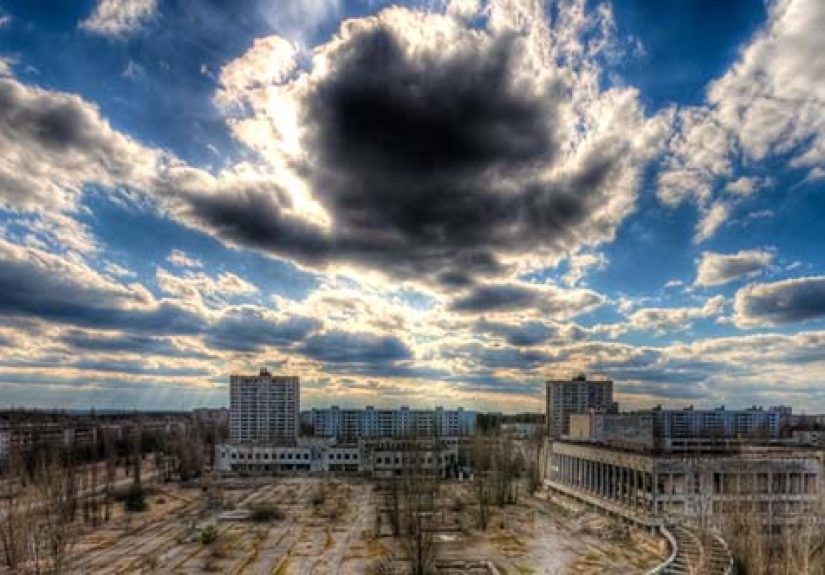
That’s part of what makes Pripyat so disturbing today. The peeling murals, rusting streetlights, and crumbling high-rises aren’t relics of the distant past; they’re the remains of a city that was barely a teenager when it died. Walking those empty avenues feels less like visiting ruins and more like stumbling into a paused life that just never resumed.
2. The Entire City Was Evacuated in a Few Hours
The explosion at Reactor 4 happened in the early hours of April 26, 1986, but Pripyat’s residents weren’t evacuated until the afternoon of April 27. By then, radiation levels in town were dangerously high, even though most people had no idea what had actually happened. Official announcements mentioned a minor accident and “temporary inconvenience.” When buses began lining up, people were told to bring documents and essentials but to leave most belongings behind. They’d be back soon, officials said.
In the end, about 49,000 people were evacuated in a matter of hours by bus, train, and boat. The cruel twist: many left food still on the table, toys on the floor, laundry on the line. They assumed they’d be home by the end of the week. Decades later, those half-finished lives are still scattered through apartments and schoolrooms, slowly collapsing under the weight of dust, mold, and trees growing through the floors.
3. The Famous Amusement Park Never Opened
You’ve probably seen it: the Ferris wheel silhouetted against gray skies, bumper cars rusting in waist-high weeds. The Pripyat amusement park is one of the world’s most photographed abandoned attractions. Here’s the bizarre part – it never officially opened. The park’s grand opening was scheduled for May 1, 1986, as part of May Day celebrations. The disaster on April 26 canceled those plans permanently.
Residents say some rides briefly ran on April 27 to distract people during the evacuation and keep spirits calm. Whether that’s a myth or not, the idea that children may have ridden that Ferris wheel while invisible radiation washed over them is chilling. Today, the wheel is a symbol of Pripyat itself: a bright, joyful thing that never got the future it was built for.
4. There’s a Radiation Hotspot Under the Ferris Wheel
As if an abandoned amusement park in a nuclear ghost town wasn’t creepy enough, parts of it are still surprisingly “hot.” Over the years, surveys have shown that some patches of ground, including areas around the Ferris wheel and certain corners of the bumper-car arena, retain higher radiation levels than surrounding concrete. That’s partially due to how radioactive fallout was deposited by wind and rain, and how some soil absorbed more contamination.
Tour guides typically carry dosimeters and know where readings spike, steering visitors around the worst spots. Step a meter to the left: manageable. Step a meter to the right: your Geiger counter suddenly starts complaining loudly. It’s a weird reminder that, even decades later, this place is not just a spooky photo backdrop. The danger is invisible, but very real.
5. Children’s Gas Masks and Dolls Litter the Schools
If Pripyat had a “most disturbing interior” award, the schools and kindergartens would win it. Classrooms are still filled with decaying textbooks, Soviet posters, and tiny desks. But what really hits visitors are the children’s gas masks, scattered across floors and piled on tables. Many are child-sized, with cracked rubber and empty glass eye pieces.
Contrary to some myths, the masks weren’t dropped during an immediate panicked evacuation of the school. Most were stored in civil-defense rooms and later dragged into more visible spaces by looters and photographers. Scavengers tore gas masks apart to retrieve tiny bits of silver from their filters, leaving the remains strewn everywhere. Add in abandoned dolls, headless teddy bears, and tiny shoes, and the result is a scene that feels staged for a horror movie – except it’s all painfully real.
6. The Hospital Basement Still Holds Highly Radioactive Gear
One of the most infamous places connected to Pripyat is the hospital where firefighters and plant workers were first treated after the explosion. These were the people who arrived at Reactor 4 with little more than basic gear, facing radiation levels that no protective suit could truly handle. Their clothing, boots, and equipment became intensely contaminated.
Those items were reportedly dumped in the hospital’s basement. Even decades later, reports suggest that radiation levels around that material remain dangerously high, far above what’s safe for casual visits. Most tours avoid that area entirely for safety reasons. The idea that a pile of discarded uniforms can still quietly “glow” with deadly energy after all this time is one of the most morbid reminders of what happened here – and what it cost the people who responded first.
7. A Radioactive Forest Died and Came Back Red
Just outside Pripyat lies one of the strangest forests on Earth. When the reactor exploded, a huge plume of radiation blasted across nearby pine woods, killing entire swaths of trees within days. The needles turned a sickly reddish-brown, earning the area the nickname “Red Forest.” Much of it was bulldozed and buried under soil in an attempt to reduce contamination.
Fast-forward to today and the forest has grown back, but it’s still one of the most contaminated places in the exclusion zone. Curiously, animal life has returned with a vengeance: wolves, wild boar, elk, foxes, and rare birds all roam the area. Scientists debate how these animals cope with chronic radiation exposure, but it’s undeniably bizarre to see wildlife thriving in a place humans still consider too dangerous to live.
8. Nature Is Methodically Dismantling the City
If you want to see what happens when humans vanish from a city for a few decades, Pripyat is your live demonstration. Trees grow through sidewalks. Birch saplings sprout in living rooms. Vines crawl across cinema walls. The once-proud Azure Swimming Pool is empty, its tiles cracked, roof partially collapsed, with vegetation creeping in through gaping windows.
Streets have become leafy tunnels where car tires once rolled. Apartment blocks are being quietly dismantled by water, frost, and roots. One of the eerier sights is a basketball court or gym floor sagging and buckling under the weight of soil and small trees that somehow found a way in. It’s as if nature looked at this meticulously planned Soviet city and said, “Cute. My turn.”
9. It’s Now a Mecca for Dark Tourism
Before the full-scale invasion of Ukraine in 2022, Pripyat was attracting tens of thousands of visitors a year as part of officially sanctioned tours into the Chernobyl Exclusion Zone. Tour companies ran day trips from Kyiv with strict routes, radiation checks, and safety briefings. Visitors wore dosimeters, posed for haunting Instagram photos, and walked through the city with that odd mix of fascination, sadness, and unease you only feel in places marked by mass tragedy.
There’s something undeniably morbid about traveling to a disaster zone for vacation, yet people do it for the same reasons they visit battlefields or concentration camp memorials: to understand history in a visceral way. Pripyat’s decaying playgrounds, classrooms, and apartments make the abstract idea of a nuclear disaster painfully concrete.
10. Pripyat Is a Soviet Time Capsule Frozen in the 1980s
Pripyat may be collapsing, but its details still scream “late-Soviet 1980s.” Faded portraits of Lenin linger on walls. Propaganda posters about labor, heroism, and nuclear power curl at the edges. Old movie posters cling to cinema foyers. Schoolbooks, handwritten notes, and personal letters sit untouched on desks and inside drawers. Grocery price lists still hang in some stores, listing goods that vanished along with the people.
What makes it uniquely unsettling is how ordinary everything is. This wasn’t a secret military base or a villain’s lair; it was a normal town filled with kids going to music lessons, parents shopping for bread, teenagers hanging out in the square. The bizarre, morbid part is that all of that normalcy stopped at almost the exact same moment – and then nobody ever came back to turn off the lights (or, more accurately, to put the lights back on).
What It’s Like to Experience the Ghost Town of Pripyat
Reading about Pripyat is one thing; imagining yourself walking through it is another level entirely. Visitors who have toured the exclusion zone often describe a strange emotional mix. At first, there’s the thrill of doing something slightly forbidden: crossing military checkpoints, riding past radiation warning signs, stepping into a place that the rest of the world still thinks of as dangerous and off-limits.
That feeling fades quickly once you start exploring the city. Your first view of Pripyat’s apartment blocks might not look dramatic: just rows of concrete buildings in the distance. But as you get closer, the silence hits you. There are no dogs barking, no kids shouting, no traffic noise. Just wind in the trees and the crunch of broken glass under your boots. It’s here that the word “ghost town” stops being a metaphor and starts feeling literal.
Inside the buildings, time plays tricks on you. In one room you might see Soviet-era electronics and rotary phones, reminders that this was the high-tech world of the 1980s. In another, you’ll find cribs, toys, and notebooks with careful handwriting from children who are now middle-aged adults living somewhere else under entirely different circumstances. A collapsed ceiling here, a tree growing through a window there – it feels like nature and history are co-authoring a very slow, very eerie art installation.
The amusement park is usually the emotional peak of the visit. Tour guides may pause there to explain what was planned for May Day 1986: music, food stalls, rides packed with families. Instead, the Ferris wheel stands frozen, bumper cars rust in formation, and weeds climb over everything. Some visitors leave small toys or flowers as quiet memorials. Others simply stand and stare, trying to imagine what the laughter would have sounded like.
Before the current conflict in Ukraine, tours emphasized safety as much as history. Radiation levels on official routes were kept within limits comparable to a long-haul flight or medical X-ray, and guides carefully avoided hotspots. Still, the presence of dosimeters – and the occasional angry click when you stray too close to contaminated soil – keeps you reminded that this isn’t just an open-air museum. The danger that emptied Pripyat never fully went away; it just became quieter and more spread out.
Perhaps the most lasting impact of visiting Pripyat, at least for those who have been, isn’t the spooky atmosphere or the photo ops. It’s the realization of how fragile “normal life” really is. Here was a city with schools, cinemas, gyms, and parks, full of people planning birthdays, weddings, and summer vacations. One invisible hazard, mishandled and covered up, erased all of that in less than 48 hours. You walk out of the ghost town feeling a little heavier, a little more respectful of things you can’t see, and a lot more aware that history doesn’t just live in textbooks. Sometimes it’s standing quietly in an empty apartment, waiting for someone to notice.
Conclusion: Pripyat’s Haunting Lesson
The ghost town of Pripyat is morbid, bizarre, and deeply unsettling – but it’s also one of the most powerful reminders of how technology, politics, and everyday life intersect. A city built as a proud symbol of nuclear progress became a permanent warning label for what happens when safety, transparency, and human lives take second place to image and control.
From the never-opened amusement park to the gas-mask-strewn classrooms and the quietly radioactive forest next door, Pripyat forces us to look straight at the uncomfortable truth: some mistakes echo for centuries. And yet, in the middle of all that, birds still sing, trees still grow, and wolves still patrol abandoned streets. The city that died in a weekend is now a strange fusion of ruin and rebirth – a place where time stopped, but the world kept going.






 Close
Close