
Table of Contents >> Show >> Hide
- Why Squirrels Love Bird Feeders So Much
- Way #1: Beat the Acrobatics With Smart Feeder Placement
- Way #2: Upgrade to Squirrel-Resistant Feeder Hardware
- Way #3: Change the Menu and Clean Up the Evidence
- Common Mistakes That Make Squirrel Problems Worse
- The Best Strategy Is a Layered One
- Experience From the Backyard: What Actually Happens in Real Life
- Conclusion
- SEO Tags
If you feed backyard birds, congratulations: you are now running a tiny neighborhood restaurant with very opinionated customers. Cardinals arrive dressed for a gala, chickadees zip in like caffeine with wings, and then a squirrel shows up like he owns the franchise. He does not. He just acts like he negotiated the lease.
The good news is that you do not need to declare war on wildlife to keep squirrels away from your bird feeders. You just need better strategy. The most effective squirrel deterrents are not gimmicks or internet folklore involving soap, mystery sprays, or enough petroleum jelly to slick a bowling lane. The real solutions are simpler: smarter feeder placement, better feeder hardware, and food choices that birds enjoy more than squirrels do.
In this guide, you will learn three practical ways to deter squirrels from bird feeders without turning your backyard into a cartoon chase scene. We will also cover common mistakes, bird-feeding safety, and real-world lessons from people who have fought this fluffy little crime wave and lived to tell the tale.
Why Squirrels Love Bird Feeders So Much
Squirrels are not raiding your feeders out of personal spite. Usually. They are opportunistic, agile, persistent, and highly motivated by calorie-dense foods like sunflower seed, peanuts, suet, and mixed seed blends. In other words, your feeder is not just a snack bar. It is an all-you-can-eat buffet with zero reservations required.
That is why the phrase squirrel-proof bird feeder should be taken with a grain of safflower. Truly squirrel-proof is rare. Squirrel-resistant is more realistic. A determined squirrel can leap, cling, hang upside down, and spend an amount of time on problem-solving that most humans reserve for passwords and tax season.
So the goal is not magic. The goal is to make your setup annoying enough that squirrels decide it is easier to forage somewhere else while birds still have easy access.
Way #1: Beat the Acrobatics With Smart Feeder Placement
If you only do one thing to deter squirrels from bird feeders, do this one first. Placement matters more than most people realize. You can buy an expensive feeder, but if it hangs three feet from a deck rail, a low tree branch, or a fence top, you have basically built a squirrel zip-line destination.
Put Distance to Work
Start by placing feeders well away from launch points. Trees, fences, railings, roofs, sheds, and nearby furniture all count. Squirrels are outstanding jumpers, and a feeder that looks safe to you may look to them like an easy layup. A little breathing room around the feeding station makes a huge difference.
A pole-mounted feeder station is often the best choice because it gives you more control over access from below and from the sides. Hanging a feeder from a tree branch may look charming and woodland-approved, but it is also the squirrel equivalent of curbside pickup.
Use a Baffle Like You Mean It
The unsung hero of backyard bird feeding is the baffle. A baffle is a dome, cone, cylinder, or other physical barrier that blocks squirrels from climbing up to the feeder or dropping down onto it. Think of it as the “Nice try, buddy” device.
For pole-mounted feeders, a pole baffle below the feeder is usually the best first line of defense. For hanging feeders, a large dome or overhead baffle can help, but only if it is broad enough and positioned correctly. A tiny baffle over a huge feeder is not a system. It is an accessory.
The whole setup has to work together. If the feeder sits too low, too close to the baffle, or too close to a tree trunk or branch, squirrels may still manage a dramatic entry. And they will perform it with the confidence of a stunt double.
Avoid the Backyard “Hacks” That Backfire
Some anti-squirrel hacks are more entertaining than effective. Greasing poles, coating surfaces with oil, or smearing slippery substances might sound clever in theory, but they are not recommended. They can create mess, collect dirt, and may harm fur or feathers by reducing natural insulation. That is bad for wildlife and bad for the dignity of your yard.
Better placement plus a properly installed baffle beats weird chemistry every time.
Best Practices for Placement
Try to keep feeders in an open area with clear space around them. Use sturdy metal poles instead of flimsy hooks when possible. If you feed near windows for birdwatching, prioritize bird-safe window practices too, so your squirrel problem does not become a bird safety problem.
Bottom line: when squirrels cannot jump to the feeder and cannot climb to it, you have already solved half the battle.
Way #2: Upgrade to Squirrel-Resistant Feeder Hardware
Once placement is working in your favor, the next step is hardware. This is where you stop relying on hope and start relying on engineering.
Choose Weight-Activated Feeders
One of the best tools for deterring squirrels is a weight-sensitive feeder. These feeders are designed so that when a heavier animal lands on the perch, the feeding ports close. Small songbirds still get access. Squirrels get a lesson in disappointment.
This type of feeder can be especially useful if your yard layout is less than ideal and you cannot achieve perfect spacing from jump-off points. It is not a force field, but it can sharply reduce seed theft.
Use Cage-Style Feeders for Small Birds
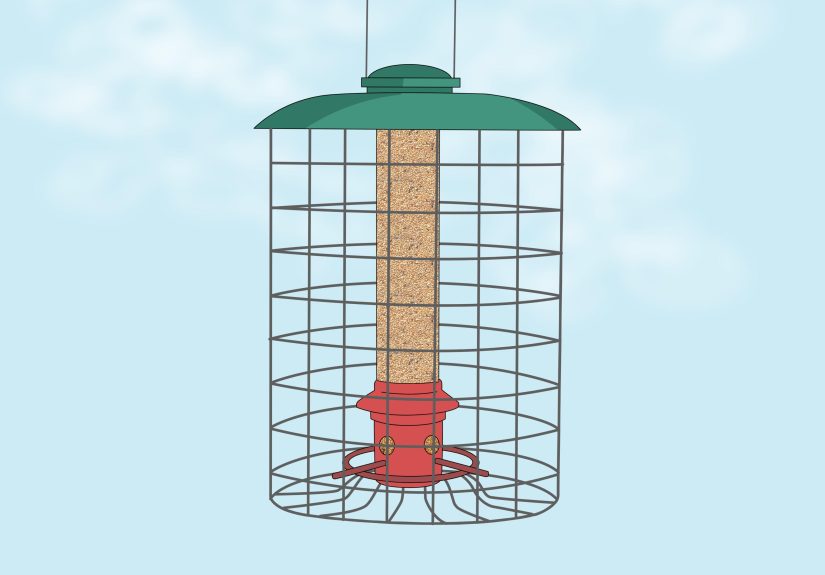
Another smart option is a feeder surrounded by a wire cage. The openings are large enough for smaller birds like chickadees, titmice, finches, and nuthatches, but too small for squirrels and some larger birds. If your goal is to protect seed for smaller visitors, cage systems can work beautifully.
This approach also helps if bully birds are part of the problem. Suddenly your backyard café becomes a reservation-only lounge, and the bouncer is made of metal.
Pick Durable Materials
Squirrels do not just steal seed. They chew. Plastic parts, soft lids, weak ports, and decorative but flimsy feeders often lose this battle. A metal feeder or a feeder with reinforced chew-resistant components usually lasts longer and performs better over time.
This matters because a damaged feeder quickly becomes a leaky feeder, and a leaky feeder becomes a ground buffet. Once that happens, squirrels may stop bothering with the ports entirely and just camp out below like they discovered curbside catering.
Know the Limits of “Squirrel-Proof” Marketing
Not every feeder labeled squirrel-proof will perform equally well in a real backyard. Some work brilliantly when mounted correctly. Others work until one determined squirrel treats the instructions as a personal challenge. Read the design, not just the label.
Look for features such as:
Weight-activated port closure, metal shrouds or cages, chew-resistant construction, secure lids, and compatibility with baffles or pole systems. A strong feeder works best as part of a whole setup, not as a lone superhero.
Way #3: Change the Menu and Clean Up the Evidence
If squirrels are obsessed with your bird feeder, your menu may be part of the problem. Some seeds are basically squirrel candy. Others are far less tempting while still attracting plenty of desirable birds.
Try Safflower Seed
Safflower is one of the best-known birdseed choices for reducing squirrel visits. Many favorite backyard birds will still eat it, including cardinals, doves, chickadees, titmice, nuthatches, and some finches. Squirrels, on the other hand, often show much less enthusiasm for it than they do for sunflower seed or peanuts.
That does not mean every squirrel in America signed the same contract. Some eventually learn to sample safflower. But many bird feeders see noticeably less squirrel traffic after making the switch or even offering a safflower-only feeder as part of the setup.
Consider No-Mess or Hulled Seed Blends
Another overlooked trick is reducing what lands on the ground. Hulled seed, hearts, chips, and cleaner blends leave less debris under the feeder. Less mess means fewer free snacks for squirrels, chipmunks, rats, and other opportunists.
If the floor under your feeder looks like a seed confetti parade after every refill, you are not just feeding birds. You are advertising.
Hot Pepper Seed Can HelpWith a Few Caveats
Some birdseed products are coated with chili pepper or capsaicin to deter mammals while remaining acceptable to birds. This can work for some yards, but results are mixed. In some cases it helps a lot. In others, squirrels seem to interpret the challenge as seasoning.
If you try hot-pepper-treated products, buy products designed for bird feeding rather than dumping random spices into the feeder like you are improvising a backyard taco recipe. Loose powders can blow around and irritate eyes. Use the product as directed and think of it as a supporting tactic, not your entire strategy.
Clean Feeders and Rake Underneath Them
This part is less glamorous than buying a fancy feeder, but it matters. Old seed, wet clumps, hull piles, and scattered debris attract squirrels and can create unhealthy conditions for birds. Clean feeders regularly, remove spoiled seed, and rake or sweep the area beneath them.
A tidy feeding station does two important things: it makes the area less rewarding for squirrels and helps reduce the spread of mold, bacteria, and disease among birds. That is one of those rare life moments where cleaning really does solve something.
Should You Give Squirrels Their Own Feeding Spot?
Sometimes, yes. Some backyard birders set up a separate squirrel feeding area far from bird feeders using corn or other squirrel-friendly foods. This will not work in every yard, and it can increase squirrel activity if poorly placed, but in some setups it redirects attention effectively.
If you try it, keep the squirrel station well away from bird feeders. The goal is redirection, not opening a second restaurant next door.
Common Mistakes That Make Squirrel Problems Worse
Hanging Feeders Too Close to Cover
If a squirrel can launch from something nearby, your feeder is not isolated enough.
Using Feeders That Spill Too Much Seed
Spillage feeds the ground crew, and the ground crew tells their friends.
Refilling Before Cleaning
Topping off old seed instead of cleaning the feeder first creates stale food, mold risk, and more mess below.
Trusting One Single Fix
The best squirrel deterrent is usually a combination of placement, hardware, and food choice. One tactic is helpful. Three tactics working together are far more convincing.
The Best Strategy Is a Layered One
If you are wondering which of these three ways to deter squirrels from bird feeders works best, the honest answer is: all of them together. Backyard success usually comes from stacking advantages.
Start with a pole and a baffle. Add a squirrel-resistant feeder. Switch to safflower or cleaner seed blends. Keep the ground tidy. Suddenly your yard becomes much less convenient for squirrels and much more enjoyable for birds.
That is the real secret. You are not trying to out-cute the squirrel. You are trying to out-design him.
Experience From the Backyard: What Actually Happens in Real Life
Anyone who has tried to deter squirrels from bird feeders knows the emotional journey. It starts with optimism. You hang a lovely feeder, pour in premium seed, step back with coffee in hand, and wait for a peaceful nature documentary to unfold. Within an hour, a squirrel drops in from a nearby branch like a furry action hero, clings to the feeder with all four limbs, and eats like he has a lunch meeting in ten minutes.
At first, many people assume the answer is buying a more expensive feeder. Sometimes that helps, but usually the real lesson comes later: location matters more than price. A basic feeder on a smart pole with a proper baffle often outperforms a fancy feeder hung in the wrong place. Backyard experience tends to humble us that way.
One common story goes like this: the feeder starts near the deck because that is where it looks nicest from the kitchen window. Birds come. Squirrels come faster. The homeowner tries clapping at the window. The squirrel pauses, makes eye contact, and continues eating with the calm confidence of someone paying rent. Then the feeder gets moved to a pole in open space, and suddenly the squirrel traffic drops. Not to zero, because squirrels are persistent little philosophers, but enough to feel like progress.
Another real-world lesson is that no single trick stays magical forever. Some people swear by safflower because their squirrels ignore it. Others discover their neighborhood squirrels eventually decide safflower is acceptable, especially when the usual sunflower buffet disappears. The same thing happens with hot-pepper-treated seed. In one yard it works beautifully. In another, the squirrels seem mildly annoyed but still willing to clock in. That is why layered strategy wins. If the menu does not discourage them, the feeder design might. If the feeder design is not enough, the baffle and spacing often finish the job.
Experience also teaches that spilled seed is basically a standing invitation. A yard may look squirrel-proof from above while the ground below tells a very different story. Once hulls, cracked seed, and dropped bits collect under the feeder, squirrels start treating the whole area like a picnic site. Raking up regularly may not be exciting, but it changes the behavior around the feeder more than many people expect.
Then there is the emotional reality: backyard bird feeding gets more fun when you stop expecting perfection. The goal is not to defeat every squirrel in a fifty-yard radius forever. The goal is to reduce the chaos enough that birds get a fair share, the feeder stays cleaner, and you do not feel personally outsmarted before breakfast.
Many experienced bird lovers eventually settle into a balanced mindset. They accept that squirrels are part of the ecosystem, but they also build systems that favor birds. They choose sturdier feeders, better poles, smarter seed, and cleaner routines. They laugh more, fuss less, and treat the occasional squirrel breakthrough as a reminder that wildlife is clever, not cruel.
And honestly, that may be the best experience-based lesson of all. The perfect backyard is not the one with no squirrel drama. It is the one where the birds still visit, the feeder still works, and you can enjoy the view without muttering, “How did you even get up there?” five times a day.
Conclusion
The best ways to deter squirrels from bird feeders are refreshingly practical. First, place feeders where squirrels cannot easily jump or climb to them, and use a proper baffle. Second, choose squirrel-resistant feeder hardware such as weight-activated or cage-style designs. Third, adjust the menu with safflower or cleaner blends and keep the feeding area clean so squirrels are not rewarded for hanging around.
Do those three things consistently, and your backyard birds have a much better chance of eating in peace. The squirrels will still be clever. They will still be athletic. They may still test your setup like tiny engineers with fluffy tails. But with the right system, they are far less likely to win the buffet war.





 Close
Close