
Table of Contents >> Show >> Hide
- First, Why Mars Landings Are So Ridiculously Hard
- The Big Picture: Perseverance EDL in One Breath
- Step 1: Entry Turning Speed Into Heat (On Purpose)
- Step 2: Parachute Deployment Supersonic, Because Mars Likes Drama
- Step 3: Heat Shield Separation Now the Rover Starts “Looking”
- Step 4: Backshell Separation Goodbye Parachute, Hello Rockets
- Step 5: Powered Descent Eight Rockets, One Job: Don’t Mess This Up
- Step 6: Sky Crane The Weirdest (And Smartest) Delivery Method Ever
- Step 7: “Touchdown Confirmed” The Delay That Makes Everyone Sweat
- What Perseverance Added (Compared to Earlier Rovers)
- Why Jezero Crater Was Worth the Risk
- EDL as a System: The Secret Sauce Is Redundancy and Margins
- Quick “Not Too Technical” Glossary
- of Real-World “Experience”: What It Feels Like to Follow a Mars Landing
- Conclusion
Landing a car-sized rover on Mars is like trying to parallel-park while falling off a cliff… except the cliff is space, the parking spot is an ancient crater,
the air is 1% as thick as Earth’s, and your steering wheel is 200 million+ miles away with an ~11-minute lag. In other words: the
Perseverance rover landing had to be fully autonomous, wildly precise, and just a little bit audacious.
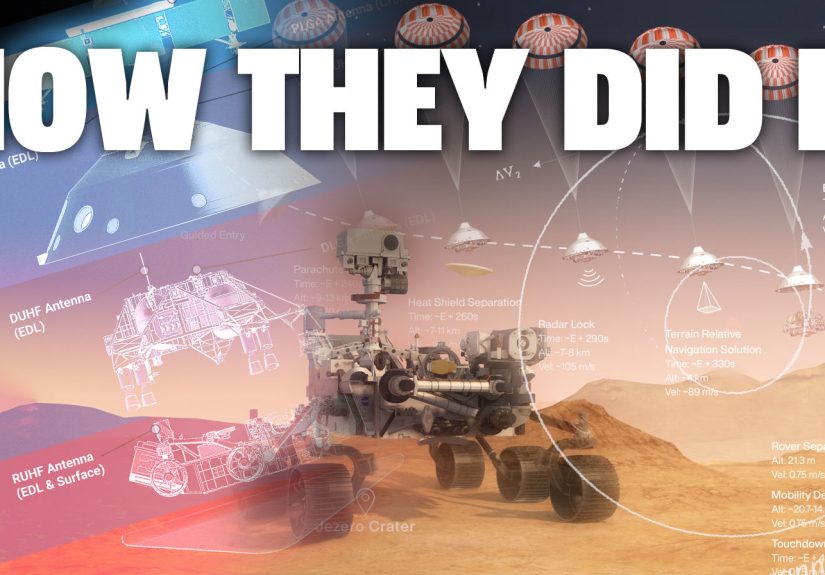
This article breaks down Perseverance’s Entry, Descent, and Landing (EDL)NASA’s famous “seven minutes of terror”in plain English,
with enough technical detail to satisfy your inner nerd, but not so much that your eyes do the Windows update reboot spiral.
First, Why Mars Landings Are So Ridiculously Hard
If Earth were a comfy pillow, Mars is more like a thin, crunchy tortilla chip. Its atmosphere is thick enough to heat you up during entry, but too thin to slow
a heavy spacecraft with a parachute all the way to a gentle landing. So NASA has to do a carefully choreographed combo move:
heat shield + parachute + rockets + sky crane.
And Perseverance didn’t have the luxury of landing somewhere flat and boring. It targeted Jezero Crater, a scientifically juicy ancient lakebed
with cliffs, dunes, rocks, and other things that love turning rovers into expensive lawn ornaments.
The Big Picture: Perseverance EDL in One Breath
Here’s the short version of Mars 2020 EDL:
- Entry: Hit the atmosphere fast, use the heat shield to survive, and steer like a spaceship with a plan.
- Parachute: Pop a giant supersonic chute at exactly the right moment.
- Radar + cameras: Figure out where you are and where the hazards are.
- Powered descent: Ditch the parachute, fire rockets, and slow way down.
- Sky crane: Hover and lower the rover on tethers for a soft touchdown.
- Flyaway: The descent stage zooms off to crash safely far away, like a responsible ex.
Step 1: Entry Turning Speed Into Heat (On Purpose)
Perseverance began EDL at the “top” of the Martian atmosphere roughly 81 miles (131 km) above the surface, screaming in at about
12,500 mph (20,000 kph). At that speed, the problem isn’t “how do we land?”it’s “how do we not become a brief, emotional shooting star?”
The spacecraft rode inside an aeroshell, which is basically a protective capsule made of two main parts:
the heat shield (front) and the backshell (rear). The heat shield’s job: absorb and shed insane heat as the atmosphere compresses
and forms a super-hot plasma around the vehicle. The goal is to convert speed into heat, and then dump that heat into space without dumping the rover into
the ground.
“Guided Entry”: Not Just Falling, But Flying a Little
Perseverance didn’t simply plunge straight down. It used a form of guided entrytilting and banking the aeroshell to generate a small amount of
lift. That lets the spacecraft steer, adjust its path, and reduce landing uncertainty. Think: less “leaf in the wind,” more “disciplined frisbee with a PhD.”
Step 2: Parachute Deployment Supersonic, Because Mars Likes Drama
Once atmospheric drag had done as much as it could, the next move was deploying a giant supersonic parachute.
This parachute is about 70.5 feet (21.5 meters) in diameterbig enough to make your neighborhood trampoline feel inadequate.
NASA’s published EDL descriptions note that the parachute deploys around 240 seconds after entry, at about
7 miles (11 km) altitude and roughly 940 mph (1,512 kph), then slows the vehicle to around 200 mph (320 kph).
That’s a huge slowdown… and still way too fast to land a rover without turning it into modern art.
Range Trigger: Deploying the Parachute at the Right Place, Not Just the Right Speed
One of Perseverance’s key upgrades was Range Trigger. Earlier missions used a more fixed sequence to pop the chute. Range Trigger
uses navigation estimates to choose the best deployment moment based on how the spacecraft is tracking toward the targethelping shrink the landing ellipse
(the “oops margin”) and improve accuracy.
Step 3: Heat Shield Separation Now the Rover Starts “Looking”
After the parachute had stabilized the descent, Perseverance dropped its heat shield. This is a big deal because it exposes the hardware
needed for the next phase: sensors that can see and measure the surface during descent.
Terrain-Relative Navigation: The Rover’s “Wait, Where Am I?” Moment
Another major upgrade was Terrain-Relative Navigation (TRN). Under parachute, the spacecraft took images of the ground and compared them to
onboard maps to estimate its position and avoid hazards. Instead of hoping the winds and atmospheric conditions deliver you to a safe patch of dirt,
TRN helps the system say, “Nope, that’s a boulder field,” and aim for something less… rock-forward.
TRN is one reason Perseverance could target Jezero’s riskier terrain more confidently than earlier rovers. In simple terms: it’s like your phone’s maps,
but with fewer coffee shops and more craters named after scientists.
Step 4: Backshell Separation Goodbye Parachute, Hello Rockets
Even with the parachute, Mars’s thin air can’t slow a heavy rover enough for landing. So at low altitude, the system cut the rover and descent stage free from
the backshell and parachute. This is the moment where it stops being “parachute landing” and becomes “rocket landing.”
Radar Comes Online: Measuring the Ground Like It Matters (Because It Does)
During powered descent, the spacecraft used radar to measure altitude and velocity relative to the ground. That data feeds the guidance system so it can control
the final approach, slow down smoothly, and time the last maneuver without guessing.
Step 5: Powered Descent Eight Rockets, One Job: Don’t Mess This Up
The descent stage (the rocket-powered “jetpack” on top) fired its engines to slow the spacecraft dramatically. This phase is all about control:
managing thrust, keeping the vehicle stable, and steering toward a safe touchdown point.
The landing system is designed to handle uncertainty: atmospheric density variations, winds, and the fact that Mars does not provide customer support.
Powered descent gives NASA the ability to make last-second correctionsbecause “close enough” is not a real landing strategy.
Step 6: Sky Crane The Weirdest (And Smartest) Delivery Method Ever
If you’ve heard of the sky crane, you already know it sounds like a prank someone pitched during a meeting:
“What if we hover and lower the rover on cables like a sci-fi crane game?”
And then NASA said: “Yes. That. Exactly that.”
Why Not Just Land the Whole Thing?
Because rockets kick up dust and debris, and landing on legs can be unstable on uneven terrainespecially when you’re hauling a rover that needs to drive away
immediately. The sky crane keeps the rocket exhaust higher above the surface while the rover touches down on its own wheels.
How the Sky Crane Touchdown Works
- The descent stage hovers above the surface.
- Perseverance is lowered on tethers (and an umbilical for data/power) until its wheels touch the ground.
- Sensors detect touchdown and confirm the rover is stable.
- The tethers are cut.
- The descent stage flies away and intentionally crashes at a safe distance.
The result is a rover that lands already upright, already on wheels, and already ready to rolllike a very expensive Uber drop-off with a dramatic exit.
Step 7: “Touchdown Confirmed” The Delay That Makes Everyone Sweat
While Perseverance was doing all of this, mission control on Earth was watching telemetry that was already minutes old.
With an Earth–Mars light-time delay of roughly 11 minutes during the landing, engineers couldn’t joystick the rover down. They had to trust
years of testing, simulation, and design margins.
That’s why “seven minutes of terror” is less about melodrama and more about math: a short, intense window where thousands of events must happen on cue,
autonomously, with no do-overs.
What Perseverance Added (Compared to Earlier Rovers)
Perseverance’s landing system built on the architecture proven by Curiosity, but it included meaningful upgrades aimed at landing more precisely in a riskier place:
- Terrain-Relative Navigation (TRN): Onboard image matching to avoid hazards and land more safely.
- Range Trigger: Smarter parachute deployment timing for better targeting and a smaller landing ellipse.
- Extensive EDL cameras: A camera suite captured parachute deployment, descent, and sky crane footagehelpful for both science and making everyone on Earth say “WHOA.”
- More entry data: Instrumentation gathered detailed entry measurements to improve models for future missions.
Why Jezero Crater Was Worth the Risk
Jezero is an ancient crater that once held a lake and river deltaexactly the kind of environment that could have preserved signs of past microbial life.
The whole mission concept is tied to that: explore a place that was once habitable, analyze rocks up close, and collect samples for possible return to Earth.
Landing safely in Jezero meant Perseverance could start its scientific work where the story is most interestingrather than where the parking is easiest.
EDL as a System: The Secret Sauce Is Redundancy and Margins
It’s tempting to describe the landing as a single stunt. It’s not. It’s a system-of-systems problem: thermal protection, aerodynamics, parachute dynamics,
radar sensing, computer vision, propulsion, and fault protection all have to work together.
NASA engineers design these sequences with testing, simulations, and conservative margins because Mars doesn’t let you troubleshoot mid-fall.
If something is off by a littletiming, altitude, speed, attitude“a little” becomes “a crater with your name on it.”
Quick “Not Too Technical” Glossary
- EDL: Entry, Descent, and Landingthe whole landing sequence.
- Aeroshell: The protective capsule (heat shield + backshell) around the rover during entry.
- Heat shield: The part that takes the heat during atmospheric entry.
- Backshell: The rear part that carries the parachute and supports descent until separation.
- Supersonic parachute: A parachute that deploys while moving faster than sound.
- Range Trigger: A method to time parachute deployment based on where you are, not just how fast you’re going.
- Terrain-Relative Navigation (TRN): Camera-based navigation that compares descent images to maps to avoid hazards.
- Sky crane: A rocket platform that lowers the rover on tethers for a wheels-down landing.
of Real-World “Experience”: What It Feels Like to Follow a Mars Landing
Even if you’re not in mission control (most of us are tragically not), there are a bunch of “experience” angles that make Perseverance’s landing feel weirdly personal.
First, there’s the collective suspense of watching a live broadcast where the most important moments are already over, but nobody on Earth knows the outcome yet.
That time-delay twist changes the vibe: it’s not a sports game where your shouting might “help.” It’s more like opening a group text that’s been traveling through space
for 11 minutes, carrying either the best news ever or a heartbreak emoji made of physics.
Then there’s the emotional whiplash of how normal the spacecraft’s decisions look when you see them broken into milestones.
“Heat shield separated.” “Parachute deployed.” “Powered descent.” It reads like a tidy checklist, the way baking instructions make soufflé seem casual.
But once you understand the why behind each stepthin atmosphere, high speed, hazards, autonomyyou start appreciating the landing as a carefully balanced stack of
engineering compromises. Mars basically forces you into a multi-tool approach: you can’t be all parachute, and you can’t be all rockets, so you build a hybrid and
test it until your simulations have simulations.
A surprisingly fun experience is using interactive mission visualizations (the kind that let you replay EDL and rotate the camera) because it changes your mental
model from “a rover fell out of the sky” to “a spacecraft executed a plan.” Watching the sky crane sequence in particular tends to trigger the same reaction in
almost everyone: a half-laugh, half-gasp, as if you just saw someone deliver a priceless vase by dangling it from a drone. It also makes you notice details you’d
otherwise misslike how quickly events have to happen, and how often Perseverance has to separate from something (heat shield, backshell, parachute, tethers) like
it’s trying to speedrun a breakup playlist.
Finally, there’s the “try it on Earth” inspiration. Not “build a Mars lander in your backyard” (please do not), but the mindset: break a hard problem into phases,
add sensors, add redundancy, and design for what can go wrongnot just what should go right. Teachers use EDL to explain feedback loops and autonomous control.
Hobbyists make tiny paper parachutes to understand drag. Coders build simple simulations to see how timing changes outcomes. And honestly, that’s the most human
part of the story: a rover landing becomes a shared lesson in planning, patience, and daring mighty thingswithout needing a rocket in your garage.
Conclusion
Perseverance landed on Mars by turning chaos into choreography: guided entry to survive the heat, a supersonic parachute to shed speed, smart navigation to avoid
hazards, rockets to take control near the ground, and a sky crane to place the rover gently on its wheels. It’s a technical masterpiece that’s also oddly relatable:
when the environment is unforgiving and the stakes are high, you don’t rely on one trickyou build a system that adapts, checks itself, and sticks the landing.






 Close
Close