
Table of Contents >> Show >> Hide
- What Exactly Is This Train?
- How A Hydrogen Train Actually Works
- Why Supercaps Matter More Than The Headline Suggests
- Why Not Just Use Batteries?
- The Biggest Advantage: Freedom From Wires
- But There Is A Catch. Actually, Several.
- How China’s Train Fits Into The Global Race
- What This Means For The Future Of Clean Rail
- Experience Section: What Riding A Hydrogen-And-Supercap Train Might Actually Feel Like
- Conclusion
China has built its reputation in rail by doing things at full send: longer networks, faster trains, bigger stations, and enough sleek noses to make an airport jealous. So when headlines popped up about a 100 mph hydrogen train, the story sounded a little odd at first. After all, in a country famous for bullet trains cruising far beyond that speed, 100 mph is not exactly a bragging-rights number. But that misses the point. This train is not trying to dethrone China’s ultra-fast electric fleet. It is trying to solve a different problem entirely.
The real headline is this: China’s rail industry has been testing a future where certain trains can run without diesel and without overhead wires, using hydrogen fuel cells for steady power and supercapacitors for fast bursts of energy. That combination is clever, practical, and just geeky enough to make transportation nerds sit up straighter in their seats.
In other words, this is not a story about replacing every conventional train tomorrow. It is a story about what comes next on routes where full electrification is expensive, diesel is dirty, and batteries alone may not be the perfect fit. And yes, it is also a story about a train that basically says, “What if I drank hydrogen, stored braking energy like a squirrel hoarding acorns, and still showed up to work at 100 mph?”
What Exactly Is This Train?
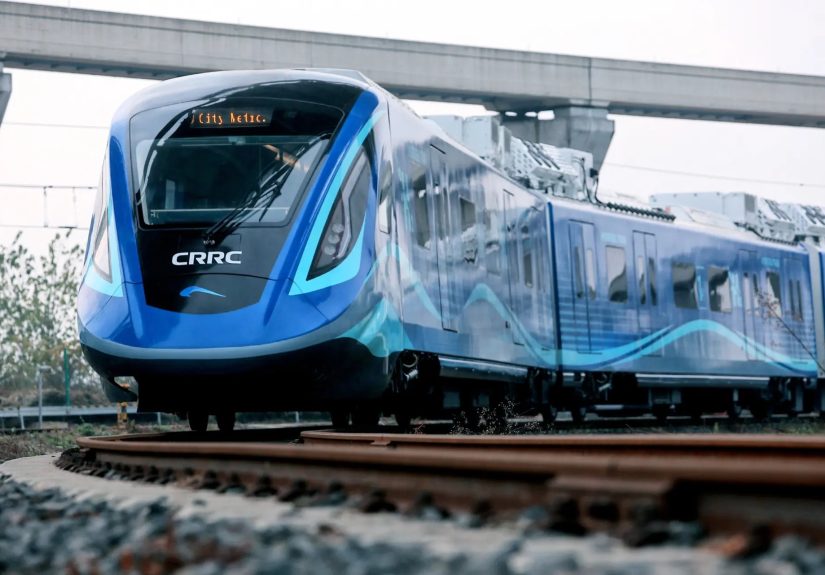
The version that grabbed global attention was a four-car Chinese passenger train developed by CRRC and reported with a top speed of 160 km/h, or roughly 100 mph. It was described as a hydrogen-powered passenger train using a supercapacitor buffer, with a reported range of around 600 kilometers on one fill. That alone made it stand out. Hydrogen-powered rail is still a niche technology, and pairing it with supercapacitors gave the project a more advanced hybrid architecture than a simple “hydrogen in, train goes zoom” headline suggests.
Then the broader idea kept evolving. Later Chinese disclosures around the CINOVA H2 concept pushed the hydrogen-train conversation further, with claims of a higher top speed, longer range, quicker refueling, and stronger suitability for non-electrified intercity routes. So while the 100 mph story made the splash, the bigger takeaway is that China is using hydrogen rail as a platform for a much larger experiment in zero-tailpipe-emission passenger transport.
That matters because rail decarbonization is not one-size-fits-all. Some lines are already electrified and should stay that way. Some can be upgraded with batteries. But some corridors are harder, messier, or more expensive to wire up. That is where hydrogen keeps sneaking back into the room like the engineering student who knows the assignment is ugly but still has a working prototype.
How A Hydrogen Train Actually Works
At the heart of the system is the hydrogen fuel cell. Instead of burning fuel in the classic smoky, noisy, combustion-heavy way, a fuel cell uses an electrochemical reaction between hydrogen and oxygen to produce electricity. The main direct byproducts are water and heat. That is why hydrogen trains get so much attention: at the point of use, they can run with no diesel exhaust and none of the usual soot and particulate drama that comes with internal combustion.
The electricity from the fuel cell powers the train’s traction system and onboard systems. In simple terms, hydrogen is the energy carrier, the fuel cell is the power plant, and the train’s motors do the hard work of moving a lot of steel and a lot of people from one place to another.
But fuel cells have a personality quirk. They are great at delivering steady power. They are not always ideal when a vehicle suddenly demands a big burst of energy, like during acceleration or when climbing grades. That is where the second half of this story enters the station.
Why Supercaps Matter More Than The Headline Suggests
The phrase “runs on hydrogen and supercaps” sounds like a sci-fi beverage order, but it is really an elegant division of labor. Hydrogen fuel cells provide the sustained energy. Supercapacitors handle the fast, high-power moments.
Unlike batteries, supercapacitors are designed to charge and discharge extremely quickly. They are excellent for absorbing energy during regenerative braking and releasing it back during acceleration. That means when the train slows down, some of that otherwise-wasted kinetic energy gets captured instead of disappearing as heat. Then, when the train needs a quick shove to get moving again, the supercapacitors can deliver power almost instantly.
This setup gives engineers several advantages. First, it reduces stress on the fuel cell because the fuel cell does not have to handle every sudden spike in demand. Second, it improves efficiency by reusing braking energy. Third, it can reduce wear on other energy-storage components by letting each part do the job it does best.
Think of the fuel cell as the marathon runner and the supercapacitor as the sprinter. One is great at going the distance. The other is great at explosive effort. Put them together and you get a train that is far more flexible than either technology would be on its own.
Why Not Just Use Batteries?
That is the obvious question, and it is a good one. Batteries are getting better, cheaper, and more common in transportation every year. On some routes, battery-electric rail absolutely makes sense. If the line is short enough, charging is manageable, and the duty cycle is predictable, batteries can be a strong option.
But rail is not a single use case. Passenger loads vary. Distances vary. Climate varies. Infrastructure budgets definitely vary. On non-electrified routes where long range matters and quick turnaround is valuable, hydrogen can look attractive because refueling is faster than charging large battery packs and because the onboard energy can be carried without the same weight tradeoffs that massive batteries sometimes bring.
That does not make hydrogen the universal winner. It just makes it potentially useful in the parts of the rail map where full electrification is too costly and pure batteries are less convenient. In fact, even U.S. transportation and energy discussions around hydrogen rail have often pointed to passenger trains and shorter-range operations as the most realistic near-term use cases.
The Biggest Advantage: Freedom From Wires
Conventional rail electrification is proven, efficient, and excellent where it exists. But installing overhead catenary systems is expensive and disruptive. It is not just the wires. It is also substations, clearances, bridges, tunnels, power integration, and the delightful paperwork mountain that every major infrastructure project seems to grow like a houseplant left in radioactive sunlight.
Hydrogen trains offer a different path. They can bring some of the environmental benefits of electrified rail without requiring full route electrification. That makes them especially interesting for regional, suburban, and intercity services running beyond existing wired networks.
For China, that opens a strategic opportunity. The country already dominates in conventional electric rail, so hydrogen is not replacing that strength. It is extending it into places where diesel still hangs around because wiring every kilometer is not always the most practical move. If a hydrogen-supercapacitor train can deliver clean operation, decent range, fast refueling, and good passenger capacity, it becomes a useful tool rather than a novelty.
But There Is A Catch. Actually, Several.
Hydrogen transportation stories often arrive dressed like superheroes, so it is worth handing this one a little realism. A hydrogen train can be zero-emission at the point of use, but that does not automatically make the full system green. Everything depends on how the hydrogen is produced, transported, stored, and dispensed.
If the hydrogen comes from fossil-fuel-heavy production without serious carbon controls, the environmental halo gets dimmer. If the delivery infrastructure is sparse, fueling becomes complicated and expensive. If safety standards and equipment certification are still developing, deployment slows down. And if the economics do not beat diesel, batteries, or catenary electrification in the real world, operators will not adopt it just because the train looks futuristic in press photos.
That is one reason hydrogen rail remains so interesting: it is not a settled story. It sits in the space between promising and proven. There are credible technical reasons to pursue it, especially for routes that are hard to electrify. There are also real questions about cost, infrastructure, regulation, and scale.
How China’s Train Fits Into The Global Race
China is not alone in hydrogen rail. Europe has been the early headline-maker, especially with Alstom’s hydrogen passenger trains in Germany and ongoing work by other manufacturers. In that global context, China’s 100 mph hydrogen train mattered because it suggested the country was not content to lead only in conventional electrified rail. It wanted a seat at the table in the next wave of alternative propulsion too.
And China did not stop with one neat prototype headline. Later hydrogen-train announcements around the CINOVA H2 suggested a much bolder ambition: higher speed, longer range, larger passenger counts, lighter structures, smarter maintenance systems, and faster refueling. In plain English, China appears to be treating hydrogen rail not as a science-fair side project but as a serious branch of future rolling-stock development.
That does not mean hydrogen trains will dominate the future. It does mean the technology is being pushed by one of the world’s biggest and most capable rail ecosystems. And when a country that already knows how to build rail at scale starts experimenting seriously with hydrogen and hybrid energy storage, the rest of the industry tends to pay attention.
What This Means For The Future Of Clean Rail
The smartest way to read this story is not as “hydrogen will replace everything.” It is as “rail systems are diversifying their clean-energy toolbox.” Electrified high-speed rail will remain the gold standard on heavily used corridors. Batteries will grow on shorter and more predictable routes. Hydrogen may find its sweet spot on lines where range, flexibility, and lack of overhead wires make it compelling.
The use of supercapacitors is especially important because it shows how advanced rail systems are thinking beyond simple fuel swaps. The best low-emission designs combine technologies. They mix steady power sources, rapid-response storage, regenerative braking, digital monitoring, and route-specific engineering. That is less romantic than saying “the future is hydrogen,” but it is far more believable.
So yes, China’s 100 mph hydrogen-and-supercaps train is impressive. Not because 100 mph is dazzling in a country full of faster trains, but because it shows how a mature rail giant is tackling the stubborn parts of decarbonization. And frankly, the stubborn parts are where the most important engineering usually lives.
Experience Section: What Riding A Hydrogen-And-Supercap Train Might Actually Feel Like
If you have ever ridden a diesel regional train, you know the experience comes with a sensory package. There is the engine rumble, the occasional vibration through the floor, the smell that says, “Yes, this machine definitely burns something,” and the general feeling that the train is doing honest mechanical labor. A hydrogen-and-supercapacitor train would likely feel different in ways passengers would notice almost immediately.
The first change would be sound. Fuel-cell systems tend to be quieter than traditional diesel propulsion, so the ride could feel calmer, especially during station departures. Instead of a loud mechanical growl, passengers might hear more of the rail itself: the contact with the track, the soft hum of auxiliary systems, the whoosh of doors, the muffled conversation of someone unwrapping a snack far louder than they think they are. In passenger terms, that quieter atmosphere matters. It makes a train feel more modern, even before anyone explains the engineering.
The second noticeable difference could be smoothness during acceleration. Because supercapacitors can deliver power quickly, launches from stations may feel responsive and clean rather than sluggish. On a well-tuned system, the train should not feel like it is gathering itself for a dramatic effort. It should simply move, with fewer hesitations and less mechanical strain. For commuters, that translates into a ride that feels less like an industrial compromise and more like a deliberately designed experience.
There is also a psychological layer to the trip. Passengers today are increasingly aware of how transportation affects cities, air quality, and climate goals. Riding a train that emits water at the point of use and captures braking energy for reuse would give the journey a different emotional texture. It would not just feel efficient. It would feel intentional. The technology becomes part of the passenger experience even when you cannot see it directly.
Then there is the infrastructure effect. On lines without overhead wires, a hydrogen train could preserve cleaner operation without covering every view in catenary equipment. That may not sound dramatic, but on regional routes, scenic areas, or older corridors, the visual simplicity can be part of the appeal. A passenger may not know the phrase “non-electrified network strategy,” but they do know when a route feels lighter, quieter, and less cluttered.
Of course, the experience would not be magical by default. If hydrogen supply is unreliable, if maintenance systems are immature, or if operators treat the train as a marketing prop instead of a dependable service vehicle, passengers will notice that too. Nobody boards a train thinking, “I hope this propulsion architecture wins an innovation award.” They board thinking, “Please be clean, on time, comfortable, and not weird in a bad way.”
That is why the real experience test is not the first unveiling. It is repeated daily service. Can the train refuel quickly enough to stay in rotation? Can the hybrid energy system perform in heat, cold, and rush-hour stop-and-go duty? Can operators maintain safety without creating complexity that eats away at the climate and cost benefits? Those practical details decide whether a hydrogen train becomes a useful part of public transport or just a beautiful engineering flex.
Still, if China and other rail builders get this formula right, the passenger experience could be genuinely compelling: lower noise, cleaner operation, strong acceleration, and modern performance on routes that would otherwise stay stuck with diesel. That is not science fiction. That is what transportation progress usually looks like when it finally leaves the lab and starts carrying people to work, school, dinner, and the occasional regrettably early morning meeting.
Conclusion
China’s new 100 mph hydrogen-and-supercapacitor train is not merely a flashy transportation headline. It is a sign that rail decarbonization is becoming more sophisticated. Instead of betting everything on one technology, engineers are combining hydrogen fuel cells, regenerative braking, and fast-response supercapacitors to solve a real-world problem: how to run cleaner trains on routes that are not easy or cheap to electrify.
That makes this train more than a curiosity. It is a case study in how the future of rail may actually unfold: not with one perfect solution, but with smart hybrids designed for specific jobs. China already mastered one version of modern rail with its electric high-speed network. This project suggests it now wants to master the next chapter too. And if the system proves reliable, affordable, and scalable, the rest of the industry may find itself borrowing a few pages from that playbook.





 Close
Close