
Table of Contents >> Show >> Hide
- What “confidence” is really measuring (and why it’s messy)
- The dip: what’s behind the mood shift?
- Why it could be worse: the “soft landing… with potholes” case
- “The economy” vs. “my economy”: why your neighbor might feel totally different
- What would make confidence rebound (or slide further)?
- How to think about a confidence dip without spiraling
- Experiences from the real world: what a confidence dip feels like (composite snapshots)
- Bottom line
If the economy were a group chat, “confidence” would be the friend who leaves on read for three days, then pops back in with
a meme and a “lol I’m fine.” That’s roughly where Americans are right now: not exactly optimistic, not exactly panickingmore
like cautiously side-eyeing the future while still ordering takeout and renewing streaming subscriptions.
Recent confidence readings suggest the national mood has softened. But here’s the twist: even with the dip, the situation
doesn’t scream “incoming doom.” It looks more like “people are tired of surprises”prices that won’t behave, job headlines
that keep getting weird, and a general sense that the economic weather app says “partly cloudy with a chance of plot twists.”
What “confidence” is really measuring (and why it’s messy)
“Confidence” sounds like a single thinglike you can pour it into a measuring cup and declare the economy 1.5 cups sturdy.
In reality, it’s a bundle of perceptions: how people feel about their jobs, their bills, their future paychecks, and whether
now is a decent time to buy anything larger than a burrito.
Two of the most-watched gauges are the Conference Board’s Consumer Confidence Index and the University of Michigan’s consumer
sentiment survey. They don’t always move in syncbecause Americans don’t always think in sync. (If you’ve ever watched a family
debate whether “we can afford this vacation,” you already understand macroeconomics.)
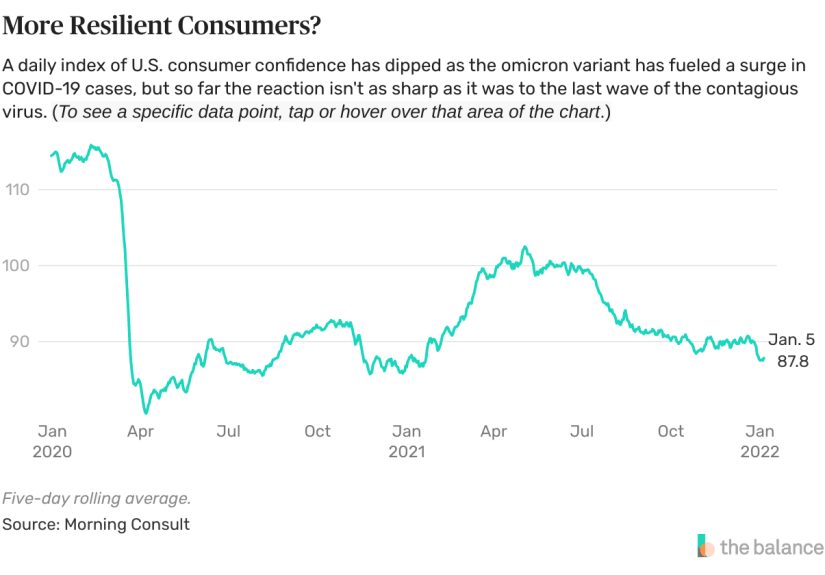
In late January, the Conference Board reported a sharp drop in consumer confidence, hitting its lowest level in more than a decade.
In early February, the University of Michigan’s preliminary sentiment reading improved modestly and reached a six-month high.
Translation: one thermometer says “fever,” the other says “slightly less fever.” Both can be true, because different surveys ask
different questions and capture different slices of household reality.
The dip: what’s behind the mood shift?
1) Inflation fatigue (a.k.a. the “why is everything still expensive?” era)
Even when inflation slows, people remember the price level. A gallon of gas or a grocery run doesn’t need to keep rising fast to
feel painfulit just needs to stay high. Recent inflation data has shown improvement compared with peak years, but households are
still feeling pressure in sticky categories like food and shelter-related costs. That wear-and-tear matters because confidence is
emotional math: it’s less about what economists celebrate and more about what shows up on a receipt.
Expectations play a starring role here. Surveys show Americans remain sensitive to any sign that inflation could re-acceleratewhether
from energy, supply disruptions, or policy shocks like tariffs. When people suspect prices might jump again, they don’t just worry;
they delay purchases, downgrade plans, and become more skeptical about “better times ahead.”
2) The job market is “fine”… until you’re the one job-hunting
A stable unemployment rate can coexist with a softer hiring vibe. Recent labor-market data has pointed to cooling demand for workers,
including a notable decline in job openings from earlier highs. That doesn’t automatically mean layoffs are everywherebut it can make
job switching harder, reduce negotiating power, and increase anxiety for younger workers and those without specialized experience.
This is where confidence gets personal. For someone securely employed, the economy may feel “okay-ish.” For someone trying to land a
first job, re-enter the workforce, or hop to a higher-paying role, it can feel like the music slowed down and the chairs are farther apart.
3) Financial markets and “headline whiplash”
Confidence doesn’t live in a vacuum; it shares a studio apartment with headlines. Stock market volatility can affect higher-income households
more directly, but the broader cultural effect hits everyone: a nervous media cycle can make people feel like something is “about to happen,”
even when the underlying data is mixed.
Add in uncertainty about interest rateswhether borrowing costs are headed down, flat, or back upand people hesitate. Big purchases (homes,
cars, renovations, business expansions) are basically confidence decisions with monthly payments attached.
Why it could be worse: the “soft landing… with potholes” case
If you only looked at confidence surveys, you might assume the economy is tumbling down a staircase. But other indicators suggest a more nuanced
story: growth that’s still positive, inflation that has moderated compared with earlier peaks, and a Federal Reserve that’s watching both jobs and
prices with a “do not touch the thermostat unless you’re sure” posture.
1) Growth hasn’t vanishedpeople are just less sure about it
Several mainstream outlooks entering 2026 leaned toward continued expansion rather than an imminent recession, though with meaningful risks.
That matters because confidence can fall even when the economy is growingespecially when people feel the gains aren’t evenly shared or the future
feels unusually uncertain.
2) The Fed isn’t in emergency mode
The Federal Reserve’s recent communications have emphasized a data-dependent approach, aiming to bring inflation closer to target while preserving
a healthy labor market. Policymakers have acknowledged that inflation remains above goal and that uncertainty is elevated, but the tone has been more
“cautious management” than “fire alarm.” Some Fed officials have highlighted vulnerabilities in the labor market, while others have expressed cautious
optimism about growth and disinflation trends.
3) Small businesses aren’t waving a white flag
Small businesses often act like an economic early-warning systembecause they feel cost pressures quickly and hire carefully. Recent small business
readings have shown optimism hovering around long-run norms, with uncertainty easing from prior highs. That doesn’t mean owners are throwing confetti.
It means they’re still operating, still planning, and still trying to make payroll work in a world where customers are value-hunting harder than ever.
“The economy” vs. “my economy”: why your neighbor might feel totally different
One reason confidence surveys can look chaotic is that the economy has been unusually uneven. Higher-income householdsespecially those with meaningful
stock exposurecan experience rising asset values and feel more stable. Lower-income households, renters, and people without financial cushions can feel
squeezed even when national averages look okay.
That split shows up in sentiment data: some groups report improvement while others remain stuck in “dismal” territory. It’s not a contradiction; it’s
an economy with multiple realities running at the same time. In that world, a national confidence dip may be less a forecast of recession and more a
signal that many households still don’t trust the runway.
What would make confidence rebound (or slide further)?
Things that could lift the mood
- Clearer inflation progress in the categories people feel weeklyfood, rent-related costs, utilities, insurance.
- More breathing room on interest rates if inflation cools enough to allow more cuts without spooking price expectations.
- Labor market stabilitynot just fewer layoffs, but better hiring momentum for people trying to move up.
- Less policy uncertainty around trade rules, taxes, and consumer costs.
Things that could drag confidence down
- A re-acceleration of inflation or a new shock that pushes essentials higher.
- A sharper labor market slowdown that turns “harder to find a job” into “harder to keep a job.”
- Financial market stress that bleeds into household decisions and business investment.
- Another round of “surprise” costshigher insurance premiums, rent spikes, or energy price jumps.
How to think about a confidence dip without spiraling
Confidence is useful, but it’s not destiny. A dip can mean “people are cautious,” not “people are doomed.” In practical terms, this is a season for
steady decisions: keep your options open, avoid locking yourself into fragile monthly payments, and treat headlines like hot saucesmall amounts add
flavor; too much ruins the meal.
For households
- Do a “subscription audit”: confidence falls fastest when fixed expenses feel out of control.
- Stress-test big purchases: if rates fall later, greatdon’t assume it; plan for “same as now.”
- Build a “small emergency buffer”: even one month of essentials changes how scary the future feels.
- Focus on income resilience: skills upgrades, side work, networkingboring, yes; powerful, also yes.
For small businesses
- Lean into value: cautious consumers still spendthey just demand a reason.
- Watch cash conversion: inventory and receivables can quietly strangle confidence inside a business.
- Scenario plan: “best case, base case, worst case” beats “hope and vibes.”
Experiences from the real world: what a confidence dip feels like (composite snapshots)
To make this less abstract, here are a few composite “on-the-ground” snapshots that reflect the kinds of situations showing up in consumer sentiment
and business surveys. These are not individual stories; they’re stitched together from common patterns many households and owners report when confidence
softensespecially during periods of sticky prices and uncertain hiring.
The grocery recalibration. A couple in the Midwest used to shop with a list. Now they shop with a calculator. They haven’t stopped buying
the things they like, but they’ve become strategic: store brands for staples, fewer impulse snacks, and a new ritual of checking unit prices like it’s a
competitive sport. Their confidence didn’t collapse overnight; it eroded through a thousand tiny momentslike realizing “quick dinner” now costs what a
sit-down meal used to cost. They still believe the economy is “okay,” but they no longer trust that prices will behave next month, so they keep their guard up.
The job search that takes longer than it should. A recent graduate on the East Coast keeps hearing, “You’re a strong candidate,” which is
hiring-manager code for “we’re not sure we’re hiring.” Friends who graduated two years earlier found jobs quickly; now the process feels slower, with more
interviews, more waiting, and more “we paused the role.” This is how a labor market can look stable in the aggregate while feeling shaky up close. Confidence
dips when people sense fewer doors are openeven if the building isn’t on fire.
The homeowner who wants to renovate… but doesn’t love the math. A family in the South has a kitchen that screams “2011.” They want to redo it,
but financing costs still make them hesitate. They can afford the project, yet they don’t want to lock in a payment that feels like it belongs in a different
decade. So they patch instead of overhaul: paint cabinets, replace hardware, upgrade lighting. The economy, to them, is a series of “maybe later” decisions.
It’s not fear; it’s cautionand caution shows up as lower confidence.
The small business owner who’s optimistic… with an asterisk. A café owner in a suburban strip mall says sales are “fine,” which means:
weekends are strong, weekdays are choppy, and customers are more price-sensitive. They’ve learned that raising menu prices too quickly triggers instant pushback.
Instead, they add a combo deal and promote a “value breakfast” to keep traffic steady. They’re not gloomy; they’re adaptive. But confidence is no longer a smooth,
upward line. It’s a zigzag: hope when foot traffic rises, anxiety when a supplier invoice jumps, relief when payroll clears.
The “K-shaped” feeling. Two neighbors compare notes. One works in a sector tied to markets and says their retirement account finally looks healthier.
The other rents and says their renewal offer feels like a prank. Both are telling the truth. This is why confidence can be low even when parts of the economy are
doing well: prosperity is louder when you have it, but stress is more persistent when you don’t. When confidence dips, it often reflects not just the level of economic
activity, but the distribution of comfort.
The cautious splurge. A family decides to take a short vacation anywaytwo nights, not a week. They drive instead of flying, cook one meal in the hotel,
and still go to the aquarium because the kids will remember it. This is modern consumer behavior in a confidence dip: people don’t stop living; they optimize living.
They substitute, they bargain-hunt, they look for “small joys” that don’t wreck the budget. It’s a reminder that lower confidence doesn’t automatically mean a collapse in
spendingit often means smarter, more selective spending.
These snapshots explain the headline: confidence can dip while the economy keeps moving. People aren’t necessarily forecasting disaster. They’re navigating an environment
where the cost of being wrong feels higherso they demand more certainty before they commit.
Bottom line
Confidence has dipped, and the reasons are understandable: lingering price pressure, softer hiring signals, and a steady drumbeat of uncertainty. But it could be worse
because the broader economy still shows resilience, policymakers aren’t acting like the sky is falling, and many households and businesses are adjusting rather than freezing.
The most honest read is this: Americans aren’t giving upthey’re just negotiating with the future, and they’d like it to stop changing the terms mid-conversation.






 Close
Close