
Table of Contents >> Show >> Hide
- Why Dave Herman Thinks the Sketch Still Hits
- MADtv Was Built for Meaner, Sharper Satire
- What the “Epstein Files Age” Really Means
- Why the Sketch Still Feels Current
- The Secret Weapon of the Sketch: It Makes the Audience the Judge
- Why Old Satire Can Feel Newer Than Today’s News
- The Experience of Watching This Sketch Now
- Conclusion
Some comedy sketches expire the minute the headlines change. They are the comic equivalent of supermarket sushi: technically still there, spiritually gone. And then there are the rare sketches that keep coming back like a stubborn political scandal, looking somehow fresher every time the culture gets more absurd.
That is the strange little miracle behind Dave Herman’s recent argument that one classic MADtv political sketch still feels painfully current in what he called the “Epstein files age.” The phrase is loaded, of course, but Herman’s point is actually simple. The sketch was never just about one scandal, one politician, or one decade. It was about projection, panic, denial, and the eternal spectacle of powerful people telling on themselves while trying very hard not to.
That is why the bit still lands. Not because history repeats itself in neat little loops, but because public hypocrisy remains one of America’s most renewable energy sources. Give it an office, a microphone, a hearing room, and a little moral grandstanding, and it practically powers itself.
Why Dave Herman Thinks the Sketch Still Hits
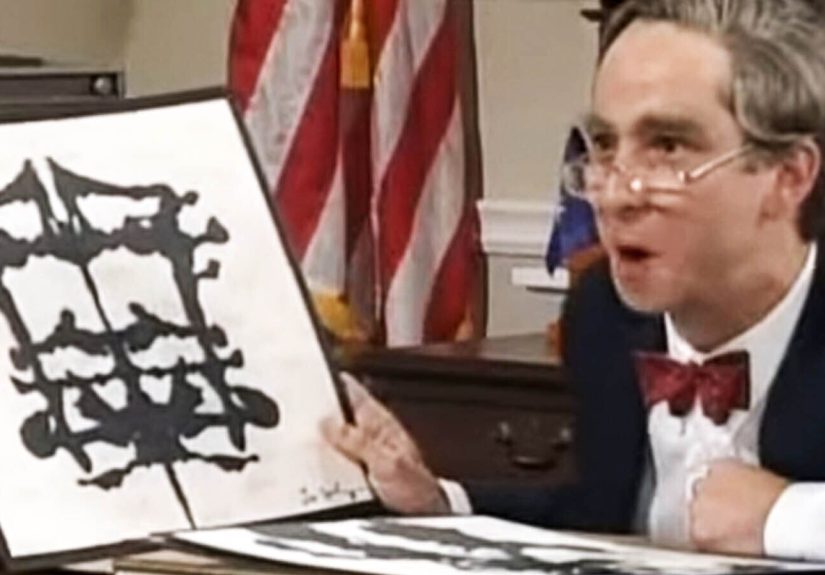
In the sketch Herman revisited, Orlando Jones plays an artist seeking a government arts grant. Herman plays a puffed-up senator evaluating the work. The setup is elegant: the artist presents ambiguous images, and the senator keeps seeing deeply incriminating meanings in them. Nobody forces him to say the quiet part out loud. He volunteers it. Repeatedly. Like a man stepping onto a rake and then filing a formal complaint against gravity.
The joke is not merely that the senator is prudish. It is that he reveals an alarming inner monologue while pretending to defend public decency. Every reaction is less an interpretation of art than an accidental confession. The more determined he becomes to prove his own righteousness, the more suspicious he looks. By the end, the audience is not laughing at a misunderstanding. They are laughing at a very recognizable pattern: the louder the denial, the shakier the innocence sounds.
That is the part Herman says still feels relevant now, and he is right. A sketch like this does not survive because it predicted a specific document dump or a particular political media frenzy. It survives because it understood the performance of power. It knew that when people in high places feel threatened, they often over-explain, overreact, and overplay their moral outrage until it becomes its own punchline.
MADtv Was Built for Meaner, Sharper Satire
A show that arrived with elbows out
To understand why this sketch feels so sturdy, it helps to remember what MADtv was designed to be. When Fox launched the show in 1995, it was positioned as a rowdier, brasher alternative in the late-night sketch space. It promised parodies, political satire, spoofs, and commentary, and it did not exactly arrive with a shy little wave. It came in ready to pick a fight, preferably with bad taste, cultural hypocrisy, and anyone taking themselves far too seriously.
The DNA mattered. MADtv inherited more than a title from MAD magazine. It inherited a worldview: distrust pomposity, puncture fake virtue, and assume that authority figures are almost always a little ridiculous up close. That sensibility was never elegant in the polished, Ivy-covered way. It was scrappier than that. It liked broad characters, dirty edges, and jokes that arrived with tire marks.
Its cast knew how to weaponize exaggeration
The original series also benefited from a cast that could sell extremes without losing the human weirdness underneath. Herman was one of the original ensemble players, and Orlando Jones brought a kind of precision chaos that could turn a simple premise into escalating comic pressure. The show later became a launching pad for stars including Jordan Peele and Keegan-Michael Key, but even in the early years it already had a strong instinct for caricature as diagnosis.
That is what the best sketch comedy does. It exaggerates behavior just enough that the truth gets easier to see. A smug senator, a self-important hearing, an innocent painting, a reaction that gets stranger by the minute it is broad, yes, but it is also forensic. The sketch asks what happens when somebody with power is so obsessed with controlling the narrative that he reveals more than any accuser ever could.
What the “Epstein Files Age” Really Means
The phrase “Epstein files age” works less as a literal era than as a shorthand for the public mood: a mix of suspicion, outrage, institutional distrust, document-chasing, and endless argument over what is known, what is hidden, and who is trying to manage the story. Recent years have kept the Jeffrey Epstein case in public circulation through new laws, document releases, corrections, political clashes, congressional pressure, and renewed media scrutiny.
That atmosphere matters because it has trained audiences to see elite behavior through a particular lens. People are not just consuming headlines anymore; they are scanning for omissions, overstatements, panic responses, and carefully staged talking points. They expect spin. They assume there is a second performance happening underneath the official one. In other words, they are primed for satire built around self-exposure.
And that is exactly what Herman’s old sketch offers. It is not a documentary. It is not an argument about evidence. It is a comic study of how the powerful can incriminate themselves through tone, fixation, and theatrical indignation. In a culture now hyper-alert to narrative management, that comic structure feels uncannily modern.
Why the Sketch Still Feels Current
Because projection ages well
Political comedy often expires when it is married too tightly to policy minutiae. A joke about a specific legislative battle may win a laugh on Saturday and gather dust by Tuesday. But projection? Projection is forever. It requires no update, no special explainer, no flowchart, and no cable-news chyron. A figure in authority sees corruption everywhere, becomes increasingly agitated, and somehow convinces everyone except himself that he is totally, definitely, absolutely not revealing anything personal. That setup could have aired in 1996, 2006, 2016, or last week.
What makes the sketch particularly durable is that it never flatters the audience with a complicated puzzle. It gives viewers a familiar human behavior: when shame and control collide, people start talking too much. The senator does not need to be cornered. He corners himself. The artist barely has to push. The comedy comes from watching power lose its balance under the weight of its own defensiveness.
Because public trust is thin, but the appetite for accountability is not
Americans are deeply skeptical of the media environment, and they have been for years. But that does not mean they have lost interest in scrutiny. If anything, they crave it. People may distrust coverage, argue about bias, and roll their eyes at performative punditry, yet they still want powerful figures examined, challenged, and held to account. That tension is one reason political satire keeps surviving even when trust in institutions gets shaky.
Comedy has always been good at squeezing through the crack between cynicism and truth. News tells you what happened. Satire asks what it looked like, sounded like, and revealed about the people involved. The joke is not a substitute for reporting. It is a pressure test for public behavior. When a politician, official, or media surrogate reacts in a way that feels comically overdetermined, satire can crystallize that faster than a thousand solemn panel discussions ever could.
The Secret Weapon of the Sketch: It Makes the Audience the Judge
There is another reason the bit survives: it turns the audience into the final interpreter. The artist presents images that could mean many things. The senator insists they mean one very specific, deeply troubling thing. The joke does not come from the pictures. It comes from the viewer realizing that the senator is supplying all the disturbing detail himself.
That structure is smarter than it looks. It mirrors the way the public experiences modern scandal culture. We are constantly handed fragments a statement, a denial, a hearing clip, a document release, a social post, a frantic interview, a claim that something is being “weaponized.” Then we are asked, directly or indirectly, to decide what those reactions reveal. The old MADtv sketch understood this instinct long before the smartphone made everyone an amateur decoder of elite behavior.
In that sense, the sketch works like an inkblot for the audience too. It asks what we see when power starts sweating. Do we see guilt, fear, vanity, corruption, self-preservation, or just old-fashioned stupidity wearing a necktie? Usually the answer is some cheerful combination of all five.
Why Old Satire Can Feel Newer Than Today’s News
There is a funny irony here. In theory, topical comedy should age badly. In practice, some older sketches feel more alive than current commentary because they were built on durable human patterns instead of disposable references. MADtv was often accused of being too broad, too loud, too shamelessly exaggerated. But exaggeration is exactly what lets a sketch survive. When the essentials are clean hypocrisy, projection, denial, public virtue covering private rot the surrounding details can change without breaking the engine.
That is why Herman’s point resonates beyond nostalgia. He is not simply saying, “Hey, remember this old bit?” He is saying the sketch still identifies a live wire in American public life: the spectacle of officials who treat moral panic as camouflage and end up drawing a circle around themselves in neon.
And frankly, that is a pretty good description of the modern attention economy too. The loudest person in the room is often not clarifying reality. He is trying to outrun it.
The Experience of Watching This Sketch Now
Watching the sketch today is a weirdly layered experience, and that is part of its power. On the first level, it still works as a simple comedy premise. A flustered authority figure keeps reacting to harmless art as if each canvas were a five-alarm emergency. The rhythm builds. The denials get more frantic. The laughter comes fast because the joke is mechanical in the best possible way: once the senator starts spiraling, you know he is only going to make things worse for himself.
But the second level is where the modern experience kicks in. A current viewer does not just laugh at the senator. The viewer recognizes the media choreography. We have all seen versions of it by now: the aggressive insistence that there is nothing to see, the hyper-specific outrage, the sudden moral sermon delivered with the energy of a man trying to stomp out a kitchen fire with a legal brief. The sketch feels current because modern audiences are fluent in that body language.
There is also a third level, and it is less comfortable. The bit reminds you how long this pattern has been around. We like to imagine our scandals are uniquely sophisticated because they arrive with bigger databases, faster timelines, and a more caffeinated internet. But old satire can be humbling that way. It looks back at you and says, gently but firmly, “No, actually, people have been acting like this for a very long time.” The details evolve. The platforms change. The sweaty overreaction remains undefeated.
That can make the laughter feel sharper. You are not only laughing at the character; you are laughing at the continuity of the problem. The same old mix of vanity, fear, and public performance keeps finding new costumes. In the 1990s, that dynamic played through network sketch comedy. Today it ricochets across cable clips, hearings, livestreams, podcasts, social posts, and frantic comment threads where everybody claims to hate the circus while somehow buying front-row tickets.
And yet the sketch is not depressing. That is important. Good satire offers relief even when it is ruthless. It tells viewers they are not crazy for noticing the contradiction. It gives shape to the absurdity. In a climate full of document hunts, spin wars, selective outrage, and public distrust, that is not a small thing. A joke can still perform a civic function. It can point to the performance and say, “There. That. The overacting is the clue.”
So yes, Herman’s take makes sense. This old MADtv sketch still feels relevant because it was never really about a single scandal cycle. It was about the way power reacts when it senses exposure. It was about how people reveal themselves while pretending to guard the public from corruption. And it was about the audience’s ability to spot the gap between the official line and the panicked energy underneath it.
That gap has not disappeared. If anything, it has become one of the defining textures of modern public life. Which means the sketch still works, still bites, and still earns that uneasy laugh that says two things at once: “That is ridiculous,” and, “Unfortunately, that sounds familiar.”
Conclusion
Dave Herman is correct to argue that this classic MADtv political sketch remains relevant. Not because it magically predicted every future scandal, but because it captured an enduring truth about public hypocrisy. When authority feels exposed, it often does not become calmer, clearer, or more persuasive. It becomes louder, stranger, and more revealing. That is comedy gold, yes, but it is also social observation with a very sharp blade.
In the so-called Epstein files age, audiences are primed to notice overreaction, narrative control, and suspiciously theatrical denials. That makes the sketch feel less like a dusty relic and more like a mirror that has somehow stayed polished for three decades. The names change. The headlines mutate. The performance remains. And as long as power keeps auditioning for its own parody, old-school satire like this will keep finding new life.







 Close
Close