
Table of Contents >> Show >> Hide
- Why Pit Stops Matter So Much in Formula 1
- What an F1 Wheel Gun Actually Does
- The Engineering Behind Formula 1 Wheel Guns
- Why Alignment Is Everything
- The Perfect Pit Stop Is a Team Sport
- Safety, Sensors, and the Limits of Automation
- When Wheel Guns Go Wrong
- Records Are Cool, but Consistency Wins Races
- Why Formula 1 Wheel Guns Fascinate Fans
- Experience: What This Feels Like From a Fan’s Point of View
- Conclusion
If Formula 1 is a circus performed at 200 miles per hour, the pit lane is where the acrobats do their most terrifying trick without a safety net. Fans often focus on the screaming cars, the tactical undercuts, and the drivers who somehow stay calm while their pulse is doing drum solos. But one of the biggest stars of a perfect pit stop is not a driver, an engineer, or even the guy waving everyone into position. It is the wheel gun: that chunky, angry-looking tool that sounds like a jet engine swallowed an espresso machine.
In modern Formula 1, pit stops are decided by microscopic margins. A gain of two tenths can change track position. A loss of two seconds can turn a clever strategy into a long, sad walk back to the team debrief. That is why F1 wheel guns matter so much. They are not just glorified impact wrenches. They are highly specialized, pneumatic, data-linked tools designed for one brutal job: remove and refit a wheel nut at ridiculous speed, with near-perfect accuracy, under pressure that would make normal humans forget how knees work.
This is what makes Formula 1 wheel guns such a critical part of a perfect pit stop, how they work, why teams obsess over them, and why one tiny mistake with one tiny piece of metal can wreck an entire Grand Prix in the blink of an eye.
Why Pit Stops Matter So Much in Formula 1
Every Formula 1 race is a strategy game disguised as a violent sprint. Teams are constantly juggling tire wear, track position, safety cars, weather, and rival behavior. A pit stop is often the turning point. The car comes in, the crew swaps tires, and the driver rejoins hoping to come out ahead of a rival. That works only if the stop is quick, clean, and drama-free.
Because refueling is no longer part of modern F1 race stops, tire service is the main event. That means the total pit stop time is heavily shaped by how fast the crew can lift the car, remove four wheels, install four fresh ones, confirm everything is secure, and send the driver away without launching a wheel into another time zone.
The wheel guns sit at the center of that sequence. If they work perfectly, the stop looks easy. If they do not, the pit box turns into organized panic. Sometimes that panic costs a podium. Sometimes it costs a race. Sometimes it costs a mechanic a very bad day and the team a very large fine.
What an F1 Wheel Gun Actually Does
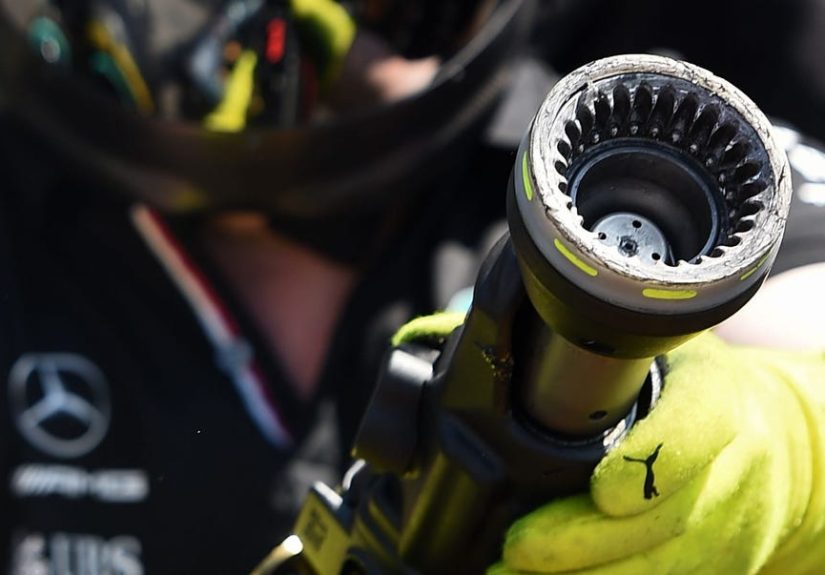
An F1 wheel gun removes and tightens the central wheel nut that locks each wheel to the car. Unlike a normal road car, which typically uses multiple lug nuts, an F1 car uses a single central nut on each wheel. That design exists for speed, but it also creates an unforgiving environment. There is only one fastener holding each wheel in place. No backups. No “close enough.” No second chance.
During a stop, the gunner follows the wheel in as the car arrives. The moment the car stops, the gun is already aligned with the nut. The first trigger action loosens the nut so the old wheel can come off. Once the new tire is fitted, the gun is applied again to tighten the nut. Then the mechanic confirms the wheel is secure, usually through a combination of sensors, internal data, and a physical confirmation button.
That sounds simple until you remember the whole operation happens in fractions of a second, while the car is hot, the crew is moving around each other like dancers with power tools, and one mistake can end the race instantly.
The Engineering Behind Formula 1 Wheel Guns
They Are Pneumatic, Violent, and Surprisingly Smart
Most F1 wheel guns are pneumatic tools powered by highly pressurized air. In plain English, they are fed enough compressed air to deliver brutal rotational force in a tiny window of time. They spin at extraordinary speed and produce staggering torque, because the nut has to come off instantly and go back on with authority. This is not the kind of tool you borrow from your neighbor next door. Unless your neighbor is secretly running a pit crew in the garage, in which case you should absolutely ask for a tour.
These tools are also smarter than they look. Modern F1 wheel guns are tied into mechatronic systems that help mechanics switch direction quickly, monitor gun behavior, and communicate status to the rest of the crew. Some feature LED status indicators so mechanics can instantly tell whether the gun is in loosening mode, tightening mode, or has properly completed the fastening process.
That matters because F1 teams are not merely chasing raw speed. They want repeatable speed. A stop that looks spectacular once but fails the next two times is useless. Teams would rather have consistently excellent stops than one record run followed by a comedy sketch.
The Wheel Nut Is Just as Important as the Gun
The wheel gun gets the glamor, but the wheel nut deserves a standing ovation too. F1 wheel nuts are not standard hex nuts. They are specially designed to interface with the gun and the wheel in a way that can survive extreme torque and rapid engagement. The retention system keeps the nut attached to the wheel assembly to reduce the risk of losing it during a stop.
This design helps the wheel-on mechanic slam the fresh tire into place without fumbling for hardware like someone rebuilding patio furniture at midnight. In Formula 1, the hardware itself is engineered for choreography. Every part is built to save fractions of a second and reduce the chance of error.
Why Alignment Is Everything
If you want to understand why wheel guns are so critical, think about what happens when one goes on at a slight angle. It does not simply “miss.” It can begin to strip the edges of the nut, round off the drive surfaces, and destroy the interface the gun needs to grip. In pit lane language, that can turn a clean stop into a mechanical horror story.
This has happened in real races. A famous example came when Valtteri Bottas stopped in Monaco and Mercedes could not remove one wheel because the gun had engaged badly and effectively machined the nut. The wheel stayed stuck on the car, the race was over, and the team had to deal with the problem later back at the factory using far less glamorous tools than the ones seen on television.
This is why top teams train obsessively for alignment. The gunner is not just operating a tool. He is hitting a tiny target with precision, at speed, under pressure, while everything around him is moving. Some teams have even used guides, sensors, and enhanced feedback systems to make that alignment more reliable.
The Perfect Pit Stop Is a Team Sport
Wheel Guns Work Only When the Whole Crew Works
A wheel gun cannot save a sloppy pit stop on its own. It is part of an entire ecosystem. The driver must stop in exactly the right spot. The front and rear jack operators must lift the car immediately. The wheel-off crew must remove the used tire cleanly. The wheel-on crew must position the new tire perfectly. Then the gunner must tighten the nut and confirm the job is done. Only after all four corners are secure can the release happen.
This is where Formula 1 pit stops begin to resemble a synchronized athletic event more than a mechanical service. Crew members train like athletes because they are athletes. Timing, balance, body position, strength, and reaction speed all matter. Teams review pit stop video, collect data from the tools and equipment, and dissect the movement of each mechanic to shave away milliseconds.
It is wonderfully ridiculous when you think about it. A sport full of aerospace engineers and advanced simulations still depends on whether 20-plus people can hit their marks at the exact same instant with machine-like consistency.
Safety, Sensors, and the Limits of Automation
As pit stops got faster, Formula 1 also had to confront the risk that the release process was becoming too automated and too unforgiving. In some cases, sensors can indicate a wheel is tight when it is not actually seated correctly. That is why teams increasingly rely on more than one kind of feedback, such as torque sensing plus positional confirmation, before allowing the car to leave.
The FIA has also stepped in over the years when pit stop procedures appeared to be racing ahead of safe human confirmation. Extra timing margins and process requirements were introduced to reduce the chance of unsafe releases. That tells you everything you need to know about the pace of development in F1 pit stops: the sport had to remind itself that human beings still need to be part of the decision loop.
Wheel guns are central to that conversation because they are both the source of the speed and one of the main sources of risk. They are the instruments that make modern pit stops possible, but they also create the possibility of false confidence if the system trusts a bad reading or a rushed operator input.
When Wheel Guns Go Wrong
Fans tend to remember pit stops only when something explodes metaphorically, and sometimes literally in the form of team radio. A jammed nut, a cross-threaded fit, a wheel that was never properly attached, or even a wheel gun left in the pit lane can turn a polished race weekend into a meme by sunset.
Ferrari, Mercedes, Haas, McLaren, and other teams have all had painful examples over the years. Some incidents were caused by cross-threading. Others involved incorrect confirmation, poor timing, or plain old human error under impossible pressure. The lesson is always the same: the wheel gun is only perfect when the operator, the hardware, the wheel nut, the sensors, and the sequence all work together.
That is also why teams carry backup equipment and why each crew member trains for contingency. Formula 1 is not just preparing for perfection. It is preparing for the ugly moment when perfection takes the afternoon off.
Records Are Cool, but Consistency Wins Races
Yes, the stopwatch matters. McLaren’s 1.80-second stop at the 2023 Qatar Grand Prix was a jaw-dropping reminder of what modern crews can do. But inside the paddock, teams care just as much about hitting solid, repeatable numbers all race long. A dependable 2.3-second stop is often more valuable than one heroic 1.9 followed by one disastrous 5.8.
That is why the best teams tune their wheel guns and their pit stop systems around reliability, usability, and communication as much as sheer muscle. The wheel gun has to be fast, but it also has to tell the truth. It has to help the mechanic know what mode it is in, whether the nut is secure, and when the car is genuinely ready to go.
In other words, F1 wheel guns are not just power tools. They are trust machines.
Why Formula 1 Wheel Guns Fascinate Fans
Part of the appeal is that wheel guns capture Formula 1 in miniature. They are absurdly specialized. They are overengineered in the best possible way. They take a task the average person understands, changing a wheel, and transform it into a display of elite performance, engineering obsession, and split-second decision-making.
You do not need a mechanical engineering degree to appreciate the drama. The sound alone tells the story. A driver stops. Four guns bark at once. Tires fly off and on. The jacks drop. The car vanishes. It is loud, violent, beautiful, and a little terrifying. It feels less like maintenance and more like a tactical airstrike on a set of tire compounds.
That is why wheel guns have become iconic in Formula 1. They symbolize speed, but they also symbolize control. When they work, they make the impossible look routine. When they fail, they remind everyone that this sport lives at the edge of what people and machines can reliably do.
Experience: What This Feels Like From a Fan’s Point of View
Watching an F1 pit stop on television is impressive. Watching one with a deeper understanding of the wheel guns makes it something else entirely. Suddenly, you are not just staring at four tires being changed. You are reading body language, listening for timing, and noticing whether the gunner is perfectly square to the nut or slightly fighting the angle. The whole thing becomes richer, faster, and somehow more human.
The first time many fans learn how much force and precision is packed into those tools, a pit stop stops looking like background race administration and starts feeling like its own event within the event. You realize the mechanics are doing work that demands the reactions of sprinters, the accuracy of craftsmen, and the nerve of people who cannot afford hesitation. There is no pause button. No reset. No “hang on, let me try that again.”
That changes how you experience the race. When a car dives into the pits during a close battle, your stomach gets involved. You know the undercut may depend on a wheel gun hitting perfectly, on a crew member reading the feedback correctly, and on four corners being finished without a single hitch. A pit stop becomes suspense theater. You are not just hoping for speed. You are hoping for clean execution.
There is also something strangely satisfying about the physicality of it all. Formula 1 is often described through software, aerodynamics, simulations, and data models, and all of that matters. But the pit lane reminds you that sport still comes down to people performing under pressure. The wheel gun is one of the few parts of F1 that feels gloriously industrial. It growls. It kicks. It demands total commitment. It is technology you can almost feel in your ribs.
Fans who have visited a circuit often say pit lane sounds different from what television suggests. The wheel guns crack through the air with a violence that feels immediate and mechanical in the purest sense. Even if you are not standing right there, you can imagine the force in the operator’s hands. That helps explain why pit crew training is so intense. These are not lightweight gadgets. These are precision tools with enough attitude to punish bad technique instantly.
And then there is the emotional side. A perfect stop can make you cheer for people whose names casual fans may never learn. The four gunners, the jack operators, the tire carriers, the release system coordinator, the crew chief on the stand, all of them become visible for two seconds and then invisible again. Yet in those two seconds, they can win or lose a race. That creates a kind of respect that sticks with you. You stop thinking of pit crews as background staff and start seeing them as elite performers.
Maybe that is the best part of learning about Formula 1 wheel guns. They make the sport feel bigger. You realize the race is not only happening on track. It is happening in the pit box, inside compressed-air systems, in the shape of a wheel nut, in the reflexes of a gunner, and in the confidence of a crew that has rehearsed the same move thousands of times. Once you know that, every pit stop becomes more than a tire change. It becomes one of the purest expressions of what Formula 1 really is: precision under pressure, powered by nerve, engineering, and a lot of compressed air.
Conclusion
Formula 1 wheel guns are key to making a perfect pit stop because they sit at the intersection of raw power, smart engineering, human precision, and race strategy. They remove and refit the single component that can make or break the stop: the central wheel nut. They communicate with sensors and crew systems. They reward accuracy and punish hesitation. And they turn one of motorsport’s most frantic moments into a repeatable performance that can decide championships.
So the next time a car ducks into the pit lane and disappears in a blur of motion, pay attention to the four mechanics with the angry-looking tools. Those wheel guns are not side characters. In Formula 1, they are the difference between a perfect stop and a very expensive disaster.






 Close
Close