
Table of Contents >> Show >> Hide
- HomePod vs. Nest Audio: Quick Comparison
- Design and Build Quality
- Sound Quality: The Biggest Difference
- Voice Assistant: Siri vs. Google Assistant
- Smart Home Features
- Music Services and Streaming
- Stereo Pairing and Multiroom Audio
- Privacy and Microphones
- Price and Value
- Who Should Buy the Apple HomePod?
- Who Should Buy the Google Nest Audio?
- HomePod vs. Nest Audio: Real-World Experience
- Final Verdict: Which Speaker Should You Buy?
- SEO Tags
Choosing between the Apple HomePod and Google Nest Audio is a little like choosing between a fancy espresso machine and a very helpful kitchen assistant. One wants to wow you with polished sound, premium design, and deep Apple ecosystem magic. The other wants to answer questions, control your smart home, play your playlists, and do it without making your wallet hide under the couch.
The short answer? Buy the HomePod if you live inside the Apple ecosystem, care deeply about room-filling sound, use Apple Music, and want a premium smart speaker that also works as an Apple Home hub. Buy the Nest Audio if you want a more affordable smart speaker, prefer Google Assistant, use Android or Chromecast-friendly services, and need practical everyday voice control more than hi-fi drama.
But smart speakers are sneaky. Specs matter, yes, but so do the little daily moments: asking for the weather while brushing your teeth, blasting music while cooking, turning off lights from bed, or realizing your speaker understands your roommate better than you do. So let’s compare HomePod vs. Nest Audio in plain English, with real buying advice and zero robot-speak.
HomePod vs. Nest Audio: Quick Comparison
| Category | Apple HomePod | Google Nest Audio |
|---|---|---|
| Best For | Apple users, Apple Music, premium sound, HomeKit | Google users, Android users, budget smart homes |
| Voice Assistant | Siri | Google Assistant |
| Typical Price Class | Premium | Budget-to-midrange |
| Audio Strength | Stronger bass, richer sound, room adaptation | Balanced mids, good clarity, solid casual listening |
| Smart Home Platform | Apple Home, HomeKit, Matter, Thread support | Google Home, Chromecast, Google Assistant ecosystem |
| Best Music Experience | Apple Music, AirPlay, Spatial Audio | YouTube Music, Spotify, Chromecast-compatible apps |
Design and Build Quality
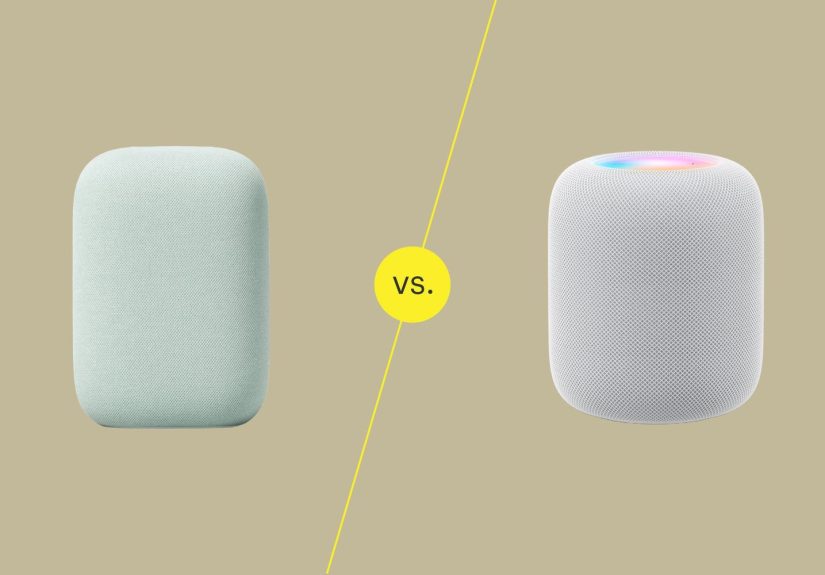
The HomePod looks like Apple asked, “What if a speaker were also a very serious decorative object?” It has a rounded fabric-wrapped body, a glowing touch surface on top, and a compact but premium presence. It does not scream for attention, but it also does not look cheap. Put it on a shelf, side table, or kitchen counter, and it blends in like it has been paying rent there for years.
Nest Audio is more modest and more rectangular, with a soft fabric exterior and a friendly, minimalist shape. It looks less like a luxury audio product and more like a smart home appliance that has good manners. That is not an insult. In many homes, the Nest Audio’s quiet design is exactly the point. It is slim enough for a nightstand, bookshelf, desk, or kitchen corner, and it comes across as practical rather than showy.
Which One Looks Better?
If your home already has Apple devices, neutral decor, and a love for polished minimalism, the HomePod feels more premium. If you want something simple, compact, and less expensive-looking in the best possible way, Nest Audio fits easily into everyday spaces. HomePod wins for luxury. Nest Audio wins for low-key practicality.
Sound Quality: The Biggest Difference
This is where the HomePod starts flexing. Apple designed the second-generation HomePod with a high-excursion woofer, an array of tweeters, room-sensing technology, and software that adjusts playback based on where the speaker sits. In real-world use, that means the HomePod can sound surprisingly big for its size. Bass has more weight, vocals feel more centered, and music spreads through the room instead of sounding trapped inside a little fabric ball.
The HomePod is especially impressive with Apple Music, Spatial Audio, and Dolby Atmos tracks. Not every song becomes a cinematic event, of course. Your old workout playlist will not suddenly turn into a private concert at Madison Square Garden. But with well-mixed tracks, the HomePod creates a wider, richer presentation than most small smart speakers.
Nest Audio is good, but it plays in a different league. It is much better than tiny entry-level speakers, and it handles podcasts, casual music, kitchen playlists, news, and voice responses clearly. Its mids are pleasant, which means vocals and spoken content sound natural. For background music while cooking pasta or folding laundry, Nest Audio is perfectly capable.
However, when you compare Nest Audio directly with HomePod, the difference is obvious. Nest Audio does not deliver the same low-end punch, room-filling scale, or polished detail. It can sound a bit flatter at higher volumes, and larger rooms expose its limits. Think of Nest Audio as a very good everyday speaker. Think of HomePod as a speaker that actually wants you to sit down and listen.
Winner for Sound Quality: HomePod
If music quality is your top priority, HomePod wins. It costs more, but you can hear where the money went. Nest Audio is good for casual listening, but HomePod is the better choice for people who care about bass, detail, and a fuller soundstage.
Voice Assistant: Siri vs. Google Assistant
The voice assistant battle is more complicated. Siri works best when your life is already organized around Apple devices. It can send messages, control Apple Home accessories, set timers, play Apple Music, check your calendar, and handle personal requests from an iPhone-connected household. It is smooth inside Apple’s garden, but that garden definitely has walls.
Google Assistant is usually better at general knowledge questions, search-style answers, and flexible everyday commands. Ask Nest Audio random things like “How long do I roast sweet potatoes?” or “What time does the pharmacy close?” and it often feels more natural. Google’s strength is information retrieval, and Nest Audio benefits from that.
For smart home commands, both speakers can be excellent, but the winner depends on your devices. If your lights, locks, thermostats, and sensors live in Apple Home, HomePod is the obvious pick. If your home runs through Google Home, Nest Audio will feel more natural. Mixing ecosystems can work, especially with Matter, but it can also become the kind of tech puzzle that makes people say things like, “I miss light switches.”
Winner for Voice Smarts: Nest Audio
For broad question-answering and everyday assistant flexibility, Nest Audio has the edge. For Apple-specific tasks, HomePod is better. The right answer depends less on raw intelligence and more on which digital ecosystem already knows where you live, what you listen to, and how many timers you set while making dinner.
Smart Home Features
HomePod is more than a speaker. It can act as a home hub for Apple Home, supports Matter-compatible accessories, and works with Thread-enabled smart home devices. That makes it a strong choice if you want a modern Apple smart home setup. It can help run automations, keep accessories connected, and work with devices like smart locks, lights, sensors, and thermostats.
The second-generation HomePod also includes temperature and humidity sensing, which can be useful for automations. For example, you could use it to trigger a fan, adjust climate settings, or simply check the room conditions. It can also support sound recognition features for certain alarm sounds, which adds another layer of home awareness.
Nest Audio fits nicely into the Google Home ecosystem. It controls compatible lights, plugs, TVs, thermostats, cameras, and other connected devices. It also works well with Chromecast, making it easy to send audio from compatible apps. For households already using Google services, Nest Audio is simple and friendly.
The key difference is that HomePod feels more like a premium smart home anchor for Apple users, while Nest Audio feels like an affordable voice-control point for Google homes. If you want one speaker in every room, Nest Audio’s lower price makes that easier. If you want one or two speakers that double as serious audio and smart home hubs, HomePod is more compelling.
Winner for Smart Home: Tie, Based on Ecosystem
Apple Home users should buy HomePod. Google Home users should buy Nest Audio. If you are starting from scratch, choose the ecosystem first, then the speaker. A smart speaker is not just a speaker anymore; it is a tiny ambassador for a much larger tech kingdom.
Music Services and Streaming
HomePod is happiest with Apple Music. That is where it feels fastest, smoothest, and most complete. You can use Siri to request songs, albums, playlists, genres, moods, and radio stations. AirPlay also lets you send audio from iPhones, iPads, and Macs, which is excellent if your household is mostly Apple.
However, HomePod is not as universally friendly as some competitors. If you live in Spotify all day, you may not get the same native voice-first experience that Apple Music users enjoy. You can still stream through AirPlay, but it feels more like using a bridge than walking through the front door.
Nest Audio is more flexible for Google-friendly and Chromecast-friendly streaming. YouTube Music, Spotify, and other supported services fit naturally into the experience. Android users in particular will appreciate how easy it is to cast audio. Nest Audio may not sound as premium, but it is often easier to integrate into a mixed-device household.
Winner for Streaming Flexibility: Nest Audio
HomePod is excellent for Apple Music. Nest Audio is better for people who use a wider mix of streaming services, especially in Android or Google-heavy homes.
Stereo Pairing and Multiroom Audio
Both speakers can be used in stereo pairs, and both can participate in multiroom audio setups. Two HomePods paired together can sound genuinely impressive, especially with Apple TV 4K for home theater audio. This setup is not cheap, but it can create a clean, cable-free living room experience with strong sound and simple Apple integration.
Two Nest Audio speakers also make a lot of sense, especially because the cost is more approachable. A stereo pair improves separation and makes music feel wider. For bedrooms, offices, kitchens, or small living rooms, two Nest Audio units can be a smart value move.
For serious home theater, HomePod is stronger. For affordable multiroom coverage, Nest Audio is easier to scale. One HomePod may sound better than one Nest Audio, but two or three Nest Audio speakers around the house can be more useful than one premium speaker sitting alone like royalty.
Privacy and Microphones
Both Apple and Google give users ways to manage microphones and voice data, but their privacy reputations feel different. Apple markets privacy as a core part of its brand, and HomePod benefits from that image. Siri requests are designed to work within Apple’s privacy-focused approach, and many Apple users trust the company’s stance on personal data.
Google, meanwhile, is built around services, search, personalization, and cloud intelligence. That makes Google Assistant extremely useful, but some people are more cautious about having a Google-connected microphone in the home. Nest Audio includes physical microphone controls, and Google offers privacy settings, but privacy-sensitive buyers may still lean Apple.
The practical advice is simple: whichever speaker you choose, review the privacy settings. Mute the microphone when needed. Delete voice history if you prefer. Do not put any smart speaker in a place where you would feel weird about a microphone existing. Yes, that includes the bathroom. Especially the bathroom.
Price and Value
Price is one of the biggest reasons to choose Nest Audio. It belongs to a much more affordable category than HomePod, and that changes the buying decision dramatically. If you want smart speakers in several rooms, Nest Audio is the easier recommendation. It offers good sound, helpful voice control, and smart home features at a budget-friendly price.
HomePod costs more because it aims higher. You are paying for better audio hardware, Apple integration, room correction, premium materials, Spatial Audio support, and smart home hub features. Whether that is “worth it” depends on how much you will actually use those advantages.
If you mostly ask for the weather, set timers, and play background music while doing chores, Nest Audio is the better value. If you listen to music every day, use Apple Music, own an Apple TV 4K, and want a speaker that feels premium every time it plays, HomePod justifies its higher price.
Winner for Value: Nest Audio
Nest Audio wins on price-to-function value. HomePod wins on premium experience. Your wallet and your ears may vote differently, so let them have a polite debate before checkout.
Who Should Buy the Apple HomePod?
You should buy the HomePod if you are deeply invested in Apple products. If your phone is an iPhone, your laptop is a MacBook, your streaming service is Apple Music, and your TV setup includes Apple TV 4K, the HomePod fits beautifully. It feels less like a separate gadget and more like another room in the Apple house.
HomePod is also the better choice if sound quality matters. It has stronger bass, better room presence, and a more premium listening experience. It is the speaker you buy when you want music to feel important, not just audible.
Buy HomePod If:
- You use iPhone, Apple Music, AirPlay, or Apple TV 4K.
- You want better sound quality from a single smart speaker.
- You are building an Apple Home or HomeKit smart home.
- You care about Spatial Audio and a richer music experience.
- You prefer Apple’s privacy-focused ecosystem.
Who Should Buy the Google Nest Audio?
You should buy Nest Audio if you want a practical, affordable, and helpful smart speaker. It is great for Android users, Google Home households, Chromecast fans, and anyone who wants voice control without spending premium-speaker money.
Nest Audio is also ideal for people who care more about assistant features than sound quality. Google Assistant is excellent for answering questions, controlling routines, managing everyday tasks, and working with Google services. It feels like a useful household helper first and a speaker second.
Buy Nest Audio If:
- You use Android, Google Home, Chromecast, or YouTube Music.
- You want a more affordable smart speaker.
- You need good sound for casual listening, not audiophile listening.
- You want to place multiple speakers around the house.
- You prefer Google Assistant for questions and daily commands.
HomePod vs. Nest Audio: Real-World Experience
In daily life, the HomePod and Nest Audio feel different in ways that specs do not fully capture. Imagine starting your morning. With Nest Audio in the kitchen, you can ask for the weather, news, traffic, a recipe conversion, and a timer for eggs, all while half-awake and emotionally dependent on coffee. Google Assistant is very good at this kind of casual back-and-forth. It feels quick, useful, and forgiving when your command is not perfectly phrased.
The HomePod morning experience is more polished if you are an Apple user. You can ask Siri to play a personal Apple Music station, check your calendar, control HomeKit lights, or send a message. The experience feels smooth when everything is Apple. But when you step outside that ecosystem, you may notice more friction. HomePod is not bad at being smart; it is just picky about the party guest list.
For music, the HomePod creates more “wow” moments. Put it in a living room, play a well-produced track, and it can make you look around like someone secretly installed bigger speakers. The bass has more confidence, the sound feels more spacious, and vocals have a polished quality. It is the kind of speaker that makes casual listening turn into “Wait, let me hear that again.”
Nest Audio is more humble. It is the speaker you appreciate because it does its job without drama. In a bedroom, office, or kitchen, it sounds clean enough for playlists, podcasts, audiobooks, and radio. It does not make every song feel cinematic, but it also does not demand a premium price. If HomePod is the dinner-party speaker, Nest Audio is the reliable friend who brings snacks, remembers the Wi-Fi password, and never complains.
In a smart home, Nest Audio can feel more conversational. Asking Google random questions, controlling devices, or checking information is usually easy. If your smart home devices are already in Google Home, it becomes a convenient voice remote for the entire house. The lower price also means you can put one in multiple rooms without feeling like you are building a luxury recording studio.
HomePod feels more elegant in an Apple smart home. Automations, HomeKit scenes, Thread accessories, and Apple TV integration make it feel like part of a larger premium system. A pair of HomePods with Apple TV 4K can be especially satisfying for people who want better TV audio without a traditional soundbar. It is not the cheapest path, but it is clean, stylish, and easy to live with.
The biggest lesson from real-world use is this: do not buy the speaker you wish matched your ecosystem. Buy the one that actually does. An Android-heavy household will probably find Nest Audio more useful. An Apple-heavy household will probably enjoy HomePod more. Sound quality matters, but convenience matters every single day.
Final Verdict: Which Speaker Should You Buy?
The best speaker depends on your ecosystem, budget, and listening habits. The Apple HomePod is the better speaker in the traditional audio sense. It sounds richer, fills a room more convincingly, supports premium Apple features, and works beautifully in an Apple-centered home. If you want the best sound between these two, choose HomePod.
The Google Nest Audio is the better everyday value. It is affordable, useful, compact, and smart. It works especially well for Google Home and Android users, and it is easier to buy in multiples for whole-home coverage. If you want a smart assistant with decent sound at a friendly price, choose Nest Audio.
So, HomePod vs. Nest Audio: which speaker should you buy? Choose HomePod for premium sound and Apple ecosystem power. Choose Nest Audio for smart features, affordability, and Google Assistant convenience. Either way, your kitchen timer game is about to get much more sophisticated.
Note: Product availability, pricing, and supported services can change over time. Before purchasing, check the latest retail listings and confirm that your preferred music services and smart home devices work with your chosen speaker.





 Close
Close