
Table of Contents >> Show >> Hide
- A quick feng shui refresher (no incense required)
- So… what’s the issue with a staircase facing the front door?
- When it’s a big deal vs. when it’s mostly fine
- How this layout can feel in real life (a.k.a. the non-mystical version)
- 10 feng shui-friendly fixes that also look good
- 1) Add a rug that makes people pause
- 2) Use a console table as a “speed bump”
- 3) Bring in a tall, healthy plant to redirect flow
- 4) Improve lightingespecially at the entry
- 5) Hang art that “pulls” attention sideways, not upward
- 6) Try a screen or room divider if you have the space
- 7) Use a faceted crystal sphere (if you like traditional cures)
- 8) Be cautious with mirrorsand place them thoughtfully
- 9) Create a “landing ritual” with function
- 10) Keep the stairs in good repair (yes, this counts)
- Examples: How to fix common American layouts
- If you’re remodeling: smarter staircase placement ideas
- FAQ: Quick answers (because we all have things to do)
- Real-World Experiences: What People Notice When the Stairs Face the Door (About )
- Conclusion
You know that moment when you open the front door andbamthere’s a staircase staring back at you like it’s been expecting company?
In a lot of American homes (hello, center-hall colonials and two-story foyers), that layout is common. In feng shui, though, it’s also a classic
“okay, let’s talk about energy flow” situation.
Before anyone panics and starts pricing out demolition: feng shui is a design philosophy rooted in how spaces feel and functionhow they support
(or sabotage) calm, connection, and momentum in daily life. The goal isn’t perfection. It’s creating a home that feels like it’s on your team.
A quick feng shui refresher (no incense required)
Feng shui is an ancient Chinese practice focused on arranging spaces in harmony with the flow of qioften described as “life force” or
vital energy. In modern home terms, you can think of qi like a mix of movement, attention, mood, and “how this place hits you the second you walk in.”
The front door matters because it’s considered the primary “entry point” for qisymbolically tied to opportunities, helpful people, and the overall
tone of the home. Many feng shui educators call the entry the “mouth” where energy is received. That’s why entryways get so much attention:
light, cleanliness, and a welcoming vibe are considered foundational.
So… what’s the issue with a staircase facing the front door?
When the staircase is directly aligned with the front door, feng shui practitioners often describe it as fast-moving or “rushing” qi.
Instead of gently circulating through the first floorwhere most people live, gather, and actually eat snacks standing at the counterthe energy
is said to shoot straight upward (or rush down and out) like it’s late for an appointment.
Symbolically, that can translate into themes like:
- Opportunities “bypassing” you (things come in, but don’t stick around long enough to benefit the household).
- Wealth energy feeling slippery (money goes out as quickly as it comes inhello, surprise car repairs).
- Restlessness at home (a “busy” entry that never feels settled or grounding).
- Disconnected household flow (people drifting upstairs immediately instead of naturally gathering in shared areas).
Whether you take those ideas literally or as a helpful metaphor, the design logic is pretty practical: a straight visual and physical runway from
the door to the stairs encourages quick movement through the space, not a warm pause.
When it’s a big deal vs. when it’s mostly fine
Feng shui is rarely a single “good” or “bad.” Context matters. A staircase facing the door tends to be more challenging when:
1) The door and stairs are in a straight, unobstructed line
Think: you open the door and can practically hear the words, “Upstairs is this way.” There’s no visual buffer, no foyer moment, no soft landing.
2) The entry is narrow or echo-y
Small entryways, hard floors, and minimal furniture can amplify that “rushing” feeling. The space doesn’t slow anyone downpeople or energy.
3) The stairs are steep, open-riser, or aggressively prominent
Dramatic staircases look amazing on real estate listings. But in feng shui, a bold, direct staircase can feel like it’s “pulling” attention and
movement upward immediately.
4) You’ve got a spiral staircase right in front of the door
Many feng shui practitioners view spirals as more chaotic for qi because the movement is tighter and more swirling than steady and grounded.
On the other hand, the “problem” often feels smaller if your stairs are offset, the entry is spacious, or there’s a landing that naturally slows traffic.
Even a simple foyer area (a mat, a console, a light fixture, a plant) can change the experience dramatically.
How this layout can feel in real life (a.k.a. the non-mystical version)
If your staircase faces your front door, you might notice the entryway is hard to keep tidy, conversations don’t naturally start there, and the space
feels more like a passageway than a welcome. Guests step in and immediately look up, which can be slightly disorientinglike your house is saying,
“Nice to meet you, please proceed to Level Two.”
Feng shui is often about solving those subtle frictions. The best “cures” don’t need to be magical. They just need to:
slow the pace, soften the line, and redirect attention.
10 feng shui-friendly fixes that also look good
Here are design-forward adjustments that feng shui practitioners commonly recommendadapted for modern American homes (and modern American budgets).
1) Add a rug that makes people pause
Place a substantial rug or mat inside the front door and/or at the base of the stairs. In feng shui terms, this “grounds” the entry and slows qi.
In real life, it also catches dirt and gives the space a “yes, we live here” anchor. Round or oval rugs are often suggested to soften sharp, fast lines.
2) Use a console table as a “speed bump”
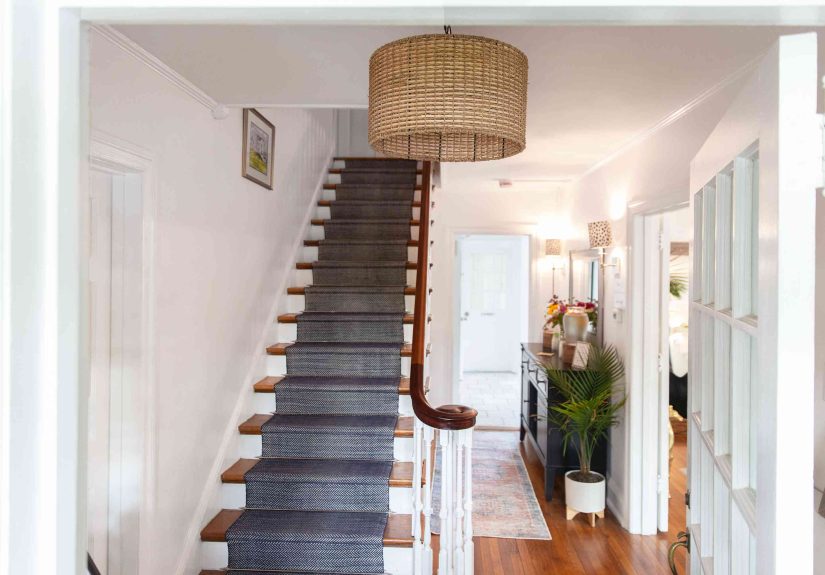
If you have room, place a console table between the door and the stairs (or along the wall that visually interrupts the direct line). Style it with a lamp,
a bowl for keys, and something alive (flowers or a plant). The point is to create a moment of arrival before the “upstairs” storyline begins.
3) Bring in a tall, healthy plant to redirect flow
A tall plant near the base of the stairs can act as a gentle visual barrier. Choose something upright and happy-looking (not spiky, struggling, or
leaning like it’s tired of this layout too). A plant also adds softness and life right where things tend to feel rushed.
4) Improve lightingespecially at the entry
A bright, welcoming entryway is a repeated feng shui theme. Add a lamp, upgrade overhead lighting, or use warm bulbs so the first impression
feels inviting rather than transitional.
5) Hang art that “pulls” attention sideways, not upward
Place artwork on the wall adjacent to the door or along the first-floor sightline to encourage your eyes (and your feet) to move into the home
rather than straight up the stairs. Pick pieces that feel uplifting and calmnot chaotic or heavy.
6) Try a screen or room divider if you have the space
Folding screens, open shelving, or a slatted divider can break the direct line between the door and stairs. This is one of the most effective fixes
when the alignment is very straight. Bonus: it creates an instant “intentional foyer,” even in an open-concept layout.
7) Use a faceted crystal sphere (if you like traditional cures)
Many feng shui practitioners recommend hanging a faceted crystal ball in the space between the door and the stairs to “disperse” rushing qi.
Whether you view it as energetic or simply decorative, it can add sparkle, softness, and a focal point that interrupts the visual runway.
8) Be cautious with mirrorsand place them thoughtfully
Mirrors are powerful in feng shui because they visually expand space and redirect attention. But avoid placing a mirror that directly reflects the front door
if it makes the entry feel like energy bounces right back out. A better move is positioning a mirror where it brightens the space or reflects something
pleasant (like art or greenery), not the exit.
9) Create a “landing ritual” with function
Feng shui loves practicality. A designated drop zonehooks, a tray, a small benchreduces clutter, and clutter is one of the fastest ways for an entry
to feel energetically “stuck.” If shoes, backpacks, and mail explode right next to the stairs, the whole area can feel chaotic.
10) Keep the stairs in good repair (yes, this counts)
Wobbly railings, squeaky steps, burnt-out bulbs, and scuffed walls create a subtle sense of instability. Feng shui emphasizes care and maintenance
because your home’s “signals” affect your nervous system. Fix what’s broken, brighten what’s dim, and your entry instantly feels more supportive.
Examples: How to fix common American layouts
The classic center-hall colonial
This is the poster child of “stairs facing the door.” Add a round rug in the foyer, then place a console table along one wall with a lamp and a large mirror
that reflects light (not the door). If there’s room, add a tall plant near the first stair tread to interrupt the straight line.
The townhouse “door opens straight to stairs” situation
When there’s barely a landing area, go vertical: a slim wall-mounted shelf for keys, a bright sconce or pendant, and a runner that begins at the threshold
can create an instant pause. Artwork on the wall opposite the stairs helps redirect attention away from the climb.
The split-level entry
Split-levels can feel “all stairs, all the time.” Use layered lighting and a substantial rug at the entry. If the stairs are visible immediately, introduce
a strong focal point on the main levellike a statement plant or artso the eye has somewhere else to land first.
The open-concept modern build
If the staircase is sculptural and unavoidable, create an intentional foyer zone: a bench, a console, or a partial divider (even an open bookcase) can
define the entry without closing off the space.
If you’re remodeling: smarter staircase placement ideas
If you’re in design mode (or daydreaming with a tape measure), feng shui-friendly staircase strategies often include:
- Offsetting the staircase so it’s not directly aligned with the door.
- Adding a landing to slow movement and soften the vertical pull.
- Using a half wall or architectural screen to break the straight line of sight.
- Curving the approach so circulation feels natural, not rushed.
You don’t have to treat feng shui like a strict rulebook. Think of it as a quality-control check for how your entry feels: welcoming, grounded,
and easy to move through without feeling pushed.
FAQ: Quick answers (because we all have things to do)
Is a staircase facing the front door “bad luck”?
Not automatically. It’s considered a challenging layout in many feng shui schools because the flow can be too fast. But good design fixes can
make a huge differenceoften without changing any architecture.
Do I need to move the staircase to fix it?
Almost never. Most homes benefit from simpler adjustments: a rug, better lighting, a focal point, and a bit of visual buffering. Remodeling is optional,
not required.
What’s the most effective “one thing” to do?
If you can only do one: create a pause point. A rug plus a console (or a plant) is often the quickest way to slow the entry experience and redirect flow.
Real-World Experiences: What People Notice When the Stairs Face the Door (About )
Homeowners who live with a staircase facing the front door often describe a surprisingly similar vibe, even if they’ve never read a word about feng shui.
The first comment is usually about speed: people walk in and immediately head up. Kids run upstairs to drop backpacks. Guests drift up to
find a bathroom without realizing they’ve skipped the living room. Deliveries land on the first step like the staircase is the home’s unofficial inbox.
Over time, the entry starts to feel less like a welcome and more like a launch ramp.
Another common theme is difficulty “settling” the space. Even in a beautiful two-story foyer, the eye can get pulled upward, which makes
the ground floor feel visually unfinishedlike the “real” home begins on the second level. People compensate by adding bigger decor, louder art, or
extra furniture, but if it’s not intentional, that can turn into clutter (the enemy of calm entryways everywhere).
Designers and feng shui practitioners often note that the fix is less about superstition and more about human behavior. When the path of
least resistance is straight ahead and up, the layout trains you to move quickly through the first floor. After a while, the main level can feel like a
hallway rather than a destination. In households where everyone is busy, that can subtly reduce shared timebecause the home’s default movement pattern
encourages separation.
Once simple changes go in, people tend to report very practical improvements. A rug inside the door and a lamp on a console can make the entry feel
warmer and more “owned.” A tall plant or a sculptural piece near the stairs often changes traffic: instead of beelining upward, people naturally turn
into the living room or pause to set things down. It’s not unusual for homeowners to say, “I didn’t realize how stressed that entry made me until it
felt calmer.” That’s a nervous system response as much as a feng shui one.
Some families also notice a shift in daily routines. With a defined drop zone (hooks, tray, bench), keys stop vanishing, shoes stop piling
up, and the stairs stop acting like the storage unit of last resort. When the first few steps aren’t covered in stuff, the whole home feels more organized.
That “lighter” feeling is exactly what feng shui is aiming for when it talks about improving qi flow.
And yespeople still keep their staircase-facing-door layout. They just make it work smarter. The most successful setups share a common thread:
they don’t fight the architecture; they add a welcome moment. A pause. A focal point. A gentle cue that says, “You’re homenow exhale.”
Conclusion
A staircase facing the front door is one of the most common feng shui “challenge layouts,” but it’s also one of the easiest to improve without major
construction. The goal is simple: slow the entry experience, soften the straight line of sight, and help energy (and people) circulate through the
spaces where life actually happens.
Start with the basicslight, a grounded rug, and a clutter-free landing zonethen add one strong visual buffer like a plant, console, or screen.
Your home doesn’t need to be perfect. It just needs to feel like it’s welcoming you in, not funneling you out.







 Close
Close