
Table of Contents >> Show >> Hide
- Quick Prep Checklist (Do This Before You Sit Down)
- The 13 Steps to a Haircut You’ll Like
- Step 1: Figure out what your hair can realistically do
- Step 2: Choose a goal, not a celebrity
- Step 3: Bring reference photos that actually help
- Step 4: Pick a cut that matches your maintenance personality
- Step 5: Learn the two or three words that make you sound like you know what you’re doing
- Step 6: Choose the right person, not just the closest appointment
- Step 7: Arrive with “normal” hair, not “hiding evidence” hair
- Step 8: Start the consultation by describing your problem
- Step 9: Be specific about length (use “show and tell”)
- Step 10: Ask what will (and won’t) work for your hair type
- Step 11: Agree on the plan before the first snip
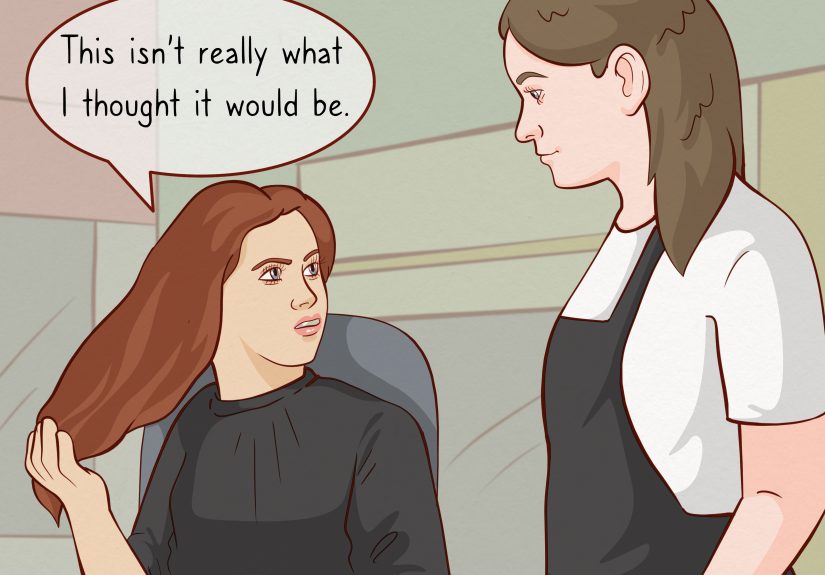
- Step 12: Speak up early (and politely) if something feels off
- Step 13: Lock it in with aftercarethen document what you liked
- Mini “Translation Guide” (So Your Words Match Their Scissors)
- of Real-Life-Style Experiences (So This Feels Easier Next Time)
- Conclusion
A haircut is basically a short-term relationship: you meet, you communicate, you commit, and then you stare at yourself in the mirror for three days wondering
if this was a “growth moment” or a “why did I do that” moment.
The good news: getting a haircut you actually like isn’t about luck, mind-reading, or having the bone structure of a marble statue. It’s mostly about
preparation, clear communication, and choosing a plan that matches your real life (not your “I totally blow-dry every morning” fantasy life).
Quick Prep Checklist (Do This Before You Sit Down)
- 3 photos max: front, side, and back of what you want.
- 1 photo of what you don’t want (optional but powerful).
- A note on your daily routine: time, tools, and styling skill level (be honest).
- Any hair quirks: cowlicks, swirl at the crown, shrinkage, stubborn part, etc.
- A rough maintenance plan: how often you’re willing to come back for trims.
The 13 Steps to a Haircut You’ll Like
-
Step 1: Figure out what your hair can realistically do
Your hair has a personality. Sometimes it’s cooperative. Sometimes it’s a raccoon that found a wall outlet. Before choosing a style, look at your hair’s
texture (straight, wavy, curly, coily), thickness, density, and growth patterns. If your hair poofs when it dries, shrinks dramatically, or refuses to lay
flat in one spot, that’s not “bad hair”that’s useful information.Practical move: check your hair when it’s air-dried and styled the way you normally wear it. That’s the version your stylist/barber needs to design for,
not the “freshly shampooed, perfectly behaved for 12 minutes” version. -
Step 2: Choose a goal, not a celebrity
It’s totally fine to bring inspiration from a celebrity or influencer. Just don’t make the goal “Give me their head.” Make the goal the effect:
cleaner jawline, more volume, softer layers, curl definition, a sharper neckline, less bulk at the sides, or a style that grows out nicely.A helpful question: “What do I like about this haircut?” If you can answer that, you’re already ahead of most humans.
-
Step 3: Bring reference photos that actually help
Photos beat vague adjectives every time. Pick images in good lighting with a clear view of the shape. Even better: find photos of people with hair similar
to yours (texture and density matter a lot). Bring front/side/back angles if possible so your pro isn’t guessing what happens behind your
ear.Pro tip: avoid heavily filtered images. If the hair looks like it was rendered by a graphics card, it may not be a useful haircut reference.
-
Step 4: Pick a cut that matches your maintenance personality
Some cuts are “wash-and-go.” Others are “wash, blow-dry, round-brush, product, prayer.” Decide how much daily effort you’re willing to invest and choose
accordingly. If you don’t want to style, look for cuts designed to work with natural texture and easy grow-out.Be direct: “I’ll style this maybe twice a week.” That sentence saves everyone time, money, and emotional damage.
-
Step 5: Learn the two or three words that make you sound like you know what you’re doing
You don’t need a cosmetology degree. You just need a few basics:
- Length: how much stays on top, sides, and back.
- Shape: blunt vs. layered; square vs. rounded; tight vs. soft neckline.
- Transition: taper (subtle) vs. fade (more dramatic) if you’re using clippers.
- Texture: point cutting, thinning, or removing bulk (not the same as “shorter”).
If you’re getting a clipper cut, you can mention guard lengthsor simply show with fingers how short you want it. Both work.
-
Step 6: Choose the right person, not just the closest appointment
If you’ve ever thought, “Well, it was available at 2:15,” you’ve met the enemy. Look for a stylist/barber who regularly does the type of cut you want:
fades, long layers, curly shaping, pixies, shags, bobs, etc. Check portfolios and reviews, but prioritize photos of hair similar to yours.Low-risk strategy: book a small service first (a trim, shape-up, or bang trim). It’s like a first date, but with better lighting.
-
Step 7: Arrive with “normal” hair, not “hiding evidence” hair
Come in wearing your hair the way you usually doparted how you part it, textured how it naturally textures, and styled (or not styled) like a typical day.
This gives your pro accurate data about your routine and your hair’s behavior.If your hair is usually curly and you arrive with it flat-ironed to another dimension, say so. No judgment. Just information.
-
Step 8: Start the consultation by describing your problem
The easiest way to get a great haircut is to explain what’s not working right now. Examples:
- “My hair mushrooms out at the sides.”
- “The back gets bulky fast.”
- “My bangs split in a weird way.”
- “I want more movement, less triangle.”
- “I want to grow it out, but I need it to look intentional.”
When you speak in problems and goals, your stylist can build a plan instead of just following a list of instructions like a robot with scissors.
-
Step 9: Be specific about length (use “show and tell”)
“Take off a little” is the haircut equivalent of “Bring me a snack.” It could mean anything. Use measurable language:
- “About an inch off.”
- “Collarbone length.”
- “I want the fringe to hit my eyebrows (not my eyelashes).”
- “Two finger-widths on the sides.”
You can also point to your body: “I want it to sit right here on my neck.” That’s clear, fast, and surprisingly hard to misinterpret.
-
Step 10: Ask what will (and won’t) work for your hair type
A good pro will tell you the truth kindly. Invite that honesty. Try:
“Is this realistic for my texture and growth pattern? What would you change to make it work?”This is where you avoid heartbreak stylescuts that look amazing in the photo, but require a different hair density, a different curl pattern, or a
different willingness to style every morning at 6:00 a.m. -
Step 11: Agree on the plan before the first snip
Before cutting begins, make sure you both understand:
- The outline: where the perimeter sits (jaw, shoulders, collarbone, etc.).
- The interior: layers, debulking, or keeping it blunt.
- The framing: bangs/fringe length and face-framing pieces.
- The finish: soft/airy vs. sharp/structured.
If you’re doing clippers, this is when you confirm taper vs. fade, and how tight you want around ears and neckline.
-
Step 12: Speak up early (and politely) if something feels off
You’re not being “difficult” by communicating. You’re being helpful. The best time to adjust is when it’s still adjustable. If you notice something,
say it calmly:- “Could we keep a bit more length on the top?”
- “I’m worried the bangs are getting shorter than I plannedcan we pause and check?”
- “Can we soften the layers so it doesn’t feel too choppy?”
Most pros would much rather tweak mid-cut than watch you quietly panic and then go home to mourn in silence.
-
Step 13: Lock it in with aftercarethen document what you liked
A great haircut can be ruined by “I have no idea how to style this.” Before you leave, ask:
- “What product did you use, and how much?”
- “How should I dry it at homeair-dry, diffuse, blow-dry direction?”
- “When should I come back to maintain the shape?”
Take a quick photo of your hair from a few angles when it’s freshly done (and you’re happy). Next time, you’ll have a “this exact thing” referenceand
that’s haircut gold.
Mini “Translation Guide” (So Your Words Match Their Scissors)
- “Trim” → Confirm how much: “half an inch” vs. “two inches.”
- “Layers” → Ask what kind: subtle movement vs. lots of separation and lift.
- “Thin it out” → Could mean debulk weight, or reduce densityclarify what you want.
- “Fade” → Usually a stronger gradient; ask how high and how tight.
- “Taper” → More natural, softer grow-out; often lower maintenance.
of Real-Life-Style Experiences (So This Feels Easier Next Time)
Here’s a common scene: someone sits down and says, “Just clean it up.” The stylist nods, because “clean it up” sounds cooperative, friendly, and completely
undefined. Ten minutes later, that same person is silently thinking, “Why is the back so short?” This isn’t because the stylist is out to get you. It’s
because vague instructions force your pro to guess what you meanand guesses are where haircut regrets are born.
The next time you’re tempted to go vague, imagine you’re ordering coffee. If you say “Just… coffee,” you might get a tiny espresso that tastes like ambition,
or a 24-ounce iced drink with five pumps of caramel and a personality of its own. Haircuts work the same way. If you want a specific outcome, you
need a specific request: “Keep the length here, remove bulk at the sides, and I want a softer neckline.” That’s a coffee order your barber can
actually make.
Another real-life moment: you bring in one perfect photo, but your hair is a different texture. Maybe the reference has pin-straight hair, and yours is wavy
with a cowlick that throws parties at your crown. If you say, “I want exactly this,” your pro has two options: (1) try to replicate it and risk a mismatch,
or (2) gently explain why it’ll behave differently on you. The best experience happens when you team up. You point to the photo and say, “I love the shape
and the fringehow do we adapt this to my texture so it still looks good when I air-dry?” That question turns the appointment into a collaboration instead of
a comparison.
Then there’s the “maintenance surprise.” You leave with an amazing blowout and think, “This is the new me.” Two days later, at home, you realize the new you
apparently owns a round brush, a diffuser, and the patience of a saintwhich you do not. This is why being honest about your routine is so powerful. When you
say, “I can do about five minutes,” a great stylist will steer you toward a cut that has built-in shape: layers placed to encourage movement, a taper that
grows out gracefully, or a length that doesn’t demand daily heat. The haircut you like most isn’t always the fanciestit’s the one that looks good on your
regular Tuesday.
Finally, here’s the quiet confidence booster: learning what to say after you get a good cut. When you love the result, don’t just leave. Ask,
“If I came back in eight weeks and wanted this exact haircut again, what should I tell you?” Stylists and barbers can translate what they did into repeatable
languageguard lengths, scissor work, where they removed weight, how they shaped the fringe. Write it in your notes app. Next appointment, you’ll walk in
sounding like someone who has their life together… even if your breakfast was a granola bar you found in your bag.
Conclusion
Getting a haircut you like is less about “finding the one” and more about showing up prepared, speaking clearly, and choosing a style that fits your hair and
your habits. Bring photos, explain your goals, confirm the plan, and don’t be afraid to communicate early. Your future self (and your camera roll) will thank
you.





 Close
Close