
Table of Contents >> Show >> Hide
- The Story Went Viral Because It Tapped Into A Very Real Problem
- Was She Wrong To Respond So Dramatically?
- Accessible Parking Is Not A Public Opinion Poll
- What Life With A Prosthetic Leg Actually Looks Like
- The Real Villain Here Is Everyday Ableism
- What Should People Do Instead?
- More Experiences That Echo This Story
- Final Thoughts
There are few people more confident than a stranger in a parking lot who has appointed himself Judge, Jury, and Lord High Protector of the Blue Painted Lines. He does not know you. He does not know your medical history. He has not been invited into your business. And yet there he is, vibrating with certainty, ready to deliver a TED Talk through your rolled-up car window.
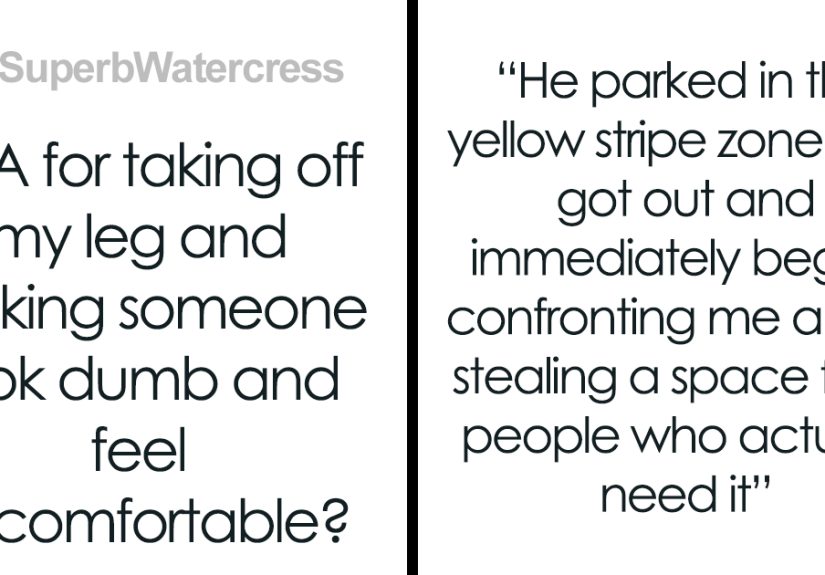
That is exactly why this viral story hit such a nerve. A woman legally parked in an accessible spot, a man yelled at her as if he had personally invented disability access, and she responded in the most unforgettable way possible: she took off her prosthetic leg to make her point. The internet, naturally, had thoughts. Some people cheered. Some gasped. A few asked whether her response was too dramatic.
Honestly? If you decide to publicly shame someone over a disability you cannot see, you are the one who brought the drama. She just handed it back with special effects.
The Story Went Viral Because It Tapped Into A Very Real Problem
The headline may sound outrageous, but the emotional core of the story is familiar to a lot of disabled people. Public confrontations over accessible parking happen far more often than they should. Similar stories keep surfacing online: a younger person with a prosthetic limb gets accused of “faking it,” someone with a disability placard is told they are “too young to be disabled,” or a person with an invisible condition is pressured to explain their body to a complete stranger.
That is the part people without disabilities often miss. The worst thing about these encounters is not only the rudeness. It is the forced performance. Disabled people are pushed into proving, on demand, that they are disabled enough. Suddenly the grocery run turns into a courtroom. Milk, eggs, bread, public humiliation. Great. Love that for everyone.
In the viral story, the woman’s response felt dramatic because it cut through the nonsense instantly. It also exposed something uncomfortable: many people still believe disability has a “look.” They expect a wheelchair, gray hair, visible frailty, or some other stereotype they can recognize in half a second. If they do not see that stereotype, they assume fraud.
That assumption is not just rude. It is deeply wrong.
Was She Wrong To Respond So Dramatically?
Not really. Maybe startling? Sure. But wrong? That is a much harder case to make.
She Was Responding To Aggression, Not Creating It
Let’s start with the obvious. The man initiated the confrontation. He chose to yell. He chose to accuse. He chose to insert himself into a situation he did not understand. When people describe the woman’s response as “dramatic,” they often skip over the part where she was already being harassed.
That matters. A lot. Disabled people are frequently expected to be endlessly calm, endlessly educational, endlessly polite, and somehow also grateful for the opportunity to correct other people’s ignorance. But emotional labor is still labor. When someone comes at you with judgment, you are not morally required to respond like a customer service chatbot.
Sometimes A Visual Reality Check Is The Fastest Way To End A Bad Situation
In a perfect world, saying “I am allowed to park here” would be enough. In the actual world, some people do not stop until they are embarrassed. Taking off the prosthetic leg was not a party trick. It was a brutal, effective way of saying: you made a reckless assumption about my body, and now you get to sit in it.
Was it uncomfortable for him? Absolutely. That was kind of the point.
The Better Question Is Why She Had To Prove Anything At All
The bigger issue is not whether her comeback was too bold. It is why accessible parking so often turns into a spectator sport. A person who has a valid permit should not have to disclose medical details, expose a prosthesis, or explain chronic pain just to buy paper towels in peace.
If a stranger had not decided to play disability detective, the “dramatic” response never would have happened.
Accessible Parking Is Not A Public Opinion Poll
Accessible parking exists for a reason. It is not a reward, a convenience, or a cute little perk for people who got enough sympathy points. It is part of disability access. Distance matters. Balance matters. Fatigue matters. Pain matters. Safety matters. Getting in and out of a vehicle with a prosthesis, crutches, limited stamina, nerve pain, or another impairment can require room, time, and a predictable path of travel.
And here is the thing that seems to blow some minds: not every disability announces itself on sight.
Not Every Disability Is Visible
Some disabilities are obvious. Many are not. A person may have a prosthetic limb hidden under pants. They may have a heart condition, a neurological disorder, severe arthritis, balance problems, joint instability, chronic pain, or another mobility-related issue that does not scream for attention the moment they step out of a car.
That is why the phrase “You don’t look disabled” lands so badly. It sounds like a compliment if you say it with enough clueless enthusiasm, but it usually means, “You do not match the stereotype I carry around in my head.” That is not insight. That is just bias wearing khakis.
Young People Can Be Disabled Too
Another persistent myth is that disability belongs exclusively to older people. It does not. Younger adults can be disabled because of congenital limb differences, accidents, chronic illnesses, autoimmune conditions, neurological disorders, or countless other reasons. A smooth face and a valid disability placard are not contradictory things. They can, in fact, exist in the same parking lot at the same time. Science is amazing.
What Life With A Prosthetic Leg Actually Looks Like
One reason stories like this matter is that they puncture the lazy fantasy many people have about prosthetics. Popular culture sometimes treats a prosthetic limb like a magic upgrade: sleek, high-tech, empowering, basically one montage away from superhero status. Real life is messier.
Mobility Is Often Harder Than It Looks
A lower-limb prosthesis can restore movement and independence, but that does not mean every day is easy. Uneven sidewalks, curbs, wet pavement, carrying groceries, walking long distances, standing for a while, or navigating crowded public spaces can all make mobility more complicated. Someone may look steady for ten seconds and still be managing pain, fatigue, pressure, or instability.
Pain Does Not Need An Audience To Be Real
People with limb loss can experience residual limb pain, skin irritation, socket discomfort, and phantom limb pain. Some days the prosthesis fits well. Some days it does not. Heat, swelling, activity level, and subtle changes in the body can change how wearable or painful a prosthesis feels. That means accessible parking is not about winning a visual contest. It is about function, energy, and safety.
Looking Fine Is Not The Same As Being Fine
This is where able-bodied assumptions get really sloppy. If a person exits the car without wobbling dramatically enough for strangers, observers may decide the accessible spot is not “really” needed. But many disabled people become experts in moving through public spaces while minimizing attention. They learn efficient patterns, controlled gait, and social camouflage. What looks effortless may be highly managed.
In other words, the public often mistakes competence for lack of disability. That is not a small misunderstanding. It is one of the engines that drives everyday ableism.
The Real Villain Here Is Everyday Ableism
This story is funny on the surface because the guy got instantly humbled. But underneath the humor is something darker: the routine suspicion that disabled people are lying, exaggerating, or taking up space they have not “earned.”
People Too Often Think They Are Entitled To Proof
There is a weird social habit of treating disabled people like they owe the public a diagnosis. They do not. A disability placard is not an invitation to cross-examination. A prosthetic limb is not community property. A body is not a pop quiz.
And when disabled people do disclose or demonstrate their condition, it is often because the situation has already become hostile. That is why so many of these stories have the same exhausted energy: “I did not want to prove anything, but this person would not stop.”
Humiliation Is Often The Price Of Being Believed
That is the truly lousy part. For many disabled people, public validation comes only after a deeply personal reveal. Show the scar. Lift the pant leg. Explain the diagnosis. Mention the surgery. Expose the pain. Then, and only then, the accuser suddenly becomes sorry. It is not a healthy social script. It is a terrible one.
The woman in this story flipped that script by making the moment so blunt and undeniable that the accusation collapsed under its own stupidity. It felt satisfying because it reversed the power dynamic, if only for a moment.
What Should People Do Instead?
If you are genuinely wondering how not to become the villain in someone else’s parking lot story, the rules are refreshingly simple.
1. Stop Policing Strangers
If someone has a valid placard or plate, keep moving. You are not the disability bouncer for Target.
2. Remember That Access Is About Function, Not Appearance
You cannot reliably assess someone’s mobility, pain, stamina, or safety needs from a three-second glance. You are not that gifted.
3. Do Not Assume Youth Means Health
Plenty of younger adults live with disabilities. Age is not a medical clearance certificate.
4. Ask Before Helping
If there is an actual moment where help might be useful, ask first and respect the answer. Grabbing, directing, or lecturing someone is not assistance. It is control wearing a fake mustache.
More Experiences That Echo This Story
If this headline felt extreme, the wider pattern is not. There have been multiple public stories from amputees and other disabled people who were challenged for using accessible parking or priority spaces. In one widely discussed encounter, a younger woman with a prosthetic leg said a man knocked on her car window and insisted she was using someone else’s pass because she looked “too young” to be disabled. She opened the door, showed him her prosthetic, and the confidence drained from his face almost immediately. Different setting, same script: accusation first, apology second, reflection maybe never.
That same script shows up beyond parking lots. A teenager with a prosthetic leg described being pressured to leave a priority seat on public transit until she revealed the prosthesis. Only then did the people questioning her back off. Notice the pattern here: the disabled person is calm, then challenged, then forced into disclosure, then retroactively declared legitimate. That cycle is exhausting. It teaches disabled people that private information may have to become public at any time, simply because someone else feels entitled to certainty.
Research and first-person accounts about prosthesis use help explain why these confrontations sting so much. Everyday tasks already involve constant calculation. Uneven surfaces, longer walks, carrying bags, soreness in the residual limb, fatigue, phantom pain, and the fit of the prosthetic socket can all shape how a person moves through the world on any given day. A grocery run may look ordinary from the outside while feeling like a carefully managed engineering problem on the inside. Add suspicion from strangers, and the emotional load spikes fast.
There is also a social penalty attached to “passing” as nondisabled. If a prosthesis is hidden under clothing, or if someone’s condition is invisible, people often assume everything is fine until access needs become visible. Then comes the judgment. Disabled advocates have been pointing out for years that this pressure creates a no-win situation. If your disability is obvious, people may stereotype you. If it is not obvious, people may doubt you. Either way, public misunderstanding is waiting in the parking lot, apparently with nothing better to do.
And yet, there is one encouraging thread running through all of these stories: more people are pushing back. Some do it with humor. Some with education. Some with blunt honesty. Some, memorably, by removing a prosthetic leg and letting silence do the rest. The details vary, but the message stays the same. Disabled people do not owe strangers a performance. They do not need to look a certain way to deserve access. And the rest of us would be wise to retire from the unpaid position of amateur disability inspector before we end up starring in somebody else’s viral cautionary tale.
Final Thoughts
So, was she wrong to dramatically respond to the man who yelled at her for parking in a handicapped spot? No. If anything, her response was a sharp lesson in what happens when arrogance meets reality at close range.
The bigger takeaway is not that every disabled person should react this way. It is that no one should be put in that position to begin with. Accessible parking is about access. Disability does not always look the way outsiders expect. And public assumptions can become cruelty with shocking speed.
If this story makes people laugh, good. Sometimes laughter is the quickest route to recognition. But the lesson underneath it is serious: stop demanding proof from people you do not know. The world gets kinder, smarter, and a lot less embarrassing when we mind our business and let disabled people use the access they are legally and humanly entitled to.







 Close
Close