
Table of Contents >> Show >> Hide
- What Marfa Really Means in American Design
- Why Los Angeles Was the Perfect Landing Spot
- The Event That Put the Idea Into Focus
- Marfa Style Is More Than Desert Minimalism
- The Makers Who Gave the Movement a Human Face
- Why This Crossover Still Feels Relevant
- Marfa, LA, and the Art of Not Overdoing It
- An Extended Experience: What “Marfa Comes to LA” Feels Like in Real Life
- Conclusion
Some ideas arrive quietly. Others kick open the door in dusty boots, set a hand-thrown mug on the table, and make your living room look underdressed. That is more or less the energy behind Marfa Comes to LA, a phrase that sounds simple but carries a whole suitcase full of design meaning. Marfa, Texas, is not just a dot in the desert. It is a mood, a design philosophy, a cultural magnet, and, depending on who you ask, either a minimalist pilgrimage site or a place where art, land, and style decided to start a long, strange, beautiful conversation.
When that Marfa spirit showed up in Los Angeles through Heath Ceramics’ “Marfa Amigos” presentation, the moment felt bigger than a showroom event. It felt like a meeting between two design languages that already understood each other. One speaks in desert silence, raw materials, handmade objects, and long horizons. The other speaks in light, curation, relaxed sophistication, and California cool. Put them together and you do not get a culture clash. You get sparks. Very tasteful sparks.
This is the story of why Marfa matters, why Los Angeles was ready for it, and why the idea of “Marfa Comes to LA” still resonates as a lesson in craft, authenticity, and the kind of style that does not need to yell to be heard.
What Marfa Really Means in American Design
To understand why Marfa coming to LA matters, you first have to understand what Marfa became. Once a small railroad and ranching town in West Texas, Marfa entered a different orbit when artist Donald Judd began transforming it into a center for permanent, site-specific art. His vision was not about filling white walls with rotating trends. It was about space, scale, permanence, and the relationship between objects and landscape. That idea changed everything.
Marfa eventually became known for the Chinati Foundation, for starkly beautiful architecture, for desert light that makes photographers act like poets, and for an art culture that values restraint over clutter. That last part is important. Marfa style is not empty minimalism. It is edited minimalism. It is what happens when design stops trying to impress everyone at once and starts caring about materials, proportion, and place.
At the same time, Marfa developed another identity beyond the museum world. It became a cultural ecosystem filled with independent businesses, bookshops, lodgings, makers, artists, musicians, and brands that felt rooted rather than mass-produced. Places like El Cosmico, Marfa Book Co., Ballroom Marfa, and small-batch makers helped define a version of American style that felt both artful and unpretentious. That combination is rare. Plenty of places do cool. Plenty do rustic. Plenty do expensive. Marfa somehow learned how to do soulful.
Why Los Angeles Was the Perfect Landing Spot
Los Angeles, for all its sprawl and spectacle, has always had a deep affection for spaces and objects that feel lived in, tactile, and quietly considered. Beneath the red carpets and giant billboards sits a city obsessed with good light, strong silhouettes, natural textures, and the holy trinity of modern West Coast design: wood, clay, and linen.
That is why Marfa’s design vocabulary translated so naturally to LA. Both places understand atmosphere. Both places appreciate architecture as part of daily life rather than a background prop. Both are drawn to the handmade, the locally rooted, and the visually spare. And both know that style works best when it looks easy, even when a lot of thought went into it.
Heath Ceramics made that connection especially believable. The company has long stood for modern American craftsmanship, practical beauty, and design that earns its place in the home. Heath was never about disposable trends. It built its reputation on ceramics and tile that age well, feel human, and make ordinary rituals look just a little more elegant. In other words, Heath was not merely hosting Marfa. It was speaking the same language, just with a California accent.
The Event That Put the Idea Into Focus
The phrase “Marfa Comes to LA” is closely tied to a Heath Ceramics Los Angeles presentation known as Marfa Amigos. The show brought together makers and objects associated with Marfa’s creative world and placed them inside an LA design setting that could showcase their textures, forms, and stories. It was not just a retail move. It was a cultural translation project.
Instead of treating Marfa like a trend to be copied, the presentation highlighted the people and goods that gave the town its visual identity. That included furniture and textiles connected to Garza Marfa, objects that reflected West Texas craftsmanship, posters from El Cosmico, soaps from Marfa Brands, and other works that captured the region’s blend of utility and charm. The result was not a themed gimmick. It was a curated conversation about place.
That matters because too many design crossovers flatten the original source. A city sees another city looking fabulous, borrows a few surface details, and suddenly every coffee table book starts using the word “authentic” like it is seasoning. But Marfa Amigos felt different. It understood that Marfa’s appeal does not come from one color palette or one piece of furniture. It comes from a worldview: make less, make better, let materials breathe, and do not decorate away the soul of an object.
Marfa Style Is More Than Desert Minimalism
It starts with materials
Marfa’s visual culture is grounded in materials that feel honest. Leather looks like leather. Wood shows its grain. Steel keeps its edge. Ceramics celebrate weight, glaze, and hand-feel. Textiles bring warmth without fuss. There is very little interest in things pretending to be other things. If an object has character, it usually comes from making, not marketing.
That sensibility is exactly what makes Marfa attractive to city dwellers who are tired of glossy sameness. In a world of fast furniture and algorithmic taste, Marfa objects feel personal. They carry evidence of the hand and the landscape. They look like they belong somewhere, which is a bigger compliment than “luxury” ever was.
It values space as much as stuff
Another hallmark of the Marfa aesthetic is that it leaves room around things. That may sound obvious, but it is surprisingly radical. Marfa style understands that an object needs breathing room to matter. A chair can be sculptural. A table can hold presence. A bowl can feel like architecture in miniature. This idea comes directly from Marfa’s landscape and art history, where horizon, silence, and scale shape perception.
In Los Angeles, that lesson lands beautifully. The city’s best interiors often use openness as a material of its own. Sunlight across a tile wall. A low table against a clean plaster backdrop. A woven textile that does not need five companions to make an impression. Marfa does not ask LA to become more rustic. It asks LA to edit.
It mixes roughness with refinement
There is also something deliciously contradictory about Marfa style. It can be polished and dusty at the same time. It can pair saddle leather with modern lines, handmade soap with gallery-grade display, a desert motel poster with collectible ceramics. That tension is part of the charm. Marfa never feels sterile because it allows beauty to keep a little grit under its fingernails.
Los Angeles, at its best, loves that mix too. The city has always looked good in contrasts: polished houses with wild gardens, elegant dinnerware beside weathered wood, modern architecture warmed up by craft. Marfa did not come to LA to teach the city style. It came to remind the city where some of its favorite instincts already lived.
The Makers Who Gave the Movement a Human Face
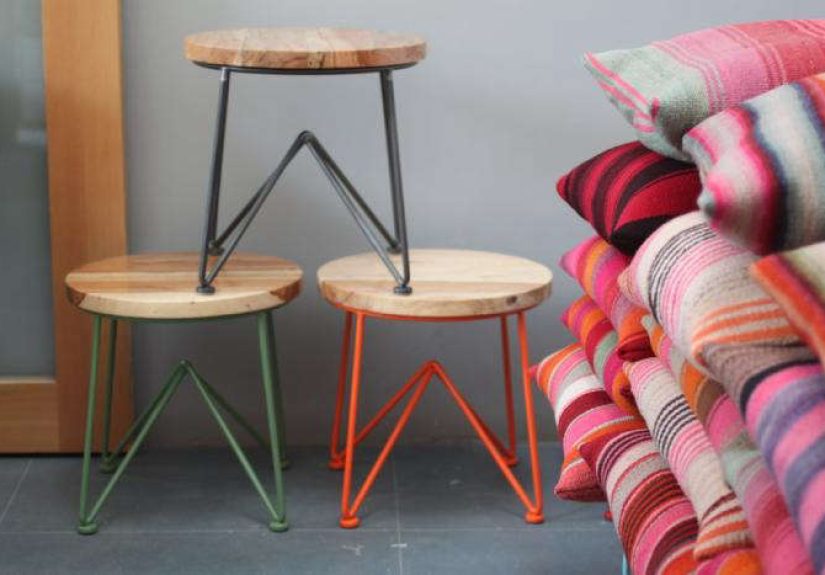
The strongest part of “Marfa Comes to LA” is not the branding. It is the people behind the work. Marfa’s influence grew because artists and makers translated the desert into functional, lived-in objects. Garza Marfa is a perfect example. Their furniture and textiles bridge West Texas spirit with a clean, colorful modernism that also makes sense in California. These are not souvenirs. They are pieces with structure, warmth, and point of view.
Then there are the smaller objects that do just as much cultural work: a soap bar that smells like cedar, sage, campfire, or rain on a ranch road; a poster from El Cosmico that captures the romance of communal desert lodging; a textile whose stitching carries both restraint and play. These items may be compact, but they do something important. They bring the mythology of place into daily life without turning it into a caricature.
That is why the Heath presentation hit a nerve. It let Angelenos experience Marfa not as a faraway concept but as a collection of touchable things: the chair you want to sit in, the plate you want to use, the fabric you want to drape over a bench, the soap you absolutely did not expect to become emotionally attached to. Design can be theoretical, yes. But the best design sneaks up on you through ritual.
Why This Crossover Still Feels Relevant
More than a decade later, “Marfa Comes to LA” still feels timely because the design world remains hungry for exactly what Marfa represents: a slower pace, regional identity, honest materials, and objects with story. Consumers are more skeptical now. They can spot fake craft from three scrolls away. They want provenance. They want meaning. They want pieces that do not look like they were developed by committee in a conference room with mood boards and panic.
Marfa offers an antidote. It says style can emerge from restraint. It says a town does not need to be large to be influential. It says the future of design may actually depend on older ideas like permanence, locality, and material intelligence. Los Angeles, for all its appetite for the new, is one of the few major cities that can appreciate that message without making it feel dusty or nostalgic.
In fact, this crossover anticipated a larger shift in American taste. Over time, more homeowners, travelers, and designers began gravitating toward interiors and experiences that felt grounded in geography. Desert palettes, handmade ceramics, weathered woods, small-batch goods, art-forward hospitality, and minimal rooms with maximal atmosphere all became more visible in national design culture. Marfa did not invent every one of those ideas, but it gave them a particularly memorable stage.
Marfa, LA, and the Art of Not Overdoing It
There is a joke buried in all of this, and it is this: both Marfa and Los Angeles know what overexposure looks like. One became famous partly because of its remoteness. The other is arguably the world capital of being seen. Yet when these two aesthetics meet, the most successful results are the least loud.
That may be the greatest lesson of all. “Marfa Comes to LA” is compelling not because it is flashy, but because it demonstrates how style deepens when it is tied to real communities, real makers, and real environments. It is a reminder that good design is not merely a look. It is a chain of values. When those values travel well, the objects do too.
And maybe that is why the idea still lingers. Marfa coming to LA was never just about desert chic landing in a coastal showroom. It was about proving that craft can move across geography without losing its soul. It was about showing that the handmade can feel cosmopolitan, that restraint can feel luxurious, and that a small town in West Texas can influence the visual habits of one of the biggest creative capitals in America. Not bad for a place where the horizon often does most of the talking.
An Extended Experience: What “Marfa Comes to LA” Feels Like in Real Life
Imagine walking into Los Angeles with your city brain still buzzing. You have notifications. You have traffic residue in your bloodstream. You have made at least one dramatic speech to yourself in the car about people who brake for no reason. Then you step into a space shaped by Marfa’s influence, and suddenly everything slows down. Not in a sleepy way. In a clarifying way.
The first thing you notice is air. There is room around the furniture, room around the objects, room around your thoughts. A leather chair does not beg for attention; it simply sits there, looking so self-assured that you begin questioning your own posture. A ceramic bowl catches light like it has a private understanding with the sun. A woven pillow adds color without shouting. Even the soap seems smug in the most charming way, as if it knows it has a backstory and you do not.
That is the experience of Marfa translated into LA. It is not a direct copy of the desert. Nobody is trucking in a tumbleweed and calling it a concept. It is more emotional than literal. The atmosphere says: choose well, buy less, notice more. In a city built on acceleration, that feels almost rebellious.
There is also something unexpectedly intimate about the whole thing. Big cities often make taste feel performative. You are not just buying a table; you are apparently announcing a personality brand. Marfa-inspired design softens that pressure. It invites you to live with objects instead of staging them like extras in your personal film trailer. The pieces feel useful, durable, and calm. They do not scream status. They whisper confidence.
And that is where the crossover becomes more than stylish. It becomes aspirational in the best sense. It suggests a way of living where your home is not cluttered with impulse and your eye is not exhausted by noise. You start thinking less about trends and more about texture. Less about collecting and more about editing. Less about having the room “finished” and more about letting it evolve honestly.
For Angelenos, that can be a powerful reset. LA is a city of reinvention, but it is also a city that can sometimes overcurate itself into fatigue. Marfa offers a counterweight. It says imperfection is welcome. Patina is not failure. Utility can be beautiful. And a room can have personality without looking like it swallowed a design blog whole.
Even the emotional tone feels different. There is humor in Marfa style, but it is dry, subtle, and deeply self-aware. It knows a chair can be serious and still invite you to relax. It knows a desert town can become globally influential and still keep a touch of mischief. It knows that a poster from a quirky campground can sit happily beside refined ceramics and somehow make both pieces look smarter.
So when people say “Marfa Comes to LA,” what they really mean is this: a certain American ideal of artful living has arrived. One that respects the hand, honors the landscape, and leaves enough silence in the room for beauty to actually register. In practical terms, yes, it may look like furniture, textiles, pottery, or soap. In emotional terms, it feels like exhaling. And in a place like Los Angeles, that may be the most luxurious thing of all.
Conclusion
Marfa Comes to LA works as a title because it captures a true cultural exchange. Marfa brought its desert modernism, maker spirit, and art-world credibility. Los Angeles brought an audience ready to appreciate craftsmanship, restraint, and story-driven design. Together, they created something larger than a showroom display: a blueprint for how regional identity can travel without losing authenticity.
The lesson still holds. People do not just want beautiful things. They want meaningful ones. They want homes that feel composed, not crowded. They want design with roots. Marfa, in all its dusty, disciplined, quietly charismatic glory, continues to offer exactly that. And LA, with all its visual intelligence and appetite for reinvention, remains one of the best places for that message to land.






 Close
Close