
Table of Contents >> Show >> Hide
- Why Ab Work Can Wreck Your Neck (And What That Has to Do With Your Upper Spine)
- The Neck-Friendly Core Rules (Do These First, Then Pick Exercises)
- Neck-Friendly Ab Exercises (With Step-by-Step Form)
- 1) Dead Bug (Best “Abs Without Neck Drama” Starter)
- 2) Bird Dog (Core Stability Without Curling Your Neck)
- 3) Forearm Plank (Or Modified Plank) “Strong Core, Quiet Neck”
- 4) Side Plank (Knee-Down CountsAnd It’s Not “Cheating”)
- 5) Glute Bridge + “Ribcage Down” Brace (A Core Move That Feels Like a Back Massage)
- 6) Reverse Crunch (Slow and Controlled = Neck-Friendly)
- 7) Heel Taps or Marching (Dead Bug’s Easygoing Cousin)
- Exercises to Be Careful With (If Your Neck Gets Angry Easily)
- Mini Warm-Up: 3 Minutes to Set Your Neck Up for Success
- A Neck-Friendly Ab Workout (15–20 Minutes, 2–3x/Week)
- Troubleshooting: If Your Neck Still Feels It
- Conclusion: Strong Abs, Peaceful Neck
- Experiences: What People Commonly Notice When They Switch to Neck-Friendly Ab Training
If ab day usually ends with your neck doing the most dramatic “I’m quitting this job” slump, you’re not alone. A lot of people try to train their core and accidentally turn it into a neck-and-upper-trap endurance event. The good news: you don’t need to “power through” neck strain to build a strong midsection. You just need smarter exercise choices, better setup, and a few form rules that keep your upper spine out of the complaint department.
This guide breaks down why common ab moves irritate the neck, how to keep your cervical spine calm, and which ab exercises build real-world core strength while your head stays comfortably supported. (Yes, your neck is allowed to relax. It’s been through enough.)
Why Ab Work Can Wreck Your Neck (And What That Has to Do With Your Upper Spine)
Neck strain during “ab exercises” usually isn’t because your neck is weak or broken. It’s more often a strategy problem: your body recruits whatever muscles can help you finish the repfast. If the deep core isn’t stabilizing well, the hip flexors, upper traps, and the muscles along the front of your neck can jump in to “assist.” That’s when you feel pulling, tightness, or that annoying burn near the base of your skull.
The usual suspects
- Too much head lifting. Traditional crunches and sit-ups often involve curling the upper spine. If your hands are behind your head and you pull, your neck becomes the unwilling handle of a suitcase. (Mayo Clinic even cues crossing arms instead of pulling on the head to reduce neck strain.)
- Forward-head posture all day, then “ab day” at night. If you spend hours looking down at screens, your head tends to drift forward. Then you ask your neck to stabilize more during exercisewithout changing the posture habit. (MedlinePlus and other clinical sources highlight posture as a major contributor to neck strain.)
- Ribs flaring + low back arching. When your rib cage pops up and your low back arches, your core loses leverage. Your neck may tense while your body tries to create stiffness somewhereanywhere.
- Holding your breath. Breath-holding increases tension. Your neck loves to join that party. Learning to exhale with effort is a surprisingly big “neck-friendly” upgrade.
The Neck-Friendly Core Rules (Do These First, Then Pick Exercises)
Rule 1: Keep your neck neutralthink “long,” not “lifted”
“Neutral” doesn’t mean stiff like a mannequin. It means your neck stays aligned with your torso. A simple cue: gently glide your chin straight back (a small “double-chin” motion) without tipping your head up or down basically a chin tuck. Johns Hopkins describes this as a small glide, not a big nod.
Rule 2: Let your head be heavy whenever possible
Many of the best neck-friendly ab exercises keep your head on the floor (or in line with your spine on hands-and-knees). Your core can work hard without your neck doing extra credit.
Rule 3: Brace like you’re about to be gently poked in the sides
Bracing isn’t sucking your stomach in like you’re trying to fit into skinny jeans from middle school. It’s a 360° “firming” around the torsofront, sides, and backso your spine feels supported. Think: sturdy, not strained.
Rule 4: Move slow enough to stay honest
Fast reps hide form problems. Slow reps expose them… and fix them. If your neck tenses only when you speed up, congrats: you just found the speed limit for your current control level.
Neck-Friendly Ab Exercises (With Step-by-Step Form)
The exercises below are chosen because they train the core’s real jobstabilizing your spinewithout forcing repeated neck flexion. Several are widely recommended by medical and fitness education sources as spine-friendly core builders (like the dead bug, bird dog, and planks).
1) Dead Bug (Best “Abs Without Neck Drama” Starter)
Dead bug is a top-tier core exercise because it trains coordination and bracing while keeping your head supported. Harvard Health specifically highlights it as a safe, effective core move.
- Lie on your back. Arms reach toward the ceiling. Hips and knees bend to about 90° (tabletop).
- Gently tuck your chin (small glide back), then relax your neckno crunching.
- Exhale and brace. Keep your ribs “down” so your low back doesn’t arch.
- Slowly extend one leg away while reaching the opposite arm overhead. Move only as far as you can keep control.
- Return to start and switch sides.
Neck-friendly tip: If your neck still tenses, place a small folded towel under your head and focus on breathing out longer.
Make it easier: Move only legs (keep arms up), or tap a heel to the floor instead of fully extending.
2) Bird Dog (Core Stability Without Curling Your Neck)
Bird dog builds anti-rotation stabilityyour torso learns to stay steady while limbs move. It’s also commonly used in spine-conditioning and PT-style core programs.
- Start on hands and knees. Hands under shoulders, knees under hips.
- Lengthen your spine from head to tailbone. Keep your gaze down so your neck stays neutral.
- Brace lightly, then extend one leg back while reaching the opposite arm forward.
- Pause briefly. Don’t twist your hips or crank your head up.
- Return with control and switch sides.
Neck-friendly tip: Imagine balancing a glass of water on the back of your head. (No, you don’t have to actually try this.)
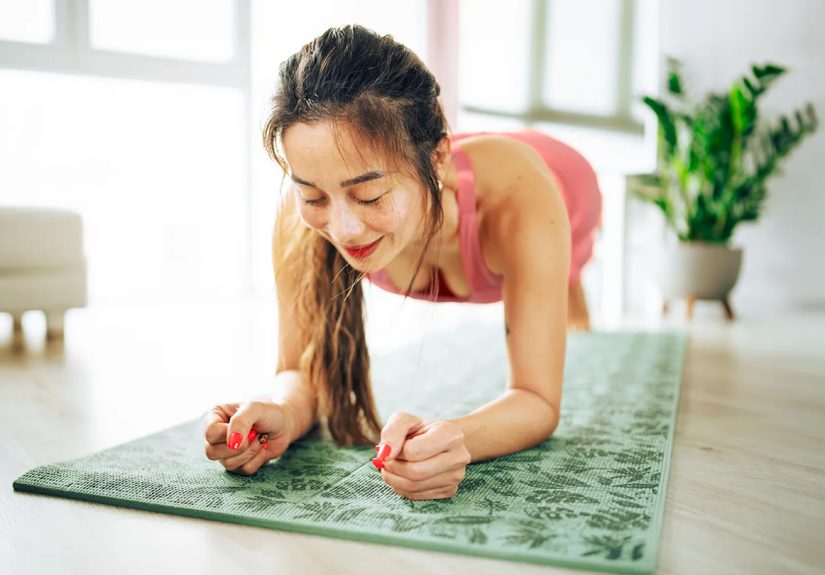
3) Forearm Plank (Or Modified Plank) “Strong Core, Quiet Neck”
Planks train full-core stiffness and endurance. Harvard Health notes planks as a key core exercise, and orthopedic spine-conditioning programs often include plank variations.
- Place forearms on the floor, elbows under shoulders.
- Step back into a straight line from head to heels (or drop knees for a modified plank).
- Gently glide your chin back, keep your gaze down, and lengthen the back of your neck.
- Brace and breathe: slow exhale, ribs stay down.
- Hold 10–30 seconds with good form. Stop before your neck starts “helping.”
Make it easier: Knees down, or elevate forearms on a bench/couch.
4) Side Plank (Knee-Down CountsAnd It’s Not “Cheating”)
Side planks train the obliques and lateral core. Many spine-friendly core routines include side plank progressions because they build stability without repetitive neck flexion.
- Lie on your side, elbow under shoulder.
- Bend knees for the beginner version (stack knees, hips forward).
- Lift hips so your body forms a straight line from head to knees (or head to feet for full version).
- Keep your neck long and neutraldon’t shrug into your shoulder.
- Hold 10–25 seconds each side.
Neck-friendly tip: Press the floor away with your forearm so your shoulder stays stable and your neck doesn’t take over.
5) Glute Bridge + “Ribcage Down” Brace (A Core Move That Feels Like a Back Massage)
Your core isn’t just “front abs.” A balanced core includes glutes and back-side support. Glute bridges show up often in core training lists because they strengthen the posterior chain and encourage better pelvic control.
- Lie on your back, knees bent, feet flat.
- Exhale, brace, and gently tuck pelvis so your ribs aren’t flaring up.
- Drive through your feet and lift hips until your torso forms a line from shoulders to knees.
- Pause, then lower slowly.
Neck-friendly tip: Keep your chin slightly tucked and shoulders relaxed. Your neck gets a vacation; your glutes do the work.
6) Reverse Crunch (Slow and Controlled = Neck-Friendly)
Reverse crunches can target the lower portion of the rectus abdominis with less temptation to yank your head forwardif you keep your head down and move your pelvis, not your neck.
- Lie on your back. Arms at your sides, palms down for stability.
- Bring knees to tabletop. Head stays relaxed on the floor.
- Exhale and gently curl your pelvis up, lifting hips slightlythink “tailbone toward the ceiling.”
- Lower slowly; don’t swing legs.
Make it easier: Reduce range of motion. The goal is control, not height.
7) Heel Taps or Marching (Dead Bug’s Easygoing Cousin)
If dead bugs are tough at first, heel taps are a perfect progression: you get bracing practice with less coordination demand.
- Lie on your back, knees up at 90°.
- Brace and keep ribs down.
- Tap one heel to the floor, return, then switch.
Exercises to Be Careful With (If Your Neck Gets Angry Easily)
- Sit-ups (often too much neck and hip flexor involvement for many people).
- High-rep bicycle crunches (rotation + speed can encourage neck tension).
- Anything that makes you pull on your head (your neck is not a handle).
That doesn’t mean these are “bad forever.” It means they’re often the wrong tool when your goal is “train abs, not neck.”
Mini Warm-Up: 3 Minutes to Set Your Neck Up for Success
Neck-friendly core training starts before the first rep. Try this quick sequence:
- Chin tucks (5 reps): Gentle chin glide straight back, head level, no big nod.
- Shoulder blade set (5 breaths): Relax shoulders down and back (not military posturejust “unshrug”).
- Pelvic tilts (6–8 reps): Small rock of the pelvis to find “ribs down” alignment. (Cleveland Clinic includes pelvic tilts in posture-focused movement.)
A Neck-Friendly Ab Workout (15–20 Minutes, 2–3x/Week)
Keep intensity moderate and form picky. Stop a set when your neck starts trying to audition as your abs.
Round 1 (Stability + Control)
- Dead Bug: 6–10 reps per side (slow)
- Bird Dog: 6–8 reps per side (pause 1–2 seconds)
- Glute Bridge: 10–12 reps
Round 2 (Endurance)
- Forearm Plank (or knees down): 10–30 seconds
- Side Plank (knee down is fine): 10–25 seconds per side
- Heel Taps: 10–16 total taps
Rest 30–60 seconds between moves as needed. The goal is quality reps with calm breathing, not dramatic suffering.
Troubleshooting: If Your Neck Still Feels It
Check your “chin strategy”
If you crank your chin hard to your chest, that can create tension too. Aim for the small chin-glide-back (neutral) that many clinical resources describenot a deep nod.
Reduce range of motion
Most neck strain shows up when you extend a leg too far in dead bug, hold a plank too long, or move too fast. Shorten the lever. Make it boring. Boring is safeand safe gets strong.
Upgrade your posture outside workouts
If you live in “forward head mode” all day, your neck is already tired when you start training. MedlinePlus emphasizes keeping your head level and posture aligned; even small workstation changes and movement breaks can help.
Know when to stop and get help
Stop exercise and talk to a clinician if you have persistent or worsening neck pain, pain that radiates down an arm, numbness/tingling, weakness, dizziness, or headache that feels unusual for you. And if you have a known spine condition or recent injury, get personalized guidance before progressing intensity.
Conclusion: Strong Abs, Peaceful Neck
Neck-friendly ab training isn’t about doing “easy” exercisesit’s about doing the right exercises the right way. When you pick movements that keep your head supported (dead bug, bridges, heel taps) or your neck aligned (bird dog, planks), you train your core to stabilize your spine like it’s supposed to. Your neck stops complaining because it’s no longer being recruited as a backup ab muscle.
Start with control, brace and breathe, and progress slowly. Your core will get stronger, your posture often improves, and your upper spine will finally stop filing HR reports after every workout.
Experiences: What People Commonly Notice When They Switch to Neck-Friendly Ab Training
When someone swaps crunch-heavy routines for neck-friendly core work, the first “result” usually isn’t a visual change. It’s relief. People often describe finishing a core session without that familiar tight band at the base of the skull or the next-day soreness that feels like they carried a backpack full of textbooks… with their neck. The big surprise is realizing how much the neck had been compensating. Once the head stays supported on the floor (as it does in dead bugs, heel taps, and bridges), the neck muscles finally get permission to clock out.
A common experience is the “humbling rep count.” Someone might be used to blasting out 50 fast sit-ups, then tries slow dead bugs and can only manage 6 clean reps per side before their ribs want to flare and their low back wants to arch. That’s not failureit’s a measurement. Controlled core work is like turning on the bright lights: you can see what’s really happening. Most people notice that when they slow down and exhale on the hard part, their midsection feels more engaged and their neck stays noticeably quieter.
Desk workers and students often report another pattern: their neck pain isn’t just “work stress,” it’s “work posture plus workout choices.” When they pair core training with small posture habitslike brief chin tucks, shoulder blade resets, or simply bringing the phone up closer to eye level core days stop triggering a flare-up. They also tend to feel planks differently. At first, a plank can light up the shoulders and upper traps. But after practicing “press the floor away,” keeping the gaze down, and holding shorter sets (like 10–20 seconds), many people feel the effort shift lower into the trunkwhere it belongs.
Another frequent experience is discovering that “abs” are not a separate department from glutes and hips. People who add glute bridges often say their lower back feels less cranky during core work, and their planks feel steadier. That makes sense: when the glutes and deep core share the load, the spine doesn’t need as many emergency stabilizers. This is also why bird dogs can feel strangely challenging at first. You’re asking your torso to resist twisting while limbs move, which is closer to real life than repeated crunching. Over a few weeks, folks often notice better balance, smoother movement when standing up or carrying things, and less “wobble” in side planks.
Finally, many people learn a personal rule: the set ends when the neck starts to participate. That boundary keeps training productive. Instead of chasing exhaustion, they chase alignment. The payoff is consistencycore sessions become something you can repeat week after week, not something that wrecks your upper spine and ruins tomorrow. If you’ve ever avoided ab work because it “always hurts your neck,” this approach can be a game changer: your core gets stronger, your confidence goes up, and your neck stops acting like it’s the main character in your workouts.





 Close
Close