
Table of Contents >> Show >> Hide
- What Is a Virtual Nuclear Reactor?
- How Nuclear Reactors Work: The Friendly Version
- Why Operating a Reactor Virtually Is So Engaging
- Virtual Reactors and Real Operator Training
- The Rise of Small Modular Reactor Simulators
- What You Can Learn from a Browser-Based Reactor Simulator
- Why Virtual Nuclear Education Matters Now
- Virtual Reality, Digital Twins, and the Future Control Room
- What Makes a Good Nuclear Reactor Simulator?
- Experiences Related to “Operate Your Own Nuclear Reactor, Virtually”
- Conclusion
There are hobbies you can casually pick up on a rainy afternoon: baking sourdough, learning guitar, reorganizing your desk for the fifth time this month. Operating a nuclear reactor is not usually on that list. For obvious reasons, “I built one in the garage” is not a sentence anyone wants to hear from a neighbor. But thanks to virtual nuclear reactor simulators, curious students, energy nerds, future engineers, and people who simply enjoy pushing digital buttons can now explore reactor operations safely from a browser or classroom screen.
The idea behind “operate your own nuclear reactor, virtually” is not to turn the internet into a control room. It is to make one of the world’s most misunderstood energy technologies easier to understand. A good simulator turns invisible physics into visible cause and effect. You adjust demand, watch gauges respond, balance heat and electricity output, and discover that a nuclear power plant is less like a glowing science-fiction cube and more like a highly disciplined steam machine with a very serious heat source.
Virtual reactor tools are becoming more important as nuclear energy returns to the center of conversations about clean electricity, grid reliability, small modular reactors, and STEM education. The United States still depends on nuclear power for a significant share of its electricity, and advanced reactor developers are using simulation not only for public outreach but also for research, human-factors testing, operator training, cybersecurity studies, and control-room design. In short: the simulator is no longer just a classroom toy. It is a window into the future of energy.
What Is a Virtual Nuclear Reactor?
A virtual nuclear reactor is a digital model that imitates selected behaviors of a real reactor system. Some versions are simple educational games. Others are sophisticated engineering environments connected to detailed physics codes. The beginner-friendly versions focus on helping users understand reactor power, electricity demand, cooling, heat transfer, and basic plant response. More advanced simulators may recreate control rooms, plant systems, alarms, operator interfaces, and scenarios used for training or research.
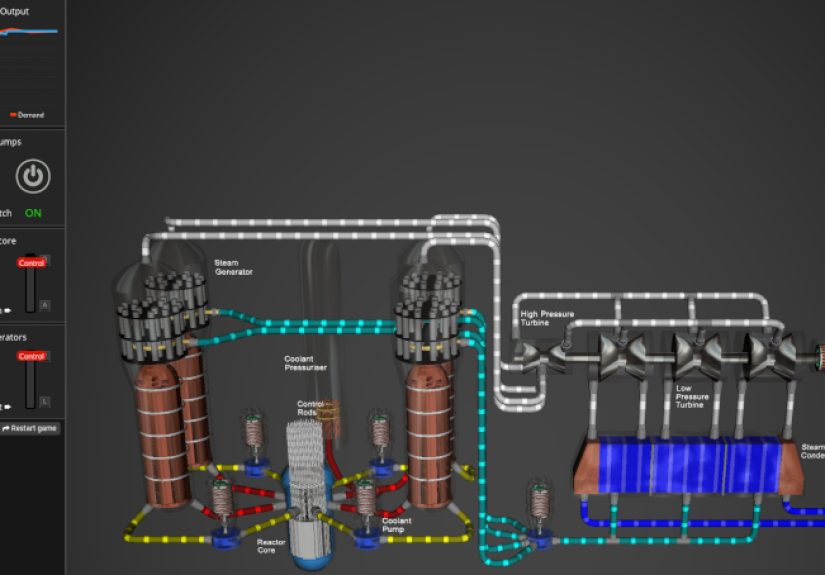
One of the most accessible examples is the browser-based pressurized water reactor simulator from the University of Manchester’s Dalton Nuclear Institute. It welcomes users into a virtual PWR and challenges them to power the nation while matching energy demand. It is simplified, friendly, and much safer than learning by wandering into an actual control room wearing flip-flops and confidence.
At the professional level, virtual control rooms are much more detailed. Idaho National Laboratory’s Human System Simulation Laboratory, for example, can represent different control room formats and test new digital interfaces before they are used in commercial nuclear plants. NuScale-style small modular reactor simulation labs have also been installed at U.S. universities and research centers to help students, researchers, and the public understand next-generation reactor behavior.
How Nuclear Reactors Work: The Friendly Version
Most people hear “nuclear reactor” and immediately picture complexity stacked on complexity, with a few warning lights for dramatic effect. The science is serious, but the basic energy pathway is surprisingly familiar: make heat, make steam, spin a turbine, generate electricity.
Fission Creates Heat
Inside a reactor, atoms split through a process called nuclear fission. This releases energy as heat. That heat is the starting point for electricity generation. In many commercial reactors, fuel rods sit inside a reactor vessel, surrounded by water that helps manage the reaction and move heat away from the core.
Water Does Several Jobs
In light-water reactors, water is a multitasker. It acts as a coolant, carrying heat away from the fuel. It can also act as a moderator, slowing down neutrons so the chain reaction can continue efficiently. The United States mainly uses two types of light-water reactors: pressurized water reactors and boiling water reactors.
Control Rods Help Regulate the Reaction
Control rods absorb neutrons. When inserted deeper into the reactor core, they reduce the number of neutrons available to continue fission, slowing the reaction. When withdrawn in a controlled way, they allow the reaction rate to increase. In a virtual simulator, these relationships may be represented with simplified controls and gauges so learners can see how tiny changes affect the larger system.
Steam Spins the Turbine
The heat produced by fission eventually creates steam or transfers heat to water that becomes steam. That steam spins a turbine connected to a generator. The generator produces electricity, which then goes to the grid. Strip away the mystery, and a nuclear plant is an extremely advanced way to boil waterwith a safety culture, engineering discipline, and regulatory framework wrapped around every step.
Why Operating a Reactor Virtually Is So Engaging
Reading about reactors is useful. Watching a diagram helps. But interacting with a simulation makes the concept click. The moment a learner adjusts a digital control and sees plant output change, nuclear energy stops feeling like a distant industrial topic and starts feeling like a system of connected decisions.
A virtual nuclear reactor makes users think like operators without giving them access to anything dangerous. You are not “running a reactor” in the real-world sense. You are exploring cause and effect inside a safe educational model. It is like a flight simulator for energy systems: useful, immersive, and unlikely to result in a stern call from federal regulators.
The game-like format also works because it rewards curiosity. Users can ask: What happens when electricity demand rises? Why does the plant not respond instantly? What does stable operation look like? Why do operators need training, teamwork, and careful procedures? The simulator turns those questions into interactive lessons.
Virtual Reactors and Real Operator Training
Professional nuclear reactor operators do not learn their jobs from a simple web game. They go through extensive classroom instruction, simulator training, on-the-job preparation, examinations, and licensing. In the United States, the Nuclear Regulatory Commission requires operator applicants to demonstrate knowledge and performance, including through operating tests that can involve plant-referenced simulators.
Commercial nuclear stations often maintain full-scope control room simulators that closely reproduce the actual control room. These simulators allow teams to practice normal operations, abnormal situations, equipment issues, communication routines, and emergency response without affecting a real plant. In other words, the simulator is where mistakes become lessons instead of headlines.
This is one of the biggest reasons virtual reactor technology matters. Nuclear plants are complex sociotechnical systems. The equipment matters, but so do the people, the interface design, the alarms, the teamwork, the procedures, and the timing of decisions. A virtual control room lets engineers and operators test how humans interact with technology before changes are introduced into real facilities.
The Rise of Small Modular Reactor Simulators
Small modular reactors, often called SMRs, are one of the most discussed developments in nuclear energy. They are designed to be smaller than traditional large reactors and may offer different construction, deployment, and operational models. Because many SMR designs are new, simulation plays an important role in education, research, and public understanding.
SMR simulation labs give students and researchers a front-row seat to plant behavior. They can observe how a virtual plant responds to inputs, study human-system interface design, and explore automation concepts. These tools are especially valuable because the next generation of reactors may use more digital controls, advanced diagnostics, and different control-room layouts than older plants.
For universities, a reactor simulator can be a bridge between theory and practice. Students who have studied thermodynamics, heat transfer, reactor physics, and electrical systems can see those subjects converge in one digital environment. Suddenly, the equations are not lonely symbols on a whiteboard. They are part of a living system that must balance safety, reliability, and power production.
What You Can Learn from a Browser-Based Reactor Simulator
A beginner-friendly virtual reactor will not make you a licensed operator, and that is a good thing. Nobody wants a world where someone says, “I played for twenty minutes, hand me the keys.” What it can do is teach foundational ideas in a memorable way.
Energy Demand Is Always Moving
Electricity demand changes throughout the day. People wake up, businesses open, air conditioners roar, factories run, and everyone charges every device they own as if preparing for a digital apocalypse. Simulators can show how power plants fit into this changing demand picture.
Stability Matters
A nuclear power plant is not operated by randomly pushing buttons and hoping the graph looks pretty. Stable operation is the goal. Virtual tools help learners see why smooth changes, monitoring, and system awareness matter.
Power Plants Are Systems, Not Single Machines
A reactor is part of a larger plant that includes cooling systems, pumps, turbines, generators, sensors, valves, and electrical equipment. Educational simulators simplify this complexity, but even simplified models reveal that energy production depends on many connected parts.
Safety Is Built Into the Culture
Nuclear energy is shaped by procedures, regulation, redundancy, training, and conservative decision-making. A good simulator does not merely show that reactors produce electricity; it hints at why the industry spends so much time practicing, testing, reviewing, and improving.
Why Virtual Nuclear Education Matters Now
Nuclear energy is back in the spotlight for several reasons. Electricity demand is growing. Data centers are hungry. States and companies are looking for reliable low-carbon power. Existing reactors remain major electricity producers. Advanced reactors promise new possibilities, while also raising practical questions about licensing, construction, cost, workforce development, and public trust.
Virtual reactors help with one of the hardest parts of that conversation: making nuclear energy understandable. Many people have strong opinions about nuclear power but limited exposure to how reactors actually work. Simulators give teachers, students, policymakers, journalists, and curious readers a more concrete starting point.
They also help address workforce needs. If the nuclear sector expands, it will need engineers, operators, technicians, cybersecurity specialists, software developers, safety analysts, construction workers, communicators, and regulators. A student who first encounters nuclear energy through an interactive simulator may later study mechanical engineering, nuclear engineering, electrical systems, computer science, or energy policy.
Virtual Reality, Digital Twins, and the Future Control Room
The phrase “virtual reactor” can mean many things. In education, it may mean a simplified game. In engineering, it may mean a high-fidelity model that predicts how a reactor system behaves. In training, it may mean a digital control room. In research, it may mean a digital twina model that mirrors real or proposed equipment closely enough to support analysis and decision-making.
Idaho National Laboratory’s RELAP5-3D, for example, is used to model complex behavior in reactor systems and can support training simulators. Other simulation environments help researchers study human factors, advanced controls, cyber resilience, and plant automation. Virtual reality systems can also let students explore spaces that would be difficult, expensive, or impossible to visit frequently.
This matters because future plants may not look exactly like the control rooms of the past. Digital displays, automation, advanced sensors, and remote monitoring could reshape how operators interact with reactors. Before those ideas become standard, researchers need to test them. A virtual control room is the perfect place to ask, “Does this help the operator understand the plant faster, or did we just create a very expensive confusion machine?”
What Makes a Good Nuclear Reactor Simulator?
A strong educational simulator does not need to include every technical detail. In fact, too much detail can overwhelm beginners. The best virtual reactor experiences usually share a few qualities.
First, they make cause and effect clear. When a user changes a setting, the simulator should show a meaningful response. Second, they use plain language. A learner should not need a PhD to understand the first screen. Third, they include context, not just controls. Labels, diagrams, tutorials, and short explanations help users connect actions to concepts.
Fourth, they respect safety. The goal is education, not imitation of sensitive operations. Simulators designed for public learning should avoid turning real-world procedures into a checklist. Finally, they should encourage reflection. The best question after a simulation is not “Did I win?” but “What did I learn about energy systems?”
Experiences Related to “Operate Your Own Nuclear Reactor, Virtually”
The first experience many users have with a virtual reactor is surprise. The screen may look like a game, but the lesson sneaks up quickly: electricity is not magic, and matching supply with demand requires attention. One moment you are casually adjusting virtual output; the next, you are staring at performance numbers wondering why your imaginary power station is not impressed with your leadership style.
A useful way to approach the simulator is to treat it like a guided museum exhibit. Do not rush. Click the information points. Read the labels. Watch how the plant diagram connects the reactor, steam system, turbine, and generator. The goal is not to dominate the leaderboard. The goal is to understand why every part of the system exists.
Another rewarding experience is using the simulator with a group. In a classroom, one student can watch demand, another can track plant output, and another can explain what changed. Suddenly, the activity becomes a miniature control-room exercise. People start communicating, predicting, debating, and occasionally blaming the person who adjusted the wrong setting. That is part of the fun, and it mirrors a real lesson: complex systems depend on clear communication.
For self-learners, the simulator can become a launchpad. After playing, look up the difference between a pressurized water reactor and a boiling water reactor. Study why water is used as a coolant and moderator. Learn what turbines do. Compare nuclear plants with coal, gas, hydro, wind, and solar generation. The virtual reactor becomes the doorway into a larger energy literacy journey.
One of the most interesting personal takeaways from using a virtual reactor is how calm the process feels when it is presented well. Popular culture often portrays nuclear technology as blinking lights, countdowns, and dramatic alarms. A simulator shows the opposite: careful monitoring, steady adjustments, system balance, and respect for procedure. That quietness is educational. It helps replace vague fear with informed caution.
For future engineers, the experience can also reveal how many disciplines meet inside one plant. Nuclear engineering is there, of course. But so are mechanical engineering, electrical engineering, materials science, computer modeling, human factors, cybersecurity, environmental science, emergency planning, and public policy. A virtual reactor is not just a reactor lesson; it is a career map disguised as an interactive challenge.
The best part is that nobody needs special equipment to begin. A browser-based simulator can give a learner the first spark of understanding. A university lab can deepen that spark with professional tools. A full-scope simulator can prepare trained operators for real responsibility. Each level has a different purpose, but they all point in the same direction: better understanding through safe practice.
So, should you operate your own nuclear reactor, virtually? Absolutelyif your goal is to learn, explore, and appreciate the engineering behind one of the world’s most powerful energy sources. Bring curiosity. Bring patience. Bring a sense of humor for the moment your digital plant underperforms. Just leave the real reactors to licensed professionals with years of training, rigorous exams, and considerably fewer snacks near the control panels.
Conclusion
Virtual nuclear reactor simulators make nuclear energy easier to understand without oversimplifying its importance. They show how fission creates heat, how heat becomes electricity, how control systems support stability, and why training matters so much in real-world operations. From browser games to university SMR labs and advanced control-room simulations, virtual reactors are helping students, researchers, and the public explore nuclear power in a safe, engaging, and memorable way.
For anyone curious about clean energy, engineering, or the future of the electric grid, operating a nuclear reactor virtually is more than a clever online activity. It is a hands-on introduction to one of the most sophisticated technologies humans have built. And unlike a real reactor, this one lets you learn by experimenting, laughing at your score, and trying again.





 Close
Close