
Table of Contents >> Show >> Hide
- Introduction: Wait, a CPU in TypeScript?
- What RISC-V Actually Is
- Why TypeScript Enters the Chat
- Emulator vs. Hardware Description: Do Not Confuse the Twins
- How a Tiny RISC-V CPU Works
- Why RISC-V and TypeScript Make a Good Learning Pair
- The Role of Open-Source FPGA Tools
- Where WebAssembly Fits
- Practical Benefits of Building RISC-V in TypeScript
- The Limitations: TypeScript Is Not a Magic FPGA Wand
- Who Should Try RISC-V in TypeScript?
- Experience Section: What It Feels Like to Build RISC-V in TypeScript
- Conclusion: The Weird Idea That Makes Sense
Note: This article is written for web publication and synthesizes real technical information about RISC-V, TypeScript, FPGA workflows, emulators, and open-source hardware tools.
Introduction: Wait, a CPU in TypeScript?
At first glance, the phrase “RISC-V in TypeScript” sounds like something whispered by a sleep-deprived developer at 2:17 a.m. after too much coffee and one very persuasive YouTube recommendation. RISC-V is an instruction set architecture, the low-level contract between software and processor hardware. TypeScript is the language many developers use to build web apps, APIs, dashboards, and the occasional todo list that somehow becomes a startup. These two worlds should not meet at brunch.
And yet, they do. The idea behind RISC-V in TypeScript is not merely writing a toy simulator that pretends to be a CPU. That can be useful, but it is only the first layer of the onion. The more interesting version is using TypeScript as a high-level way to describe digital hardware, generate Verilog, test behavior, and potentially run the resulting design on an FPGA. In plain English: you can use a familiar software language to explore how a processor works, and in some workflows, move from code to actual programmable hardware.
This is where RISC-V becomes a perfect teaching partner. Because RISC-V is open, modular, and relatively clean compared with older instruction sets, it gives developers a readable path into computer architecture. TypeScript, meanwhile, adds types, structure, editor support, interfaces, and refactoring tools. Put them together and you get a surprisingly approachable bridge between web development and hardware design.
What RISC-V Actually Is
RISC-V is an open standard instruction set architecture, commonly shortened to ISA. An ISA defines the instructions a processor understands: load this value, add those registers, branch if a condition is true, store data in memory, and so on. It does not describe one specific chip. Instead, it is a specification that many different chip designers can implement.
The “RISC” part stands for Reduced Instruction Set Computer. The design philosophy favors simple, regular instructions that are easier to decode, pipeline, optimize, and reason about. The “V” is pronounced “five,” because it came from the fifth generation of RISC research at UC Berkeley. Thankfully, nobody decided to call it “Reduced Instruction Set Computer Five: Electric Boogaloo.”
One of the reasons RISC-V is exciting is its modularity. The base integer instruction set can be extended with optional features such as multiplication, atomics, floating-point instructions, compressed instructions, vector operations, and more. A tiny embedded controller and a high-performance application processor do not need the same features. RISC-V lets designers choose what fits.
Why RV32I Is Often the Starting Point
For educational projects, many developers begin with RV32I, the 32-bit base integer instruction set. It includes 32 general-purpose registers, each 32 bits wide. Register x0 is hardwired to zero, which sounds odd until you realize how many instructions become simpler when zero is always available. Need to move a value? Add it to zero. Need to compare against zero? There it is, sitting politely in x0, doing absolutely nothing with great consistency.
RV32I is compact enough to implement in a student project but complete enough to teach real architectural ideas. You learn instruction encoding, program counters, register files, memory access, branches, immediate values, ALU operations, and control signals. In other words, it is the computer architecture buffet without forcing you to eat the entire data-center casserole.
Why TypeScript Enters the Chat
TypeScript is JavaScript with syntax for types. That simple description hides a big advantage: TypeScript helps developers model systems with clearer contracts. Types make it easier to represent signals, registers, instructions, opcodes, state machines, and module interfaces. When you are building a CPU model, those contracts matter. A mislabeled bit field can turn your elegant processor into a tiny electronic goblin.
In a typical software emulator, TypeScript can represent memory as typed arrays, registers as numeric arrays, and instructions as decoded objects. You can create functions for fetch, decode, execute, memory, and write-back stages. You can run small programs, inspect registers, and debug behavior in a browser or Node.js environment.
But the more surprising path is hardware description. Projects such as gateware-ts explore the idea of using TypeScript to describe hardware modules and generate Verilog. Verilog is a traditional hardware description language used to model digital circuits. If TypeScript can generate valid Verilog, then a developer can potentially use familiar tooling while still targeting real FPGA workflows.
Emulator vs. Hardware Description: Do Not Confuse the Twins
When people hear “RISC-V in TypeScript,” they often imagine an emulator. That is one valid interpretation. An emulator is software that mimics the behavior of a processor. It reads RISC-V instructions and performs equivalent operations using the host machine. This is excellent for learning, debugging, and building browser-based educational tools.
A hardware description is different. It describes logic that can become actual circuits. Instead of saying, “Run this instruction now,” hardware description asks, “What wires, registers, multiplexers, and state transitions should exist so this instruction can run?” That is a different mental model. Software executes step by step. Hardware exists all at once, which is both beautiful and mildly rude to the average programmer’s brain.
A TypeScript RISC-V Emulator
A TypeScript emulator can be clean and practical. You might define a CPU class with registers, memory, and a program counter. The emulator fetches a 32-bit instruction, decodes opcode fields, identifies the instruction type, and updates state. For example, an ADD instruction reads two source registers, adds their values, and writes the result to a destination register. A branch instruction changes the program counter when a comparison succeeds.
This approach is excellent for web demos. Students can type assembly, run it instantly, and watch registers change. A browser-based RISC-V emulator can make low-level programming feel less like ancient wizardry and more like an interactive lab. It also avoids the first-week pain of installing toolchains, configuring boards, and wondering why a USB driver has chosen violence.
A TypeScript Hardware Design
A TypeScript hardware design is more ambitious. Here, TypeScript does not simply simulate instructions; it helps define components such as an ALU, register file, control unit, instruction decoder, and pipeline stages. The design may then be converted into Verilog, synthesized with tools such as Yosys, placed and routed with FPGA tooling, and loaded onto compatible hardware.
This workflow matters because it lowers the intimidation barrier. Many software developers find Verilog unfamiliar, not because hardware is impossible, but because the syntax and design style require a different mindset. TypeScript cannot magically remove timing constraints, clock domains, or metastability. Sorry. Physics remains undefeated. But it can make the first steps friendlier.
How a Tiny RISC-V CPU Works
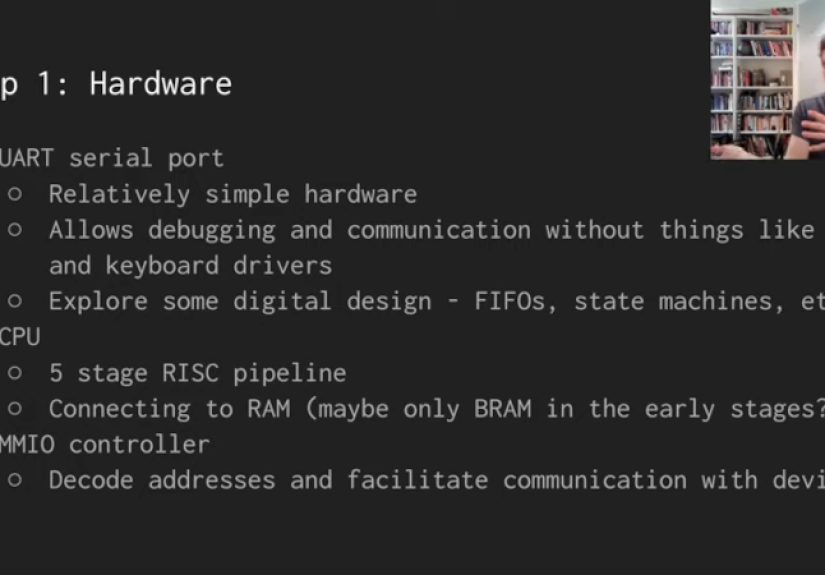
To understand the appeal, let us walk through a simple RISC-V CPU. A minimal design has a program counter, instruction memory, register file, ALU, data memory, and control logic. The program counter points to the next instruction. The CPU fetches that instruction, decodes it, reads registers, performs an operation, optionally accesses memory, writes back a result, and advances the program counter.
For RV32I, many instructions are 32 bits wide. The instruction contains fields that identify the opcode, destination register, source registers, function bits, and immediate values. Decoding is the act of pulling those fields apart. It is a bit like opening a bento box where every compartment contains either lunch or a control signal.
The ALU: The CPU’s Pocket Calculator
The arithmetic logic unit, or ALU, performs operations such as addition, subtraction, bitwise AND, OR, XOR, and shifts. In a TypeScript model, the ALU might be a function that takes an operation code and two input values. In a hardware description, the ALU becomes combinational logic: when inputs change, outputs respond according to the selected operation.
For a beginner, implementing the ALU is often the first “aha” moment. Suddenly, instructions are not mysterious. ADD is not magic. It is a decoded control signal selecting an adder. Shift left is not a spell. It is logic moving bits. The computer stops being a black box and starts looking like a very organized collection of tiny decisions.
The Register File: Thirty-Two Tiny Lockers
RISC-V’s register file is another elegant teaching tool. In RV32I, there are 32 integer registers. Software refers to them as x0 through x31, with conventional names like sp, ra, and a0 used by the calling convention. In a simple CPU, the register file usually supports reading two registers and writing one register each cycle.
The special zero register is helpful because it simplifies instruction patterns. Any write to x0 is ignored, and any read from x0 returns zero. That rule sounds like a prank until you implement it and realize it removes a surprising amount of clutter.
Why RISC-V and TypeScript Make a Good Learning Pair
RISC-V is readable. TypeScript is approachable. Together, they create a powerful educational combination for developers who know software but want to understand hardware. You can model instructions with enums, use interfaces for decoded instruction formats, write unit tests for each instruction, and use modern tooling to catch mistakes.
Software developers already understand abstraction. They understand modules, APIs, types, and tests. A TypeScript-based RISC-V project reuses those instincts. Instead of beginning with a dense HDL textbook, learners can start with familiar code and gradually discover where hardware differs from software.
Specific Example: Decoding an ADD Instruction
Imagine a 32-bit RISC-V ADD instruction. It contains fields for opcode, rd, funct3, rs1, rs2, and funct7. A TypeScript decoder can isolate those fields using bit masks and shifts. The emulator can then check that opcode and function fields match the ADD pattern. After that, it reads rs1 and rs2, adds them, and writes the answer to rd.
In a hardware-description workflow, the same concept becomes signal routing. The instruction bits feed into decoder logic. The decoder selects the ALU operation. The register file supplies inputs. The ALU output returns to the destination register. The concept is the same, but the execution model changes from “do this next” to “connect this logic.” That shift is the whole lesson.
The Role of Open-Source FPGA Tools
A TypeScript-to-Verilog RISC-V design becomes more interesting when paired with open-source FPGA tools. Yosys can synthesize Verilog into a lower-level representation. Verilator can simulate and lint Verilog or SystemVerilog designs. Other tools handle placement, routing, and bitstream generation for supported FPGA families.
This ecosystem gives independent developers a realistic path from idea to experiment. Not every design will be production-grade. Not every board will be supported by a fully open flow. But the path is real enough to learn from, and learning is the point. A blinking LED is nice. A self-built CPU blinking an LED is the kind of thing that makes engineers grin like they have discovered fire with a USB cable.
Where WebAssembly Fits
WebAssembly also appears in the RISC-V-in-the-browser conversation. Some RISC-V emulators are written in languages such as Rust or C++ and compiled to WebAssembly, allowing them to run efficiently inside the browser. This is different from writing the emulator directly in TypeScript, but it serves a similar educational goal: make RISC-V accessible without specialized hardware.
WebAssembly provides a sandboxed, portable execution environment. For browser-based CPU labs, that matters. A student can open a page, load a small RISC-V program, and observe execution. The browser becomes a tiny computer architecture classroom. No soldering iron required, although the soldering iron will still stare at you from the desk, hoping for attention.
Practical Benefits of Building RISC-V in TypeScript
The biggest benefit is clarity. TypeScript encourages explicit models. You can define instruction formats as types, make illegal states harder to represent, and add tests around each operation. That is useful whether the project is an emulator or a hardware generator.
The second benefit is accessibility. Many developers already know JavaScript or TypeScript. Meeting them where they are helps them move toward lower-level systems. A TypeScript RISC-V project can become the bridge from web development to assembly, CPU architecture, FPGA design, and compiler toolchains.
The third benefit is experimentation. Because RISC-V is modular, developers can start with RV32I and add features gradually. First comes arithmetic. Then loads and stores. Then branches. Then maybe multiplication, compressed instructions, interrupts, or peripherals. Each feature teaches a new architectural idea without requiring a leap into chaos.
The Limitations: TypeScript Is Not a Magic FPGA Wand
There are real limitations. Hardware design is not just software with extra semicolons. Timing matters. Clock boundaries matter. Resource usage matters. Synthesis tools may interpret constructs differently than expected. A design that simulates correctly may still fail timing or behave badly on real hardware.
TypeScript can make hardware design more approachable, but it cannot erase the need to understand digital logic. You still need to know what a register is, what combinational logic is, why latches can sneak into designs, and why “it worked in simulation” is not a legal defense in the court of silicon.
Performance and Correctness Challenges
For emulators, performance depends on decoding efficiency, memory representation, and host runtime behavior. JavaScript engines are fast, but a TypeScript emulator is still software pretending to be hardware. For hardware generation, correctness depends on the quality of the abstraction and generated Verilog. Debugging can involve both TypeScript source and emitted hardware code, which sometimes feels like debugging a translator who is also debugging you.
Still, these challenges are manageable for educational and experimental work. In fact, they are valuable. They force developers to ask better questions: What is an instruction? What is state? What happens in one clock cycle? What does it mean to execute code? These questions are the doorway to real systems knowledge.
Who Should Try RISC-V in TypeScript?
Web developers who are curious about hardware should absolutely explore it. So should students learning computer architecture, educators building visual labs, embedded developers wanting a clearer mental model of RISC-V, and hobbyists who enjoy projects that make friends say, “You built what in what?”
It is also useful for people interested in compilers. Once you understand how RISC-V instructions execute, compiler output becomes less mysterious. You can compile small C programs for RISC-V, inspect the assembly, and run them in an emulator. Suddenly, high-level code has a visible path down to machine behavior.
Experience Section: What It Feels Like to Build RISC-V in TypeScript
Working on a RISC-V TypeScript project feels like learning a new language inside a language you already know. At the beginning, everything seems familiar. You create files, write functions, define types, run tests, and enjoy your editor’s autocomplete. Then the CPU architecture concepts begin arriving, one by one, like guests at a party who brought oscilloscopes.
The first satisfying milestone is usually the register file. You write values into registers, read them back, and enforce the x0 rule. It is simple, but it feels important. You are no longer writing ordinary application code. You are modeling a rule that real processors follow. Then comes the ALU, and the project starts to breathe. Addition, subtraction, shifts, comparisons, and bitwise operations turn abstract binary strings into behavior.
Instruction decoding is where the project becomes serious. The first time you correctly decode an R-type instruction, it feels like unlocking a secret menu in the universe. The first time you decode an immediate incorrectly, it feels like the universe has filed a bug report against your confidence. Sign extension, bit positions, branch offsets, and instruction formats require patience. TypeScript helps because you can name everything clearly and test each decoder path. Still, the bits do not care about your feelings.
Branches are another memorable stage. Until branches work, programs are just polite lines marching forward. Once branches work, the CPU gains decision-making. Loops become possible. Conditions become possible. Bugs become dramatically more creative. Watching the program counter jump to a new address is weirdly thrilling, like seeing a tiny robot decide to turn left.
If the project moves toward hardware generation, the experience changes again. You start thinking less like a script writer and more like a circuit designer. You ask whether a value exists now, on the next clock edge, or as a result of combinational logic. This is the moment many software developers realize that hardware is not “running code” in the usual sense. Hardware is structure. The code describes the structure. That mental shift is the real prize.
Testing becomes your best friend. A good test suite can run small instruction programs, compare register states, validate memory results, and catch regressions when you refactor. It is tempting to skip tests because the project is “just for learning,” but that is how you end up staring at a wrong branch offset for three hours while blaming the compiler, the moon, and possibly your keyboard.
The most rewarding part is the moment when a tiny program runs successfully. Maybe it adds numbers. Maybe it loops through memory. Maybe it toggles a simulated output. It is not glamorous by app-store standards. Nobody will download “Add Two Registers Pro.” But emotionally, it hits harder than expected. You have built a small machine that understands instructions. That is a rare kind of fun.
RISC-V in TypeScript also changes how you see everyday computing. JavaScript stops feeling like the bottom of the stack. You become aware of layers: TypeScript, JavaScript, runtime, operating system, compiler, machine code, ISA, microarchitecture, gates. Each layer is a translation of intent. The computer becomes less magical and more impressive. Magic is vague. Engineering is magic with receipts.
For beginners, the best advice is to start small. Do not begin with Linux, virtual memory, interrupts, caches, and a five-stage pipeline unless your hobby is emotional damage. Start with RV32I arithmetic. Add loads and stores. Add branches. Write tiny programs. Test everything. Once the single-cycle model makes sense, then explore pipelining, hazards, forwarding, stalls, and peripherals.
In the end, building RISC-V in TypeScript is not about proving that TypeScript should replace Verilog everywhere. It should not. Traditional hardware description languages exist for good reasons. The real value is educational leverage. TypeScript gives a large community of developers a familiar doorway into processor design. RISC-V gives them an open, clean architecture worth exploring. Together, they make low-level computing less intimidating, more playful, and far more approachable.
Conclusion: The Weird Idea That Makes Sense
RISC-V in TypeScript sounds strange until you understand the goal. It is not about turning every web developer into a chip designer overnight. It is about building a bridge. RISC-V provides an open, modular architecture that is ideal for learning. TypeScript provides familiar syntax, type safety, tooling, and structure. Together, they create a practical way to explore emulation, hardware description, FPGA workflows, and the deeper mechanics of computing.
For educators, it can make computer architecture more interactive. For developers, it can demystify processors. For hobbyists, it is a wonderfully nerdy project with real technical substance. And for anyone who has ever wondered what happens beneath the layers of frameworks, runtimes, and operating systems, a TypeScript RISC-V project offers a direct answer: bits move, registers change, instructions execute, and suddenly the machine feels a little less mysterious.






 Close
Close