
Table of Contents >> Show >> Hide
- The Twitter Thread That Turned Teachers Into Accidental Acrobats
- Why Do Teachers Stand (And Sit) Like That?
- The Hidden Toll of Teaching on the Body
- Classroom Memes as a Love Letter to Teachers
- Where the Line Is: Humor, Privacy, and Respect
- How Teachers Can Protect Their Backs (Without Losing the Laughs)
- Real-Life Experiences: When Teacher Poses Become Classroom Lore
- Conclusion: Laugh, Appreciate, and Maybe Stretch a Little
If you ever thought your teacher’s spine was made of regular bones, the internet is here to prove you wrong.
When students started sharing photos of teachers leaning over desks, squatting in impossible half-lunges,
or casually sitting like a pretzel while explaining algebra, Twitter turned into a live-action yoga catalog.
Bored Panda rounded up 26 of the funniest pictures and turned these everyday classroom moments into viral fame
and low-key, an entire generation collectively realized: teachers will sacrifice their posture for your education.
But behind every “pre-calc teacher in a full lunge” or “sociology professor with one leg up the wall” is a bigger story
about how teaching really works: long days, awkward furniture, and a whole lot of dedication.
These memes are hilarious, surebut they also reveal how much energy teachers pour into helping students understand
what’s happening on the whiteboard, the worksheet, or that very confusing group project.
The Twitter Thread That Turned Teachers Into Accidental Acrobats
The viral thread that inspired the Bored Panda collection started the way a lot of great internet content does:
with one deeply relatable photo and a student calling out a universal experience.
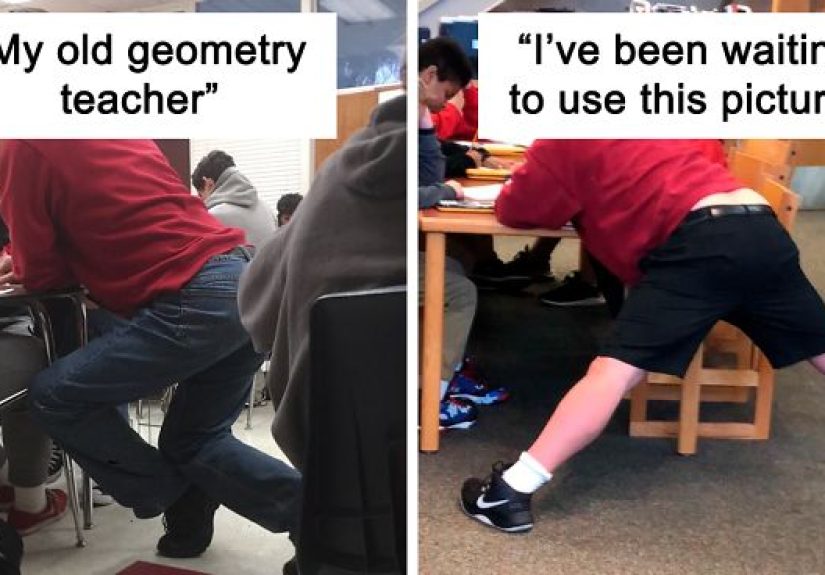
A geometry teacher is frozen mid-lean, one knee bent at a dramatic angle,
body weight supported by a single hand on the desk. Someone replies with
“Must be all geometry teachers,” and suddenly the floodgates open.
Students from all over start dropping shots of their own “leaning legends.”
You’ve got:
- The Half-Push-Up Stance: The English teacher who looks like they accidentally started a plank challenge while checking your thesis statement.
- The Flamingo Lean: The math teacher balancing on one leg while explaining how to factor polynomials, as if gravity is merely a suggestion.
- The Desk Hover: The science teacher who somehow manages to support their whole upper body on their elbows while hovering over your lab worksheet.
- The Wall-Sit Plus Bonus Leg: The sociology teacher sitting against the wall, one leg straight up, casually talking about social norms like this is perfectly normal.
Each tweet comes with a caption that makes the pose even funnier:
“My old chem teacher,” “pre-calc teacher,” “my old social studies teacher”
as if weird leaning is simply part of the job description.
And honestly? It kind of is. Teachers are constantly bending over desks,
walking between rows, crouching to a student’s eye level, or twisting to write
on the board while answering a question.
Why Do Teachers Stand (And Sit) Like That?
As tempting as it is to believe that teachers are just practicing for a secret Cirque du Soleil audition,
there’s a more practical explanation: classrooms are not exactly ergonomic wonderlands.
Desks are small, rows are tight, and most rooms were designed
with “how many bodies can we fit in here?” in mindnot “how can adults help kids comfortably at eye level?”
Picture a typical scene: a teacher is trying to help a student who’s seated at one of those small combo desks.
There’s barely room to walk between rows, much less pull up a chair.
Standing straight beside the desk blocks the aisle; kneeling on the floor is awkward and hard on the knees.
So what happens? The teacher leans. One leg back for balance, one hand braced on the desk,
torso angled toward the student’s notebook. It’s half ergonomics, half survival instinct.
Then there’s the “permanent squat” move: to get closer to a paper without bending fully at the waist,
many teachers drop into a partial lunge, hoping it’ll save their lower back.
Spoiler: it doesn’t always workbut it does make for excellent photos.
And when you’ve spent all day standing, that random choice to sit sideways,
legs up on the wall, can feel like the only way your spine remembers what relief is.
The Hidden Toll of Teaching on the Body
Underneath the jokes, these viral images highlight something serious: teaching is physically demanding.
Long periods of standing, frequent bending, twisting to write on boards,
and leaning over low desks can all contribute to back, neck, shoulder, and leg pain over time.
Many ergonomics and chiropractic experts point out that teachers face
similar strain to office workersjust with more walking, more awkward angles,
and less control over their environment.
Common issues teachers report include:
- Lower back pain from standing on hard floors, leaning over desks, and twisting repeatedly.
- Neck and shoulder tension from looking down at papers or up at screens and projectors all day.
- Hip and knee strain from those half-squat positions and quick transitions between sitting and standing.
- Foot pain from hours spent on their feet in less-than-ideal footwear or without supportive mats.
Ergonomics specialists recommend simple but powerful adjustments:
raising or lowering desks where possible, using stools for moments of rest while lecturing,
switching between sitting and standing, and taking micro-breaks to stretch or walk around.
Something as small as keeping feet flat on the floor, maintaining a neutral spine,
or positioning materials at eye level can dramatically reduce long-term strain.
Of course, none of that stops a dedicated teacher from diving into a weird stretch
mid-lesson if that’s what it takes to reach a student’s paper and fix a dangling modifier.
But understanding the physical wear and tear behind these funny photos
adds a layer of respect to the laughter.
Classroom Memes as a Love Letter to Teachers
Teacher memes are basically the internet’s way of saying,
“We notice how hard you’re working… and also, we can’t believe you just tried to sit like that.”
From posts celebrating teachers’ comebacks and creative lesson plans to
threads about grading, exhaustion, and online classes,
social media has turned these everyday heroes into endlessly relatable, shareable content.
What makes these “weird position” photos so memorable isn’t just the physical comedy;
it’s the emotional context. Students are almost always smiling or smirking in the background.
The teacher is fully focused on explaining a concept, totally unaware they’re archiving
a new addition to “teachers doing the most” history. These are not mean-spirited callouts;
they’re affectionate snapshots of the way teachers throw themselves into the job.
When former students share these pics, it usually comes with a tone of nostalgia:
“My old chem teacher…” “My old geometry teacher…”
There’s pride mixed into the jokes.
Yes, that lunge looks like a chiropractor’s nightmarebut that’s also the teacher
who stayed after class, rewrote your essay outline with you,
or finally helped you understand how to balance equations.
The pose is funny; the memory, genuinely warm.
Where the Line Is: Humor, Privacy, and Respect
There’s another side to all this viral content, though, and it’s worth taking seriously:
teachers and students still exist in a professional, real-world relationship,
even when their lives show up online. Sharing photos or tweets about classroom moments
can be harmless funbut it can also cross boundaries if it exposes someone
to ridicule, violates school policies, or ignores privacy concerns.
Digital citizenship experts encourage students to think before posting:
- Would you say this to their face? If the caption would be cruel or humiliating in real life, it’s not “just a joke” online.
- Is the person identifiable? Blurring faces, cropping out other students, or avoiding names can help protect privacy.
- Does this break school rules? Many schools have explicit policies around filming in class or posting images of staff and students.
- Is there a power imbalance? Students posting about teachers are still part of a professional environment, and online content can affect careers.
Teachers themselves are increasingly warned about what they shareespecially pictures of studentson personal social media.
Many educators now default to school-approved channels, parental consent,
and privacy-first settings to keep kids safe and avoid misunderstandings.
In other words: classroom life absolutely belongs in the story of the internet age,
but it should show up in a way that protects everyone involved.
So yes, laugh at the teacher doing a full-body diagonal plank over a lab table.
Share the meme with your group chat. But when it goes public, make sure the joke still feels like appreciation,
not a takedown.
How Teachers Can Protect Their Backs (Without Losing the Laughs)
If you’re a teacher who’s ever seen one of these photos and thought,
“Oh no, that’s me,” there’s good news: you don’t have to give up your dramatic explanations
or desk-leaning habits entirelyyou just need a more body-friendly strategy.
1. Build a More Ergonomic Classroom Setup
Whenever possible, adjust the space instead of your spine.
That might mean arranging desks to create wider aisles,
using a rolling chair to move between students,
or adding a tall stool at the front of the room so you can sit while lecturing.
If your school allows it, a standing desk or podium can help you alternate
between standing and sitting more naturally.
2. Use Micro-Breaks and Stretching
Those little moments between classesor even during a transition from lecture to group workare golden.
A few seconds of shoulder rolls, gentle twists, or hamstring stretches can reset your posture
and keep stiff muscles from becoming chronic pain. Encouraging students to stretch with you
not only normalizes movement but also turns “back-saving time” into a fun classroom ritual.
3. Pay Attention to Footwear and Flooring
Standing on hard floors all day in unsupportive shoes is basically the final boss of teacher back pain.
Cushioned, supportive shoes and, when possible, anti-fatigue mats behind the main teaching area
can make a huge difference. It might not look as dramatic as a viral teacher lunge,
but your joints will be much happier.
4. Practice Intentional Posture (Most of the Time)
No one expects you to stand like a textbook diagram all day.
But being aware of how often you bend at the waist,
twist while lifting, or stand with all your weight on one leg
can help you avoid the extremes that show up in those legendary photos.
Think “neutral spine,” relaxed shoulders, and hips squared to the desk whenever you can.
And if you occasionally end up in a ridiculous position explaining calculus?
Hey, at least make sure the example on the board is worth the screenshot.
Real-Life Experiences: When Teacher Poses Become Classroom Lore
To really understand why these pictures hit so hard,
you only have to listen to how students talk about their teachers years later.
Ask someone about a favorite teacher, and there’s a good chance
they won’t start with test scores or homework policies.
They’ll tell you storiesstories that look a lot like these photos.
Maybe it’s the history teacher who jumped up on a desk to reenact a famous speech.
Everyone in the front row was half in awe, half terrified he might fall,
but no one forgot the lesson. Or the chemistry teacher who somehow managed
to lean across three lab stations at once, arms outstretched,
saving a beaker from disaster like an action-movie stunt double.
In the moment, it’s chaotic. In hindsight, it’s iconic.
One former student might remember how their English teacher always crouched next to their desk,
reading drafts aloud, elbow resting on the tiny writing surface
while the rest of their body contorted into a side lunge.
At the time, the student just thought,
“Why are you sitting like that?”
Years later, they realize: that teacher met them where they wereliterally and figurativelyevery single day.
Another student might recall a sociology professor who treated the classroom like a living room.
She’d sit backwards in a chair, one leg propped up,
or stretch her legs along the wall mid-discussion about power dynamics and social norms.
It looked strange, sure, but it also made the room feel less stiff and more human.
Her posture said, “We’re in this conversation together,” not, “I’m above you at the front of the room.”
Teachers themselves have their own side of the story.
Many will admit that yes, some of those positions are absolutely ridiculousand surprisingly comfortable for about 30 seconds.
Others confess that the weirdest poses usually happen in moments of total focus:
they’re so locked in on helping a student understand the problem
that they forget their body is doing something gravity-defying.
And then there’s the moment a teacher sees a screenshot of themselves online.
Sometimes they laugh first:
“Wow, I really did look like I was about to launch into orbit.”
Sometimes they wince and start stretching more.
Sometimes they gently remind students about what’s okay to post and what isn’t.
But almost every teacher recognizes the underlying truth:
those photos exist because they cared enough to lean all the way inliterallyto help.
In a way, the internet has accidentally created a new kind of yearbook.
Instead of stiff portrait photos and forced smiles,
we’re capturing the unguarded moments:
a teacher mid-squat, mid-joke, mid-explanation.
The poses look ridiculous out of context, but inside the classroom,
they’re just part of the rhythm of learning.
The viral thread, the memes, the tweetsthey’re all receipts of a deeper reality:
education is messy, physical, and full of people who are willing to twist themselves into knots
so someone else can finally say, “Ohhh, now I get it.”
So the next time you see a photo of a teacher in a strange leaning pose,
go ahead and laughbut maybe also take a second to appreciate the dedication,
the sore muscles, and the thousands of small, unnoticed efforts that go into every class.
Behind that weird position is a person who showed up, day after day,
determined to help someone learn something new.
Conclusion: Laugh, Appreciate, and Maybe Stretch a Little
The viral photos of teachers leaning over desks and sitting in bizarre positions are pure internet gold,
but they’re also a reminder that teaching is both intensely human and surprisingly physical.
Students get a lifetime supply of hilarious memories.
Teachers get sore backs, great stories, and occasionally, fifteen minutes of online fame.
If you’re a student, enjoy the memesbut remember the person in the frame.
If you’re a teacher, consider this your gentle nudge to stretch,
adjust your setup, and give your body a break now and then.
And if you’re just scrolling for fun, take these 26 tweets as a tiny tribute
to the people who will literally bend over backward to help someone learn.







 Close
Close