
Table of Contents >> Show >> Hide
- America Began as an Idea Before It Became a Superpower
- The Constitution Built a Country That Distrusts Concentrated Power
- “Out of Many, One” Is More Than a Motto
- The American Dream Still Lives HereEven When It Looks Tired
- The Contradictions Are Not Outside the StoryThey Are Inside It
- Landscape, Region, and Restlessness Also Shape the American Character
- So, What Is the DNA of the United States of America?
- Experiencing the DNA of America: A Longer Reflection
- Conclusion
- SEO Tags
If countries had DNA tests, the United States would probably come back with a wonderfully chaotic report: 99% contradiction, 100% confidence, traces of rebellion, optimism, reinvention, loud opinions, and at least one barbecue argument. But beneath the jokes and the fireworks lies a serious question: what actually makes America America?
The “DNA” of the United States is not biological, of course. It is civic, cultural, historical, and emotional. It lives in the country’s founding ideas, its political system, its immigrant story, its habit of arguing with itself in public, and its stubborn belief that tomorrow can be better than today. America is not held together by one ethnicity, one religion, one accent, or one historical memory. It is held together by a shared experiment: can a huge, diverse, noisy republic keep reinventing itself without losing its core?
That question is the whole show. And for nearly 250 years, the United States has answered it in the most American way possible: messily, dramatically, imperfectly, and often with suspiciously strong coffee.
America Began as an Idea Before It Became a Superpower
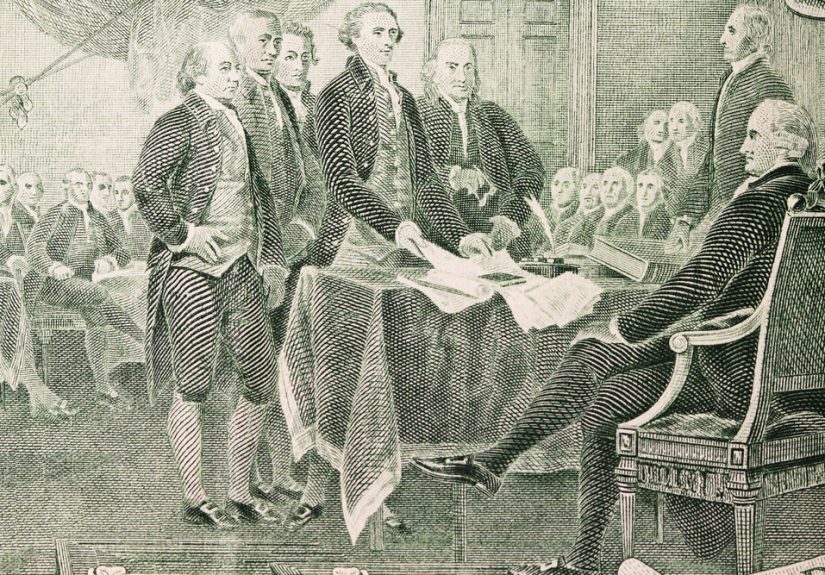
One of the most unusual things about the United States is that it was founded not only on land, armies, and borders, but on an argument. The American Revolution was a military conflict, yes, but it was also a philosophical statement. The country’s founding language centered on liberty, equality, rights, representation, and consent of the governed. In plain English, the early republic claimed that government exists to serve people, not the other way around.
That sounds obvious now, but in the eighteenth century it was explosive stuff. Monarchies did not exactly love the memo. America’s early identity came from this conviction that ordinary people should have a voice in power and a legal claim to freedom. Whether the nation lived up to those ideals is another matter entirely, and we will get to that uncomfortable family reunion in a moment.
The point is this: the United States was born with moral ambition baked into its national recipe. That recipe has often been ignored, revised, overcooked, and occasionally set on fire, but it remains the reference point. Americans return to founding language again and again because the country’s DNA includes the belief that ideals matter, even when reality is being rude about it.
The Constitution Built a Country That Distrusts Concentrated Power
If the Declaration supplied America’s poetic swagger, the Constitution supplied the engineering. The United States did not design a political system on the assumption that leaders would always be wise, noble, and allergic to ego. Quite the opposite. It was built on the suspicion that power needs supervision, and a lot of it.
Checks, Balances, and the National Talent for Arguing
The federal government was divided into legislative, executive, and judicial branches. Power was also divided between the national government and the states. This structure was not an accident. It was a deliberate effort to slow things down, force compromise, and make it difficult for any one faction to dominate too easily.
In other words, America’s political DNA includes friction. That is not a software bug. It is a design feature. The system is frustrating because it was meant to be. It can produce paralysis, but it can also prevent rushes toward tyranny. Americans complain about gridlock with Olympic-level skill, yet the deeper national instinct still favors limited power, divided authority, and a healthy skepticism toward anyone who says, “Trust me, I’ll handle everything.”
Freedom of Expression Is Not a Side Dish
The First Amendment is another major strand in the American helix. Religion, speech, press, assembly, and petition are not decorative rights in the U.S. imagination. They are central to the national self-image. Americans do not merely enjoy the right to disagree; they tend to do it recreationally.
This culture of expression has shaped every major reform era in U.S. history. Abolitionists used it. Suffragists used it. Civil-rights leaders used it. Labor organizers used it. Students, veterans, clergy, journalists, whistleblowers, comedians, and people with deeply alarming comment-section confidence have used it too. In the American story, speech is not just noise. It is one of the main tools for self-correction.
“Out of Many, One” Is More Than a Motto
The phrase E pluribus unum captures something essential about the United States. America is not a nation defined by one bloodline. It is a nation assembled from many origins into a shared political project. That does not mean harmony has been automatic. America has often struggled bitterly over who belongs, who counts, and who gets treated as fully American. Still, diversity is not incidental to the national identity. It is structural.
Immigration Is a Core Feature, Not a Footnote
The United States has long understood itself as a place of arrival and reinvention. Generations of immigrants have reshaped the country’s language, food, labor force, neighborhoods, religions, music, and business culture. The American identity is therefore unusually elastic. It is tied less to ancestry than to participation in a civic story.
That elasticity is one reason the country keeps renewing itself. Newcomers do not merely enter America; they continuously redefine it. The result is not a neat melting pot where all flavors disappear into bland soup. It is closer to a loud potluck where everyone brings something, a few dishes clash, and somehow the table still works.
Diversity Is the Reality, and Pluralism Is the Skill
Modern America is racially, ethnically, and religiously diverse, and that diversity is especially visible in younger generations. This matters because it pushes the country toward pluralism: the practical ability to live with difference without demanding total sameness. Pluralism is harder than it sounds. It requires institutions, rights, patience, compromise, and occasionally taking a deep breath before replying to a stranger online.
Yet this ability to build a shared civic identity across many backgrounds is one of the country’s defining strengths. The United States has repeatedly fought over inclusion, but it also has a long tradition of expanding the circle of belonging. The national DNA contains conflict, yes, but also enlargement.
The American Dream Still Lives HereEven When It Looks Tired
Another major genetic marker in the U.S. identity is the belief in upward mobility. Americans call it the American Dream, and even people who doubt it often speak its language. The idea is simple: where you start should not fully determine where you finish.
In practice, this promise has never been evenly distributed. Economic mobility has been real for many, limited for others, and sharply unequal across race, region, and class. But the power of the idea remains enormous. It continues to shape how Americans think about education, work, homeownership, entrepreneurship, and personal dignity.
This helps explain why the U.S. celebrates builders, inventors, founders, side hustlers, tinkerers, and anyone who has ever said, “I have a terrible but possibly brilliant business idea.” America’s admiration for self-starters is not random. It grows out of a deep cultural preference for agency, initiative, and reinvention.
Entrepreneurship Is Practically a National Accent
From family-owned shops to venture-backed startups, the United States has a long habit of turning ambition into institutions. The country values scale, invention, and risk in a way that is unusually visible. Americans do not just ask what a person does. They often ask what they are building, launching, fixing, pitching, or plotting in a garage.
This entrepreneurial streak is one reason the nation keeps producing new industries, new technologies, and new forms of economic life. The same culture that can generate excess, hype, and the occasional ridiculous app can also produce extraordinary creativity. The American mind has a persistent bias toward the next version.
Innovation Is a National Habit
The United States has long invested in research, invention, science, and commercial experimentation. Universities, federal programs, private firms, defense research, and startup culture have all helped create an environment where ideas move quickly from theory to prototype to business to global influence. Sometimes this produces lifesaving medical advances. Sometimes it produces a toothbrush with Bluetooth. America contains multitudes.
Either way, the pattern is clear: the country’s DNA includes a belief that the future is something you can build, not merely inherit.
The Contradictions Are Not Outside the StoryThey Are Inside It
Any honest analysis of the United States has to say this plainly: America’s national DNA includes both liberty and exclusion, both democratic ideals and profound injustice. The same nation that declared equality tolerated slavery. The same republic that celebrated freedom often denied it to Native peoples, women, immigrants, workers, and minorities. This is not a minor footnote with tiny print. It is central to the story.
The American character is therefore not just aspirational. It is corrective. Much of U.S. history consists of people forcing the country to become more faithful to its own principles. Abolition, Reconstruction, women’s suffrage, labor reform, civil rights, disability rights, marriage equality, and other struggles did not come from nowhere. They came from citizens insisting that the nation apply its stated ideals more honestly.
Civil Rights Rewrote the National Code
The civil-rights movement was one of the clearest moments when America confronted its own contradictions. Activists appealed not only to morality, but to the Constitution, citizenship, and national promise. They argued that the country was betraying its own creed. That strategy worked precisely because the American identity is rooted in ideals that can be invoked against injustice.
So yes, contradiction is part of the U.S. DNA. But so is self-revision. America wounds, resists, reforms, and redefines itself in recurring cycles. The country’s greatness, when it appears, often comes not from purity but from the capacity to admit failure and fight forward anyway.
Landscape, Region, and Restlessness Also Shape the American Character
America’s identity has also been shaped by geography. The frontier, the open road, the suburb, the skyline, the small town square, the factory belt, the farm, the coast, and the national park all sit inside the national imagination. Even the myths matter. The West represented possibility. Cities represented energy and collision. Parks represented shared beauty and democratic access. Regions developed strong local cultures, accents, loyalties, and moral vocabularies.
This is why the United States often feels like several countries wearing one trench coat. New England, the Deep South, the Midwest, the Mountain West, California, Alaska, Hawaii, and the mid-Atlantic do not always sound, vote, eat, or dream in the same way. Federalism helped make that possible. The nation’s DNA includes local variation as well as national unity.
That regional texture gives the country resilience. It also gives everyone more things to argue about. America would not be America without both regional pride and national ambition, preferably happening at the same barbecue.
So, What Is the DNA of the United States of America?
At its core, the DNA of the United States is made of several interlocking strands:
First, ideals. Liberty, equality, rights, citizenship, and government by consent remain the country’s moral vocabulary.
Second, institutions. Checks and balances, federalism, courts, elections, juries, and a free press create a system where disagreement is expected and power is contested.
Third, diversity. America is a nation assembled from many peoples, traditions, and beliefs into one civic project.
Fourth, reinvention. The country places unusual faith in mobility, entrepreneurship, experimentation, and second chances.
Fifth, contradiction. The United States carries both noble ideals and painful failures, and its history is shaped by the struggle to close that gap.
Put those together and you get something uniquely American: a nation that is never finished, never fully settled, and never short on opinions about itself.
Experiencing the DNA of America: A Longer Reflection
To experience the DNA of the United States is not just to read its documents or memorize its timelines. It is to move through its daily life and notice how the big national themes appear in ordinary moments. You feel it when you stand in a naturalization ceremony and watch people from different continents become citizens under the same flag. You feel it when a courtroom reminds jurors that justice depends on regular people showing up. You feel it when a protest marches down a city street with homemade signs and loud chants, because in America disagreement does not automatically mean disloyalty. Quite often, it means participation.
You also feel it in places that seem almost too ordinary to matter: the diner, the public library, the high school football game, the community college, the national park, the corner barbershop, the church basement, the union hall, the farmers market, the Fourth of July parade where nobody can agree on politics but everyone agrees the potato salad needs work. The American experience is deeply local even when the language around it is national. That is one reason the country can feel both united and fractured at the same time.
There is also something distinctly American in the tension between confidence and self-criticism. The country is capable of tremendous pride and tremendous anxiety, often before lunch. Americans celebrate freedom loudly, yet constantly debate what freedom requires. They praise individualism but depend heavily on institutions. They admire success but root for underdogs. They distrust government and then passionately demand that government solve problems. Contradiction is not a flaw in the performance. It is the performance.
Travel across the country and the DNA becomes even more visible. In one state, the story sounds like industry, grit, and unions. In another, it sounds like ranches, land, and self-reliance. In another, it sounds like immigration, innovation, and multilingual ambition. In another, it sounds like civil-rights memory, church traditions, military service, and family roots that run deep. And yet the same broad themes keep reappearing: liberty, opportunity, identity, fairness, belonging, and the future. Americans often disagree on the meaning of those words, but they keep using the same vocabulary. That shared language is part of the nation’s code.
Perhaps the deepest experience of America is the sense that the country is unfinished on purpose. It is not a museum piece sealed behind glass. It is a continuing argument about what freedom means and who gets to enjoy it fully. That can be exhausting. It can also be energizing. The United States asks its citizens, generation after generation, not merely to inherit the republic but to interpret it. That is a heavy assignment, but it is also the source of the country’s dynamism.
So if you want to understand the DNA of the United States, do not just look for symbols. Look for motion. Look for people arriving, debating, inventing, voting, protesting, building, remembering, and revising. Look for a nation that keeps trying to become what it says it is. That effortuneven, loud, imperfect, and strangely hopefulis the most American thing of all.
Conclusion
The United States of America is not defined by one tribe, one tradition, or one tidy historical storyline. Its DNA is made of ideas, institutions, diversity, ambition, conflict, and renewal. It is a country built on rights, tested by contradiction, enlarged by newcomers, and driven by the belief that reinvention is always possible.
That does not make America simple. It makes America alive. The national code is not static; it is something each generation interprets, challenges, and rewrites. And maybe that is the most accurate summary of all: the DNA of the United States is not perfection. It is a permanent experiment in becoming.





 Close
Close