
Table of Contents >> Show >> Hide
- Why the World Needed Tanks in the First Place
- The Road to Villers-Bretonneux
- The Morning the Future Rumbled Into View
- Why This Small Battle Mattered So Much
- The Battle After the Battle
- What the First Tank Duel Still Teaches Us
- Experiences From the First Tank-on-Tank Battle: What It Must Have Felt Like
- Conclusion
Military history is full of giant battles with giant names, but sometimes the moment that changes warfare forever looks strangely small. On April 24, 1918, near Villers-Bretonneux in France, a handful of British and German tanks blundered through fog, smoke, shellfire, and confusion and ran into one another. It was not a giant clash by later standards. It was not Kursk. It was not El Alamein. It was not even a massive armored operation by the rough-and-ready standards of World War I. But it was the first true tank-on-tank battle, and once that steel genie popped out of the bottle, it was never going back in.
That is what makes this episode so fascinating. The first tank-versus-tank fight did not arrive with polished doctrine, elegant engineering, or sleek machines built for the job. It arrived the way many military revolutions do: awkwardly, noisily, and with all the grace of a toolbox falling down a staircase. These early tanks were slow, hot, unreliable, hard to see out of, and hard to steer. Yet they pointed the way toward a future in which armored warfare would become one of the defining features of the twentieth century.
More than a century later, the first tank duel still feels like a hinge point in military history. It was a tiny encounter with enormous consequences, the moment when tanks stopped being merely mobile trench-busters and started becoming predators of other armored vehicles.
Why the World Needed Tanks in the First Place
To understand why the first tank-on-tank battle mattered, you have to start with the problem tanks were built to solve. World War I had turned much of the Western Front into an industrial-strength nightmare: trenches, barbed wire, machine guns, artillery, mud, shell holes, and casualty lists long enough to need their own filing cabinets. Armies could pound each other for days, then order infantry forward, only to discover that machine guns were still very much awake and in no mood to negotiate.
The British answer was the tank, a tracked armored vehicle designed to cross torn ground, crush wire, survive small-arms fire, and help break the trench stalemate. The first tanks appeared at the Somme in September 1916. Their debut was dramatic but messy. Many broke down, some never reached their starting points, and nobody watching would have confused them with the elegant war machines of a later age. Still, they proved that an armored tracked vehicle could crawl across cratered ground where ordinary wheeled vehicles were useless. That was enough to keep the idea alive.
By 1917, the British had improved the concept and were using tanks in larger numbers. The Battle of Cambrai became the great proof-of-concept moment. There, tanks showed what they could do on firmer ground when used in concentration rather than sprinkled around like battlefield seasoning. Tanks were still imperfect, but now they were no longer a weird experiment. They were a developing arm of war.
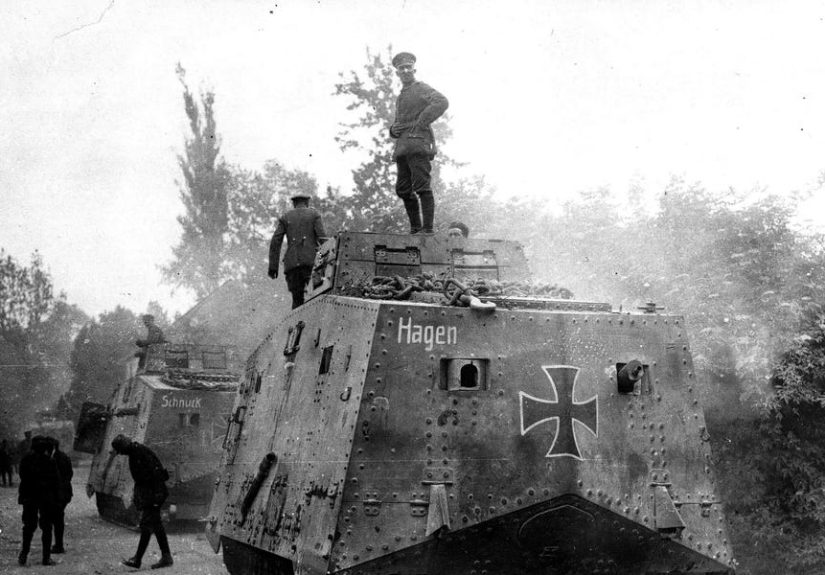
The Germans, meanwhile, had been slower to embrace tanks. German commanders recognized the danger of Allied armor, but they initially leaned more heavily on anti-tank measures such as artillery, armor-piercing ammunition, and tactical adjustments. Eventually Germany built its own tank, the A7V. Only a small number were made, which tells you something important right away: in 1918, Germany was still not a tank power in the way Britain was becoming one. But even a few armored vehicles could make a difference when used at the right time, in the right place, against already battered troops.
The Road to Villers-Bretonneux
By spring 1918, the war had entered a decisive phase. Russia was out. Germany shifted forces west and launched a major offensive before American power could be felt in full. The strategic target in this sector was Amiens, a vital rail hub. If the Germans could threaten or seize it, Allied coordination would suffer badly.
Villers-Bretonneux sat on key ground east of Amiens. That made it more than a village with a difficult-to-spell name. It was part of the shield protecting a crucial Allied position. On April 24, 1918, German forces attacked in the area with infantry, artillery, gas, smoke, and tanks. The battlefield was drenched in fog and chaos, which was normal for World War I and especially normal for any event that would later become famous.
The Germans committed A7V tanks to the operation, while the British had Mark IV tanks in the sector. The British Mark IV was a lumbering rhomboid machine built to cross trenches and support infantry. It came in “male” and “female” versions. The male carried two 6-pounder guns in side sponsons plus machine guns. The female relied on machine guns only. The German A7V, by contrast, was taller, boxier, and mounted a front-facing 57 mm gun along with multiple machine guns. It had strengths, especially in frontal firepower, but it was not exactly a ballet dancer over rough ground.
So there they were: two awkward early tank designs, both created primarily for attacking infantry positions, both suddenly discovering that the battlefield had other ideas.
The Morning the Future Rumbled Into View
The famous encounter unfolded near Cachy, close to Villers-Bretonneux. As German infantry advanced with A7Vs through fog and smoke, British tanks moved to respond. This is where the battle stopped being a historical trend and turned into a story.
Three British Mark IVs entered the fight. Two were female tanks, armed only with machine guns. One was a male tank commanded by Lieutenant Frank Mitchell. On the German side were three A7Vs, including one named Nixe. Even now, the name sounds almost too neat for history, as if someone in a war archive decided the first tank duel needed better branding.
The first moments were ugly for the British. The two female Mark IVs could not do much against the armor of the German tanks. Machine guns were excellent for suppressing infantry. They were much less persuasive when arguing with armored plate. German fire quickly disabled or drove off the female tanks, leaving Mitchell’s male Mark IV to face the enemy armor with actual cannon fire.
Now came the key lesson of the battle. Firing accurately from a moving World War I tank was extremely difficult. These machines bounced, rattled, lurched, and fought the ground as much as the enemy. Mitchell realized he had to stop to shoot well. That was dangerous, but it worked. His gunners fired carefully and hit Nixe. The German tank was damaged badly enough that its crew bailed out, fearing the vehicle might catch fire or explode. When Mitchell then engaged the other A7Vs, they withdrew.
And just like that, the first tank-on-tank battle in history was over. No giant armored corps had collided. No sweeping arrows on a war map had announced the birth of a new era. A few tanks met in a smoky field, one side proved cannon mattered more than machine guns in an armor duel, and military history quietly changed shape.
Mark IV vs. A7V: A Contest of Design Philosophy
The duel at Villers-Bretonneux was not just a clash between vehicles. It was a clash between design compromises. The British Mark IV was better at crossing trenches and mangled ground, thanks to its rhomboid shape and long tracks. It looked like an armored shed trying to climb over the moon, but in trench warfare that was a real advantage.
The German A7V had thicker armor in places and a strong forward gun, but it was tall, awkward, and vulnerable to difficult terrain. It also had serious visibility and mobility problems. On paper, each vehicle had strengths. On a wrecked battlefield, those strengths became conditional. The Mark IV could get around rough ground better. The A7V could hit hard from the front. Neither was ideal. Both were transitional machines built by armies still inventing armored warfare one noisy mistake at a time.
The battle also exposed the difference between male and female British tanks. The idea behind the split made sense in a trench-war context: one type would handle strongpoints, the other would rake infantry. But when tanks met tanks, that distinction suddenly looked much less clever. A machine-gun-only tank facing cannon-armed armor was like bringing a rake to a sword fight.
Why This Small Battle Mattered So Much
Tactically, the encounter was limited. Strategically, it did not win the war in an afternoon. Historically, though, it was pure dynamite. The first tank duel revealed several truths that future armies would spend decades refining.
First, tanks needed weapons capable of destroying other tanks. That sounds obvious now, but it was not obvious when tanks were still seen mainly as infantry support tools. Villers-Bretonneux helped make the point in steel and smoke.
Second, mobility alone was not enough. A tank had to combine mobility, armor, firepower, and crew coordination. If one of those elements lagged too far behind, the vehicle could be outclassed quickly.
Third, tank warfare would never be just about tanks. The larger battle around Villers-Bretonneux involved infantry, artillery, gas, and the fight for key ground near Amiens. The first tank-versus-tank battle happened inside a combined-arms environment, not in some neat armored laboratory. That lesson never really went away.
Fourth, doctrine had to catch up with invention. Early tanks were built before anyone fully understood how armored warfare would work. That is why World War I tank history feels like engineers and soldiers trying to write the manual while the machine is already moving. By late 1918, armies were learning fast. The Allies would use tanks far more effectively at Amiens in August, where large-scale armored support played a major role in the opening of the Hundred Days Offensive.
Even the United States was absorbing these lessons in real time. While Americans were not central to this first tank duel, the U.S. Army was building its own tank force in France under officers such as George S. Patton. The war ended before American tank development could mature fully in combat, but the education was underway. The future American armored tradition did not spring from nowhere; it grew from the same wartime learning curve.
The Battle After the Battle
One reason the first tank-on-tank battle sometimes gets overshadowed is that Villers-Bretonneux as a whole was a larger and more complex fight than the duel itself. The Germans initially made dangerous gains. Later, Allied forces, including Australian troops in a famous counterattack, helped retake the area and blunt the German threat to Amiens.
So the first tank duel sits inside a broader drama: the last great German offensive push in the west and the Allied effort to hold, recover, and eventually turn the tide. That context matters. The duel was not a random curiosity. It happened at a moment when the war’s momentum was still being contested, and when technology, tactics, and urgency were all crashing together.
It also matters that the first tank battle did not produce a perfect tank. If anything, it highlighted how imperfect these vehicles still were. But that is often how military innovation works. The first demonstration is messy. The second is bigger. The third becomes doctrine. By the time later generations saw turreted tanks, faster engines, better suspensions, radios, specialized anti-tank guns, and full armored formations, the seed planted in 1918 had become an armored forest.
What the First Tank Duel Still Teaches Us
Modern tanks are descendants of lessons learned the hard way. Today’s armored vehicles are built with enemy armor in mind from the very beginning. Their guns are optimized for long-range precision. Their crews communicate instantly. Their sights, engines, armor, and mobility would seem like sorcery to a 1918 tanker choking in fumes inside a Mark IV.
But the first principles are still recognizable. Can the vehicle move? Can it survive? Can it hit first and accurately? Can the crew function under pressure? Can the tank work with infantry, artillery, engineers, and the rest of the force? Those questions were already taking shape at Villers-Bretonneux.
That is why the first tank-on-tank battle still matters. It was not important because it was huge. It was important because it revealed the future. In one brief clash, the battlefield announced that armored vehicles would not simply help infantry; they would increasingly have to fight one another. Every later tank battle, from North Africa to the Eastern Front to the Persian Gulf, carries a faint echo of that muddy morning in 1918.
Experiences From the First Tank-on-Tank Battle: What It Must Have Felt Like
To really understand the first tank-on-tank battle, it helps to stop thinking like a historian for a moment and think like a crewman. Not in the movie version, where everything is heroic music and dramatic close-ups, but in the actual mechanical misery of a World War I tank.
Inside a Mark IV, the experience must have felt less like driving a vehicle and more like surviving inside an angry furnace that had learned to crawl. The engine was loud, the ventilation was poor, the air was fouled by fumes, and the whole machine rattled over churned earth at a speed that would not alarm a determined bicyclist. The crew had limited visibility, limited comfort, and almost no chance of pretending this was a normal day at the office.
Now add battle conditions. Fog. Smoke. Gas. Shell bursts. Mud. Splinters. Confused infantry moving in and out of view. Orders shouted over machinery. Weapons fired from inside a steel box. Every impact sounding far too personal. The first tank duel was not a clean engagement on open terrain. It was a confused encounter on a battlefield that looked like the end of landscaping as a concept.
For the British female tank crews, the experience must have been especially frustrating. They had armored protection and machine guns, but once enemy tanks appeared, they were suddenly operating with the wrong tool for the job. Imagine seeing an enemy machine advancing, knowing your fire is not likely to punch through, and realizing that survival may depend on someone else’s cannon. That is a brutal lesson to learn in real time.
For Frank Mitchell and the crew of the male Mark IV, the moment must have felt both terrifying and clarifying. There is a peculiar kind of fear that comes when history invents your job faster than your training does. They were not stepping into a well-established branch of warfare. They were improvising inside it. When Mitchell decided to halt and fire carefully, that decision carried a very human weight. Stop, and you become easier to hit. Keep moving, and you may never hit anything. It was a gunfight wrapped inside an engineering problem.
The German crews faced their own nightmare. The A7V was powerful, but it was tall, cumbersome, and not exactly famous for nimble grace. Spotting enemy tanks through haze, engaging them at short range, then taking hits from a cannon inside an already cramped vehicle must have turned the inside of Nixe into a chamber of shock, noise, and panic. Once the crew bailed out, the war would have felt suddenly much larger and much colder. A tank can make you feel invulnerable right up until the instant it absolutely does not.
There is also the psychological strangeness of being present at the birth of a new kind of combat without fully knowing it. No one there could say, “Ah yes, welcome to armored doctrine, chapter one.” They were just trying not to die, trying to make the machine work, trying to find the enemy before the enemy found them. Yet in that confusion, they were creating the template for future battlefields.
That may be the most remarkable part of the experience. The first tank-on-tank battle was fought by men trapped inside crude machines, in awful conditions, making split-second decisions with limited information. They were not operating legendary weapons. They were operating prototypes with ambitions. And still, out of all that smoke and clatter came a truth the modern battlefield never forgot: once armored vehicles exist, sooner or later they will hunt each other.
Conclusion
The first tank-on-tank battle was small enough to fit inside a few paragraphs of military history, but important enough to reshape the next century of war. At Villers-Bretonneux, early British and German tanks met not as theory, but as enemies. The result was brief, chaotic, and deeply revealing. Machine-gun tanks looked vulnerable. Cannon mattered. Mobility mattered. Design mattered. Combined arms mattered. Above all, the future mattered.
That is why this battle remains so compelling. It was the first moment when armored warfare looked at itself in the mirror. What it saw was noisy, clumsy, uncomfortable, and mechanically unreliable. But it was also unmistakably the beginning of something big. The modern main battle tank, for all its sophistication, still owes a nod to that grim little duel in 1918, when a few steel boxes in the fog announced that war had entered a new age.






 Close
Close