
Table of Contents >> Show >> Hide
- Who Is Vasif Daniel Kahraman?
- What Makes These Tattoos So Different?
- Here Are 20 Of The Best Ones And Why They Work
- 1. The swimmer becoming a sea creature
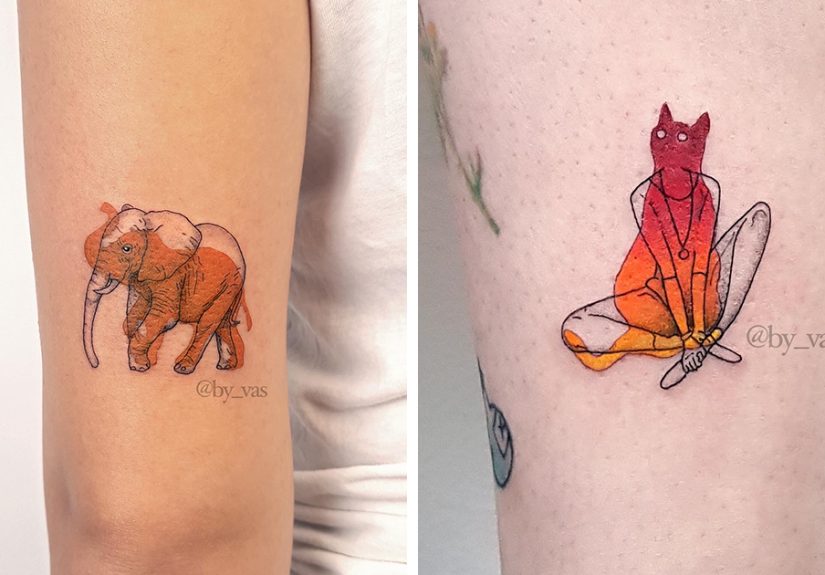
- 2. The seated woman with a cat self
- 3. Gandalf with the Balrog fire
- 4. The witch hat and broom silhouette
- 5. The elephant at sunset
- 6. The child pretending to be an elephant
- 7. The girl with the dinosaur shadow
- 8. The moose-shadow figure
- 9. The lounging cat with its bolder cat-double
- 10. The owl with the wolf behind it
- 11. The compass over the world map
- 12. The hummingbird in a burst of flowers
- 13. The dancer reaching for a star
- 14. The tiny winged child
- 15. The woman lifting a cat toward a larger cat-form
- 16. The rabbit-eared blue silhouette
- 17. The eerie purple creature study
- 18. The dancing woman in an orange silhouette
- 19. The double-elephant composition
- 20. The dream-self tattoo formula itself
- Why These Tattoos Connect With So Many People
- What To Know Before Getting A Tattoo In This Style
- Experience, Emotion, And Why This Kind Of Tattoo Stays With You
- Conclusion
Some tattoos shout. These ones lean in, lower their voice, and somehow say more.
That is the magic of Turkish tattoo artist Vasif Daniel Kahraman, whose “Pellucid” works feel less like standard body art and more like emotional X-rays with better line work. His tattoos often layer two realities at once: the person and the dream, the present self and the imagined self, the ordinary life and the inner mythology quietly setting up camp behind it. It is a clever visual trick, sure, but it is also something deeper. These pieces do not just decorate skin. They tell on the soul a little.
And that is exactly why Kahraman’s work lands so hard. In an era when fine-line tattoos, minimalist designs, and hyper-personal ink are all having a major moment, his style stands out by refusing to be merely pretty. It is pretty, yes. Ridiculously so. But it also carries tension, memory, wishfulness, humor, and the occasional emotional uppercut. His tattoos look like daydreams that accidentally became permanent.
Who Is Vasif Daniel Kahraman?
Before tattooing, Kahraman worked in graphic design and art direction, which explains a lot. His compositions are clean, intentional, and strikingly readable at a glance. But the real engine behind the work is personal history. He has described his Pellucid style as a way of showing “where I want to be and where I actually am,” which is one of those lines that sounds poetic until you realize it also explains half the human experience. We are all, in one way or another, a rough sketch standing inside a brighter silhouette.
That emotional layering is what gives these tattoos their punch. The line drawing usually represents the grounded, human, literal figure. The wash of color behind or around it becomes the inner self, fantasy self, symbolic counterpart, or emotional truth. The result is minimalist tattooing with narrative depth. Less “look at my tattoo,” more “look at my internal weather system.”
What Makes These Tattoos So Different?
Plenty of artists can do fine-line work. Plenty can do illustrative tattoos. Plenty can deliver a neat little minimalist design for your forearm. Kahraman’s work feels different because it blends storytelling with restraint. He does not overcrowd the composition. He leaves breathing room. The negative space matters. The color is used like a whisper, not a marching band. And because the design is usually built around contrast between visible self and hidden self, the concept reads almost instantly.
That clarity matters. Great tattoo design is not just about detail. It is about what stays legible over time, what still means something after the novelty wears off, and what still feels like you when you are no longer in the exact same season of life. Kahraman’s tattoos succeed because they are emotionally specific but visually simple. That is a rare combination.
Here Are 20 Of The Best Ones And Why They Work
1. The swimmer becoming a sea creature
A delicate figure gliding across the shoulder while blue aquatic form spills around the body turns a simple swimming image into a transformation story. It feels like freedom, escape, and reinvention all at once. The tattoo works because it captures movement without chaos.
2. The seated woman with a cat self
This one is equal parts identity study and mood board. The human figure sits calmly while a cat-shaped layer overtakes the composition, suggesting instinct, comfort, mystery, or maybe the simple truth that some people are spiritually housecats. Frankly, relatable.
3. Gandalf with the Balrog fire
Fantasy fans got fed here. The line work gives you the wizard, while the flame-colored mass behind him turns into the monster and the menace. It is cinematic without being oversized, and it proves pop-culture tattoos do not have to look like merchandise.
4. The witch hat and broom silhouette
Minimal, playful, and wickedly smart, this design says everything with almost nothing. The broom is rendered in fine line, while the shape behind it suggests the larger witchy persona. It is tiny storytelling with maximum charm.
5. The elephant at sunset
A small elephant crossed with a warm orange landscape wash somehow feels tender and epic at the same time. The contrast between the realistic animal line work and the dreamy color field makes it look like memory turned into ink.
6. The child pretending to be an elephant
This design is brilliant because it understands how kids imagine themselves. The child bends and poses, while the larger orange elephant shape behind them reveals the internal role-play. It is about imagination, innocence, and the way children try on power through play.
7. The girl with the dinosaur shadow
One of the most joyful pieces in the set, this tattoo shows a childlike figure with a giant dinosaur shape behind her. It is playful, funny, and weirdly moving. Underneath the cuteness is a bigger idea: our inner selves are often much louder and braver than we look.
8. The moose-shadow figure
A young person bends forward while an antlered silhouette rises behind them. The composition feels awkward on purpose, which makes it human. It captures that awkward stage between who you are and the wild creature you suspect is waiting to emerge.
9. The lounging cat with its bolder cat-double
Some tattoos chase drama. This one just stretches, blinks slowly, and wins anyway. The realistic cat in front and color-block cat behind create a layered portrait that feels both cute and psychologically sharp. House-pet energy meets alter ego energy.
10. The owl with the wolf behind it
This piece is all about contrast. An owl stands in crisp detail while a wolf-like form glows behind it in red-orange. Wisdom in front, instinct in back. Quiet face, feral shadow. It is basically an entire personality test in one compact tattoo.
11. The compass over the world map
Travel tattoos can get cheesy fast. This one does not. The compass line work stays clean and classic, while the watercolor-like blue map behind it adds scale and longing. It feels less like “I enjoy airports” and more like “I am still trying to locate myself.”
12. The hummingbird in a burst of flowers
The bird is drawn with elegant restraint, while the floral orange wash creates warmth and speed. It feels alive. Not “bird tattoo alive,” but genuinely mid-hover alive. It is one of the best examples of how Kahraman uses color to imply motion and mood instead of mere decoration.
13. The dancer reaching for a star
A ballerina-like figure arcs forward while red wing-like form blooms behind her. The tattoo reads as ambition made visible. Grace in front, fire in back. If yearning had a dress rehearsal, it might look like this.
14. The tiny winged child
This sweet, almost cherubic design gives a small child a soft blue extension that feels like wings, water, or dream-state energy. It is one of the gentlest tattoos in the group and shows how Kahraman can turn simplicity into emotional softness without becoming syrupy.
15. The woman lifting a cat toward a larger cat-form
A lovely example of tenderness meeting symbolism. The line-drawn figure raises a small black cat, while a larger blue cat-shape sits beneath and behind them. It can read as affection, memory, protection, or that very specific bond cat people explain with their entire face.
16. The rabbit-eared blue silhouette
A crouching human figure overlaps with a translucent rabbit form, creating an image that feels shy, introspective, and slightly surreal. It is a beautiful piece because it does not force an explanation. You get to feel it before you define it.
17. The eerie purple creature study
This one leans darker, with a strange central figure and expressive hands around it. It feels theatrical, uneasy, and intentionally unsettling. Not every Pellucid tattoo is cute or whimsical; some are there to show the monster under the floorboards, and this one definitely brought a flashlight.
18. The dancing woman in an orange silhouette
There is a lot of motion packed into a small footprint here. The line work captures the body, while the color layer exaggerates the leap and gives the whole thing a second pulse. It is a smart reminder that identity is often movement, not a fixed pose.
19. The double-elephant composition
Instead of using a human-and-animal pairing, this piece overlays two elephant states. It feels like memory inside memory, or maybe strength seen from two emotional distances. It is subtle, and that subtlety is what makes it linger.
20. The dream-self tattoo formula itself
Even beyond any single piece, one of the best “tattoos” in this collection is the recurring concept: the visible self paired with the hoped-for self. Whether it appears as animal, myth, movement, or landscape, that repeated visual grammar is what makes the whole body of work memorable.
Why These Tattoos Connect With So Many People
Because they are not just aesthetic. They are emotional shorthand.
Research on tattoo culture keeps pointing to the same truth: people use tattoos to honor memory, express belief, mark identity, and tell stories they want to carry with them. Kahraman’s work fits perfectly into that shift. His tattoos are symbolic without becoming generic, expressive without getting visually noisy, and deeply personal without requiring a three-page explanation in the caption.
That matters in today’s tattoo culture, where fine-line tattoos and minimalist designs are hugely popular but often criticized for being all style and no substance. Kahraman solves that problem by giving minimalist tattoos a narrative engine. These designs may be small, but they are not empty. They come with emotional architecture.
What To Know Before Getting A Tattoo In This Style
If work like this makes you want to sprint toward a tattoo studio, excellent. Just do not sprint literally. Fresh tattoos and cardio friction are not best friends.
More seriously, tattoos in a fine-line or delicate illustrative style demand real technical skill. Clean line work, thoughtful placement, and proper aftercare make a big difference in how well a design holds up over time. The best advice is boring because it works: choose an artist whose healed work looks strong, think carefully about scale and placement, protect the tattoo from excessive sun, and follow aftercare directions like they are a tiny sacred constitution.
Styles like Pellucid succeed because they balance delicacy with clarity. If the line work is too weak or the concept is too crowded, the magic disappears fast. But when an artist gets it right, the tattoo feels light, expressive, and quietly unforgettable.
Experience, Emotion, And Why This Kind Of Tattoo Stays With You
What makes these tattoos especially memorable is the experience they seem to capture, not just the image they present. Looking at them feels a bit like opening an old notebook and finding a version of yourself you had forgotten. Not the polished version for public use, but the real one: the kid who pretended to be an animal, the adult who still wants escape, the dreamer who looks composed while carrying an entire secret world in the background.
That is why so many of Kahraman’s designs feel instantly familiar, even when the subject is highly specific. Maybe you have never wanted to be a hummingbird, a wizard, a moose, or a rabbit-shadow person sitting in your own thoughts. But you probably have wanted to be larger than your circumstances. Softer than your pain. Braver than your posture suggested. More free than your calendar allowed. These tattoos understand that gap between external reality and internal desire, and they turn it into something visible.
There is also something wonderfully human about the humor in the work. Not every piece is solemn or dramatic. Some are playful, almost mischievous. A child imagining a dinosaur self. A cat layered over a human body. A figure whose inner animal is not a roaring lion but a lounging, deeply unbothered cat. That sense of humor matters because identity is not only built from trauma and longing. It is also built from jokes, obsessions, fandoms, comfort characters, and weird little truths we do not always say out loud.
And then there is the tenderness. Several of these tattoos feel like they were designed not just to impress but to comfort. They suggest protection, imagination, softness, and emotional honesty. In a lot of ways, that is what separates meaningful tattoo art from trend-chasing. Trendy tattoos can look great for six months. Meaningful ones keep talking to you years later.
If you have ever looked at a tattoo and thought, “Yes, that is exactly what my brain feels like,” then you already understand the appeal here. Kahraman’s work captures contradiction without trying to resolve it. You can be grounded and restless. Gentle and feral. Tiny and enormous. A grown adult with responsibilities and a secret dinosaur in your chest. The tattoos do not ask you to pick one version of yourself. They let both exist at the same time.
That may be the most powerful thing about this collection. These are not just tattoos about fantasy. They are tattoos about honesty. They admit that the self we show to the world is rarely the only self we carry. And in that sense, Pellucid tattoos are not merely beautiful. They are strangely liberating. They give form to the inner double many people spend years trying to explain with words, therapy, playlists, dramatic walks, or all three.
So yes, these are 20 great tattoos. But they are also 20 small case studies in longing, memory, humor, and becoming. Which is a lot for a few lines and a wash of color to accomplish. Then again, the best art has always been a little unfair that way.
Conclusion
Vasif Daniel Kahraman’s Pellucid tattoos work because they combine visual restraint with emotional ambition. They are stylish enough for tattoo lovers, meaningful enough for story-driven people, and smart enough to keep revealing something new after the first look. In a crowded field of minimalist tattoo ideas, these designs feel original because they are not trying to be minimal for minimalism’s sake. They are using less to say more.
And honestly, that is the dream. A tattoo that looks elegant on day one, holds narrative weight on day one thousand, and still makes you grin a little when someone asks what it means. The best answer, in this case, might be: “It is me. And also the version of me I am still trying to catch up with.”





 Close
Close