
Table of Contents >> Show >> Hide
Walk into a room where children see themselves on the walls, and the vibe changes immediately. It feels less like a generic building with fluorescent lighting and more like a place that says, “You matter here.” That is the quiet power of family photos. They do not just decorate a classroom, hallway, childcare center, counseling office, or homeschool nook. They send a message. They tell children that their lives outside the room count inside the room too.
In a time when educators and caregivers talk constantly about belonging, engagement, and emotional safety, family photos offer one of the simplest and most human tools available. No expensive app. No 47-step strategic framework. Just real images of the people, caregivers, siblings, grandparents, foster parents, guardians, and loved ones who shape a child’s world. When used thoughtfully, these photos can strengthen identity, invite conversation, improve trust between families and educators, and help children feel recognized instead of merely managed.
That matters because belonging is not fluff. It is not the educational version of whipped cream. It is part of the cake. Children learn better when they feel seen, valued, and connected. And one practical way to build that sense of connection is by making family life visible in respectful, inclusive ways.
Why Family Photos Matter More Than People Think
Family photos work because they bridge two worlds children often experience separately: home and school. Adults may think of those spaces as naturally connected, but children do not always feel that connection. For some, school can feel like a place where they are expected to leave parts of themselves at the door. Their language, traditions, family structure, neighborhood, and daily routines can seem invisible unless an adult intentionally makes room for them.
Photos help solve that problem in a deeply ordinary way. A child who sees a picture of their grandmother dropping them off, their two dads smiling on a weekend hike, or their older brother holding the baby at a family cookout receives a subtle but powerful signal: My people belong here too.
That sense of belonging is especially important for children who may already feel “othered,” including multilingual learners, students with disabilities, children in foster or kinship care, kids from military families, and students whose families do not match the outdated “mom-dad-two-kids-and-a-golden-retriever” template. Family photos create a more accurate picture of the world children actually live in. And honestly, the real world has always been more interesting than the stock-photo version.
The Big Benefits of Using Family Photos
1. They make children feel recognized
Belonging begins with recognition. When children see themselves and the people they love represented in a space, it reduces the emotional distance between “who I am at home” and “who I am at school.” That matters for preschoolers who need comfort, elementary students who are building identity, and even older students who may pretend not to care while absolutely caring.
A family photo display can also become an anchor during the day. Young children often revisit familiar images for reassurance. Older students may use them as conversation starters, writing prompts, or memory cues. In both cases, photos function as more than visual décor. They help ground students in a shared environment.
2. They help build trust with families
When schools invite family photos, they are communicating that families are not side characters in a child’s education. They are valued partners. That invitation can open the door to stronger communication, especially when it is framed warmly and flexibly. A request like, “Send any photo that represents the people important to your child,” feels far more welcoming than a rigid assignment that assumes every family looks the same.
Photos can also create better conversations between educators and caregivers. Instead of contact being limited to missing homework, behavior issues, or a mysterious form that somehow requires three signatures and a snack-size baggie, the relationship starts with something positive and personal.
3. They support identity and cultural pride
Family photos can affirm language, culture, traditions, and heritage in ways that feel authentic instead of performative. A bulletin board featuring labeled photos in home languages, celebrations from different communities, or multigenerational family moments tells students that diversity is not just tolerated. It is normal, meaningful, and worthy of space.
This is especially effective when photos are combined with student storytelling. A picture alone is powerful, but a picture plus a child’s words is even better. “This is my auntie who makes the best tamales.” “This is my uncle teaching me to fish.” “This is my grandma and me at Lunar New Year.” Suddenly, the room is not just decorated. It is alive with identity.
4. They create conversation and empathy
Children are naturally curious about one another. Used well, family photos can encourage connection instead of comparison. Students begin to notice both differences and common ground. One child lives with grandparents. Another has a blended family. Another spends weekends with cousins who feel like siblings. Another has relatives in another country. These conversations help normalize variety and reduce the idea that there is only one “right” kind of family.
5. They support a warm, student-centered environment
A good learning environment is not about filling every inch of wall space until the room looks like a craft store had a dramatic emotional event. It is about choosing visuals that are meaningful. Family photos are meaningful. They connect to relationships, identity, communication, and community. When displayed intentionally, they can make a space feel welcoming without becoming visually chaotic.
How to Use Family Photos Thoughtfully
Start with an inclusive invitation
The language you use matters. Do not ask only for “mom and dad” pictures. Ask for photos of the people who are important in the child’s life. That may include parents, grandparents, foster parents, older siblings, cousins, godparents, guardians, or chosen family. Some children may want to include a beloved pet, and frankly, if that dog is part of the emotional support system, the dog has earned a spot.
Offer options too. Families can send printed photos, email images, or help children draw portraits if sharing a photo is difficult. Some families may have privacy concerns, unstable housing, complicated custody situations, or immigration-related worries. Participation should be invited, never pressured.
Make sure every child can be represented
Nothing undermines belonging faster than a display where some children are fully represented and others are missing. If you create a family photo wall, have a plan for ensuring each child has something on display. That may mean following up gently with families, offering to print photos at school, or helping students create alternative identity pieces when photos are unavailable.
The goal is not perfection. The goal is equity. Every child should be able to look up and think, “I’m part of this place.”
Add names, stories, and languages
Photos become even more powerful when paired with words. Add captions, student quotes, labels in home languages, or short “About My Family” cards. This helps children practice oral language and literacy while also sharing identity in ways that feel personal and proud.
For example, instead of a wall of unlabeled images, you might create mini displays such as:
- Who’s in My Circle: names and relationships
- What We Love to Do: favorite family activities
- Words We Use at Home: greetings or special phrases
- Family Traditions: meals, holidays, routines, and celebrations
Keep the display current
Belonging is not a one-week theme for the beginning of the year. It should live all year long. Update displays with new photos, classroom moments, family events, and student reflections. This keeps the space dynamic and reminds students that belonging is ongoing, not seasonal like pumpkin spice.
Be careful with privacy and sensitivity
Always get permission before publicly displaying images. Some schools need formal consent; others may use class communication systems. Either way, make expectations clear. Also think carefully about where photos are placed. A hallway display might be lovely, but an in-class display may be more appropriate for families who want a lower-profile option.
Be sensitive to grief, separation, and family transitions. A child may have lost a loved one, live between households, or feel unsure about which photo to share. In those cases, flexibility and compassion matter more than neat bulletin board symmetry.
Creative Ways to Use Family Photos
Family photo welcome wall
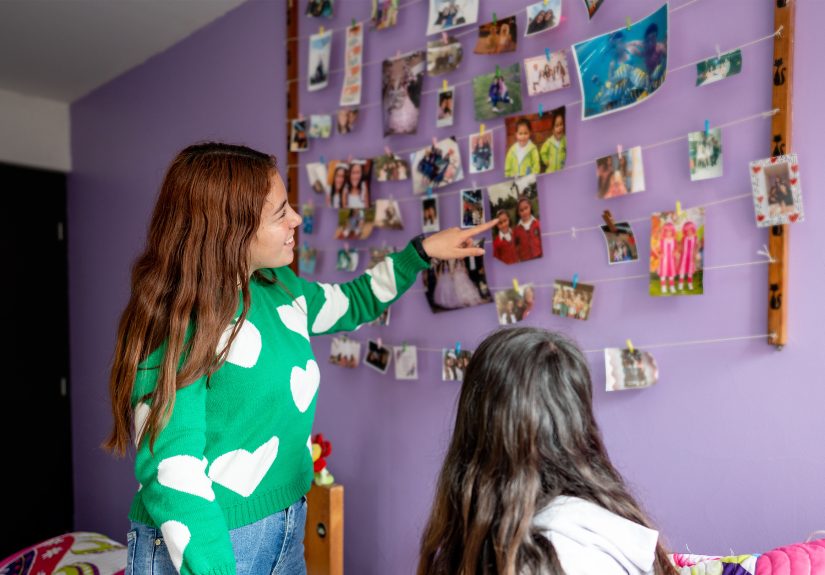
Create a dedicated area near the door with student and family images. This sends a strong message as soon as children enter the room: the people in this space matter.
All About Us books
Turn family photos into class books or individual student books. Young children especially love revisiting familiar faces during transitions, quiet reading time, or moments of stress.
Morning meeting connections
Invite students to share a photo and tell a story connected to it. This can build speaking skills, confidence, and peer understanding.
Writing and art prompts
Use photos as inspiration for narrative writing, descriptive language, family interviews, timelines, self-portraits, or heritage projects. Students often write more authentically when the prompt starts with something real.
Digital slideshows and class presentations
In upper grades, family photos can be incorporated into digital “identity slides,” beginning-of-year introductions, or end-of-year reflection projects. This is a good option when wall space is limited or when teachers serve multiple classes.
Belonging corners in shared spaces
Libraries, counseling offices, after-school programs, and child-care centers can also use family photos. Belonging should not be trapped in one classroom like a well-behaved houseplant. Shared spaces matter too.
Common Mistakes to Avoid
Do not make the display competitive. Bigger, fancier, newer, or more “Pinterest-worthy” photos should never get more attention than others. This is about connection, not a family branding campaign.
Do not assume every student wants the same kind of sharing. Some children love presenting. Others prefer a private display or a one-on-one conversation. Offer choices.
Do not overfill the environment. A meaningful, organized photo display works better than visual overload. Belonging should feel warm, not chaotic.
Do not use family photos as a token diversity move. Representation should connect to broader classroom practice, including language inclusion, respectful communication, accessible materials, and family partnership.
Why This Strategy Works So Well
At its heart, using family photos to create belonging works because it honors a basic truth: children do not arrive as blank slates. They arrive with histories, relationships, routines, languages, losses, jokes, recipes, traditions, and people who love them. When educators make room for those realities, children are more likely to feel safe enough to participate, brave enough to connect, and confident enough to learn.
That is what makes this practice powerful. It is simple, but it is not small. A family photo on the wall can say what every child needs to hear: You are not an outsider here. Your story came with you, and it belongs in this room.
Experiences Related to Using Family Photos to Create Belonging
One of the most memorable things about family photos is how quickly they change the emotional temperature of a room. In many classrooms, the first few weeks can feel polite, awkward, and a little stiff. Students are still figuring out where to sit, who talks too much, who finishes every worksheet in four minutes, and who somehow always has three mechanical pencils. But when family photos go up, the room often becomes more human. Students stop seeing one another only as classmates and start seeing one another as people with full lives.
Teachers often notice this first during informal moments. A child points to a photo and says, “That’s my baby sister.” Another replies, “I have a baby brother!” A third student adds, “My grandma picks me up too.” Those tiny conversations may look small to adults, but they are the building blocks of community. They create recognition. They create familiarity. They create the beginning of friendship.
For younger children, family photos can be especially comforting during transitions. A preschooler who is having a rough morning may walk over to a classroom book filled with family pictures and settle down faster than anyone expected. The photo becomes a bridge between separation and security. It reminds the child that home is not gone just because the school day has started. That emotional reassurance can make a huge difference in how the rest of the day unfolds.
In elementary classrooms, family photos often spark incredible storytelling. Students who are usually quiet suddenly have plenty to say when the topic is personal and meaningful. A simple image can unlock language, memory, and confidence. One student may describe a birthday party. Another may explain a holiday tradition. Another may talk about a relative who lives far away. Without even trying too hard, the teacher has created an opportunity for speaking, listening, writing, empathy, and cultural exchange all at once.
Older students benefit too, even if they pretend the whole idea sounds “kinda cheesy.” Middle and high school students still want to be known. They may just prefer more age-appropriate formats, like digital identity slides, advisory displays, or reflective writing tied to a personal image. When done respectfully, these activities can help adolescents feel less anonymous in large school settings where it is easy to disappear into the crowd.
Family photos can also reveal important truths to educators. A teacher may learn who lives with whom, which language a family uses at home, what traditions matter to a student, or which adults play a major caregiving role. That knowledge can improve communication, strengthen classroom relationships, and prevent awkward assumptions. It is hard to build belonging around children you do not truly know. Family photos help adults know them better.
Perhaps the best experiences come from the unexpected moments. The student who beams with pride while explaining a family reunion photo. The caregiver who says, “Thank you for making us feel included.” The class that begins to notice not only differences, but shared joys. In those moments, belonging is no longer an abstract goal written in a school improvement plan. It is visible. It is personal. It is hanging on the wall, smiling back.
Final Thoughts
Using family photos to create belonging is one of those rare ideas that is both beautifully simple and genuinely effective. It helps students feel seen. It strengthens family engagement. It supports identity, trust, and connection. Most of all, it reminds everyone in the room that learning is relational. Children do not thrive because a wall looks impressive. They thrive because a space feels human. Family photos help create that feeling, one familiar face at a time.







 Close
Close