
Table of Contents >> Show >> Hide
- What “35%” Really Means (and Why It’s Not the Finish Line)
- The Leaky Pipeline Is Realbut It’s Not a Pipe Problem
- So What Works? Practical Moves That Change the Numbers
- 1) Start early, but don’t stop at “inspiration posters”
- 2) Fix the “confidence penalty” with better feedback and grading culture
- 3) Expand access to gateway coursesand recruit girls on purpose
- 4) Make college STEM feel like a team sport, not a survival show
- 5) In the workplace: measure what matters and redesign the system
- 6) Make computing and engineering less “mysterious” (and less gatekept)
- Specific Examples That Help (Because Vibes Aren’t a Strategy)
- What Different Stakeholders Can Do (Without Starting a 47-Person Task Force)
- Conclusion: 35% Is a Clue, Not a Trophy
- Experiences From the Field: What It Feels Like When STEM Doors Open (and When They Don’t)
Imagine you’re throwing a “Future of Innovation” party. The music is pumping, the snacks are
molecular-gastronomy-level fancy, and the guest list includes everyone who’s going to build
the next generation of medicine, clean energy, AI, cybersecurity, and climate solutions.
Then you realize you invited only some of the talentbecause your door policy
quietly nudges women to the back of the line.
That’s basically what happens when we treat “35%” as a victory lap instead of a pit stop.
Whether you’re talking about women’s share of STEM education outcomes or the STEM labor
market, the headline is the same: progress exists, but parity is still playing hard to get.
And no, it’s not because women “just aren’t interested.” If anything, the data and decades
of research point to a maze of structural barriersplus a few cultural banana peels we keep
leaving on the floor.
Let’s talk about why 35% isn’t enough, where the leaks in the pipeline really happen, and
what actually moves the needlefrom middle school classrooms to hiring committees to
boardrooms that still think “inclusive culture” is a nice-to-have garnish.
What “35%” Really Means (and Why It’s Not the Finish Line)
In the U.S., STEM is a big dealmillions of jobs, strong wages, and an outsized impact on
competitiveness. Yet women remain underrepresented across many STEM roles, especially in
computing and engineering. For example, the National Science Board’s STEM-labor-force
reporting highlights that STEM jobs make up a substantial portion of the U.S. workforce and
that participation differs sharply by gender. Women are also more likely to be concentrated
in some STEM subfields than othershealth-related STEM roles may look different from
software or mechanical engineering.
Here’s the part that should make us put down the confetti cannon: underrepresentation is
not just about “getting in.” It’s about who stays, who advances, who gets
the high-visibility projects, and who’s still explaining in meetings that “No, I’m not the
note-taker. I’m the lead engineer.”
STEM isn’t one big roomit’s a building with weirdly labeled hallways
When people say “women in STEM,” they sometimes mash together very different realities:
biology, medicine, data science, environmental science, IT support, aerospace engineering,
and research labs that run on caffeine and grant deadlines. Representation can look “okay”
in one corridor and bleak in another. That’s why any single number35%, 26%, 18%, pick
your statisticcan hide the real story: where women are thriving, where they’re missing,
and where they’re leaving.
The Leaky Pipeline Is Realbut It’s Not a Pipe Problem
The “pipeline” metaphor gets dunked on because it sounds like people are passively floating
along until they spill out. Real life is messier. Women aren’t leaking out because they
forgot how to do calculus. They’re getting nudged, bumped, and sometimes shoved by
barriers that show up early and compound over time.
Leak #1: Early bias and confidence games
Research and advocacy groups have documented how gender stereotypes can take root early.
Girls may receive subtle signals about who “belongs” in math, science, robotics, or coding.
The result isn’t a lack of abilityit’s a tax on confidence, identity, and willingness to take
risks. By the time course selection matters (think: algebra tracking, physics, AP computer
science), girls may be less likely to be encouraged into the classes that function like VIP
passes for certain majors.
This is where adults accidentally become bouncers. A teacher says, “You’re so good at
writing,” and forgets to also say, “You’re also great at problem-solving.” A counselor
steers a student toward “practical” choices. A parentloving, well-meaningworries that
engineering is “too intense.” None of these moments feels dramatic. Together, they become a
pattern.
Leak #2: Gatekeeper courses and uneven access
Advanced coursework and enrichment opportunities are not evenly distributed. Schools vary
wildly in whether they offer AP science, calculus, computer science, robotics teams, or
dual-enrollment options. If access is limited, or if students don’t see themselves welcomed
into those spaces, the pathway narrows before students ever set foot on a college campus.
Leak #3: Stereotype threat and “prove it again” culture
In higher education and beyond, women can experience the burden of being the “only” (or one
of very few) in a classroom, lab, or engineering team. Classic research summarized in major
reports has described how stereotype threat can affect performance and persistenceespecially
when environments signal that someone is an outsider.
Add to that a workplace pattern many women recognize instantly: men are assumed competent
until proven otherwise; women are asked to prove it again. And again. And sometimes once
more, just for fun.
Leak #4: Workplace climate, harassment, and the cost of “just tough it out”
Retention is where the story gets spicyand not in a fun way. Workplace culture, bias in
evaluation, and harassment can push talented women out. National Academies reporting on
sexual harassment in academia emphasized how these experiences can drive a costly loss of
talent and harm scientific integrity. When the environment makes people spend energy on
self-protection instead of innovation, the organization isn’t “high-performing”it’s just
high-friction.
Leak #5: Advancement bottlenecks and uneven support
Even when companies hire women into technical roles, advancement can stall without equitable
sponsorship, high-visibility opportunities, and fair performance systems. Large-scale
workplace research (including major corporate studies) consistently finds that career support
and opportunity allocation matterbecause talent isn’t the problem. Systems are.
So What Works? Practical Moves That Change the Numbers
The good news: we don’t have to guess. Multiple U.S.-based organizations, universities, and
employers have tested approaches that help girls and women enter, persist, and lead in STEM.
The best strategies are not magicalthey’re repeatable.
1) Start early, but don’t stop at “inspiration posters”
“You can be anything!” is cute on a wall. It’s less helpful if a student can’t access the
course, the club, or the mentor that turns interest into skill. Effective early efforts look
like hands-on STEM experiences, sustained exposure (not a one-off “STEM Day”), and visible
role models who feel realnot like mythical creatures who were born holding a soldering iron.
Programs that use near-peer mentorship can be especially powerful. When middle schoolers see
high school and college women leading technical projects, STEM stops feeling like an exclusive
club and starts feeling like a community.
2) Fix the “confidence penalty” with better feedback and grading culture
Girls often get rewarded for perfection and compliance; STEM rewards iteration and failure-as-data.
Educators can help by praising strategies, persistence, and problem-solvingthen backing that up
with grading policies that don’t treat every mistake like a character flaw.
In other words: normalize debugging. If we can’t laugh at a broken loop at 1:00 a.m., are we
even doing STEM?
3) Expand access to gateway coursesand recruit girls on purpose
Schools and districts can increase enrollment of girls in physics, calculus, and computer science
by removing unnecessary prerequisites, improving scheduling, training counselors, and doing
active outreach. “Open enrollment” doesn’t work if the culture still whispers, “This isn’t for you.”
A practical tactic: personally invite students who show curiosity, grit, or strong math foundations
and be explicit that they belong. One sincere invitation can undo years of quiet discouragement.
4) Make college STEM feel like a team sport, not a survival show
STEM departments can reduce attrition by building cohort models, improving intro-course teaching,
offering research opportunities early, and supporting students through tutoring and community.
The goal isn’t to “coddle.” It’s to stop confusing unnecessary suffering with rigor.
Also, let’s retire the vibe that being miserable is a prerequisite for becoming an engineer.
It’s not a hazing ritual. It’s education.
5) In the workplace: measure what matters and redesign the system
If you want more women in STEM jobs, you have to keep themand promote them. Organizations can:
- Audit hiring and promotion for bias (structured interviews, consistent rubrics, diverse panels).
- Track opportunity allocation (who gets the flagship projects, client exposure, patents, and speaking slots).
- Build sponsorship (not just mentorship) so women have advocates who open doors.
- Improve flexibility without “flexibility penalties” that stall careers.
- Act on culture quicklyharassment, hostility, and “bro-y” dynamics aren’t quirks; they’re retention killers.
Some of the most credible workplace research emphasizes that progress depends on consistent support,
fair systems, and a culture where people can belong and thriverather than forcing women to adapt
to environments that were never designed with them in mind.
6) Make computing and engineering less “mysterious” (and less gatekept)
Computing, in particular, has a long-running representation problem. Major nonprofit efforts have
shown that interventions can move outcomesespecially when girls get sustained learning time,
community, and confidence-building experiences. The biggest drop-offs can happen during the teen
years, when identity and belonging become loud influences.
Translation: if we wait until college to “solve” women in tech, we’re showing up to the movie in
the third act and asking, “Wait, who’s that villain?”
Specific Examples That Help (Because Vibes Aren’t a Strategy)
Example: Near-peer programs that build skill and belonging
Near-peer learningwhere older students teach younger onesdoes two things at once: it builds a
supportive ladder of mentorship, and it makes “women in STEM” visible and normal. Government and
nonprofit initiatives have highlighted how near-peer outreach can scale hands-on computing experiences
across states and communities.
Example: Large-scale coding organizations changing major selection
Several major nonprofits report strong outcomes in guiding alumni toward computer science and related
fields compared with national baselines. The point isn’t that everyone needs to code. It’s that access,
community, and confidence can dramatically change what students decide is possible.
Example: Fixing the workplacenot “fixing women”
If a workplace keeps losing women after five to seven years, the problem is not a mysterious lack of
resilience. It’s usually the daily experience: undervaluation, limited advancement, isolation,
and subtle (or not-so-subtle) bias. Some of the most compelling management research argues for changing
systemsperformance processes, feedback culture, sponsorship, and inclusionrather than diagnosing women
with “confidence issues” and calling it a day.
What Different Stakeholders Can Do (Without Starting a 47-Person Task Force)
If you’re a parent or caregiver
- Encourage curiosity and tinkering: kits, experiments, building projects, beginner coding.
- Talk about STEM careers as creative and people-centered, not just “hard.”
- Celebrate effort and iterationespecially when something doesn’t work the first time.
If you’re an educator or school leader
- Recruit girls into gateway classes intentionally.
- Train counselors to avoid stereotype-driven steering.
- Expand access to advanced courses and extracurricular STEM opportunities.
- Use inclusive examples and role models in curriculum (real women, real jobs, real stories).
If you’re a college department
- Improve intro course teaching and reduce weed-out culture.
- Create cohorts, study communities, and early research opportunities.
- Address harassment and bias with real accountability, not “awareness emails.”
If you’re an employer
- Standardize hiring and promotion criteria.
- Track retention and advancement by role, team, and levelnot just companywide averages.
- Invest in sponsorship and equitable access to high-impact work.
- Build a culture where inclusion is operational, not ornamental.
Conclusion: 35% Is a Clue, Not a Trophy
“35%” is not nothing. It can represent real momentum, thousands of careers, and a lot of hard-won wins.
But it’s also a signal that opportunity still isn’t distributed fairlyand that STEM, the engine room
of the modern economy, is running below capacity because we’re leaving talent on the sidelines.
Getting more women into STEM isn’t about charity. It’s about competence, competitiveness, and basic
common sense. If we want better products, safer systems, smarter AI, more resilient infrastructure,
and science that reflects the needs of the whole population, we need more women building, leading,
and shaping what comes next.
And honestly? If we can put a rover on Mars, we can probably figure out how to stop acting surprised
when a woman walks into the lab andplot twistknows exactly what she’s doing.
Experiences From the Field: What It Feels Like When STEM Doors Open (and When They Don’t)
The statistics tell you what is happening. Experiences tell you how it happensone moment,
one classroom, one meeting at a time. Here are a few true-to-life scenarios that show why representation
is more than a recruiting slogan.
Experience 1: The middle-school “invitation” that changes everything
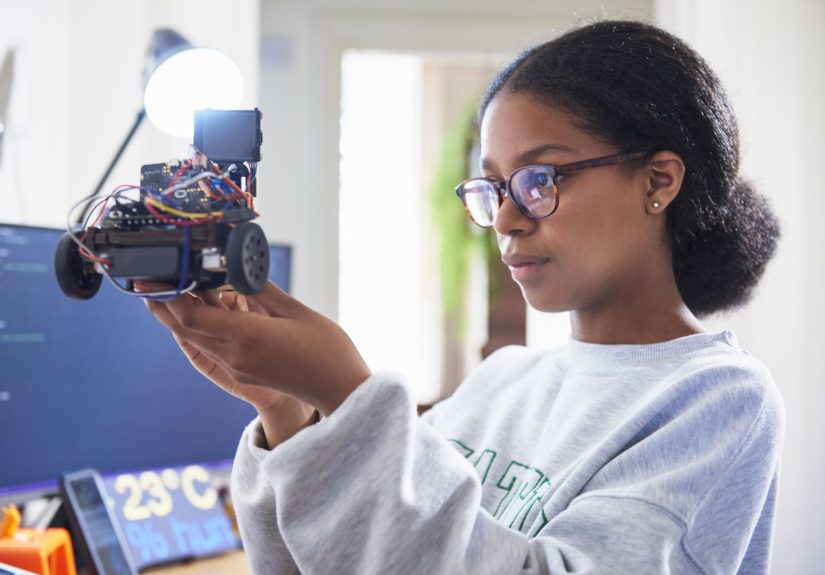
A seventh grader joins a robotics demo because her friend is going. She likes the build process but
assumes the “real” technical work belongs to the loud kid who already has a screwdriver collection.
Then the teacher casually says, “You should drive the design on the arm mechanismyou’re thinking
like an engineer.” It’s a small sentence, but it lands like a permission slip. The student goes home
and Googles “mechanical engineering,” then starts watching videos about prosthetics and medical devices.
She doesn’t become confident overnight, but now she has a new identity option: maybe this is me.
That’s the power of an explicit invitation. Not hype. Not pressure. Just a credible adult noticing skill
and naming it.
Experience 2: The college lab where belonging is the difference between quitting and thriving
A first-year engineering student walks into an intro course that feels like a competitive sport. Half
the class seems to have been coding since age ten. The student is capable, but she’s also doing constant
mental math: “If I ask a question, will they think I don’t belong?” In her first project group, she’s
quietly assigned organizing tasks while others handle the technical parts. She starts to doubt herself,
not because the content is impossible, but because the environment keeps sending the message that she’s
an extra.
Then she joins a peer-led study group with a couple of older studentswomen who remember exactly what
this stage feels like. They normalize struggle, swap debugging tips, and share the unglamorous truth:
nobody is born knowing how to write clean code or run simulations. The student’s grades improve, but more
importantly, the internal narrative changes from “I’m behind” to “I’m learning.” She stays. Later, she
becomes a peer leader herself. That’s how retention happensthrough community and competence-building,
not through inspirational speeches delivered once per semester.
Experience 3: The workplace that slowly drains talent with a thousand paper cuts
A software engineer starts her first job excited and ready. She’s productive, ships features, and gets
positive feedback. But over time, the pattern becomes familiar: her ideas are ignored until repeated by
someone else. She’s praised for being “helpful” more than for being technically sharp. She gets assigned
“glue work” that keeps teams running but doesn’t show up in promotion packets. The men on her team are
given stretch projects that lead directly to visibility.
She’s not leaving because she can’t handle the work. She’s leaving because she can’t see a fair path.
When she brings it up, she gets the classic non-solution: “Be more confident.” What she actually needs
is a manager who tracks who gets high-impact tasks, who sponsors her for opportunities, and who takes
meeting dynamics seriously. When companies do thatwhen they redesign systems rather than advising women
to “lean in” harderretention improves. When they don’t, women quietly exit, and the company calls it a
“pipeline issue” as if the pipeline is a weather event.
Experience 4: The moment mentorship becomes sponsorship
A mid-level data scientist has a mentor who gives great advice. Helpful, but not career-changing. Then
she meets a sponsorsomeone senior who publicly credits her work, recommends her for a cross-functional
project, and puts her name forward for a leadership opportunity. The difference is immediate. Her work
becomes visible to decision-makers. She gets stretch assignments with real authority. She grows faster
because the system is finally giving her room to grow.
That’s the “more women in STEM” secret most organizations overlook: hiring is the beginning. Opportunity
is the multiplier.






 Close
Close