
Table of Contents >> Show >> Hide
- Quick Start: The 10-Minute Container Audit (Do This First)
- Table of Contents
- 1) Standardize Your Container “Team” (Fewer Types, Less Chaos)
- 2) Store Containers With Lids On (Yes, Really)
- 3) File Lids Vertically Like Folders (The “No More Lid Pile” Method)
- 4) Use a Tiered Shelf Riser for Flat Lids and Shallow Pieces
- 5) Create a “Container Corral” With Bins (So Everything Has a Job)
- 6) Mount Lid Storage on the Cabinet Door (Hello, Free Space)
- 7) Turn a Drawer Into Lanes With Dividers or Tension Rods
- 8) Use a Dish Rack or Cooling Rack Hack for Upright Lids
- 9) Label by Size (So Your Family Stops “Guessing”)
- 10) Adopt the 60-Second Reset Routine (The Secret to Staying Organized)
- A Quick Cheat Sheet: Pick Your Best 3 Solutions
- Conclusion: Your Future Self Deserves Better Than “Lid Roulette”
- Real-Life Experiences: What It’s Like After You Finally Organize the Container Chaos (500+ Words)
If your cabinet full of food storage containers has ever avalanched like a tiny plastic landslide, you’re not alone.
The “container cabinet” is where good intentions go to do cardio. Lids vanish. Bases multiply. And suddenly you’re
playing Leftovers Tetris with a side of frustration.
The good news: you don’t need a brand-new kitchen (or a professional organizer hiding in your pantry) to fix this.
You need a system that matches how you actually cookweeknight leftovers, meal prep, school lunches, snack hoarding,
the occasional “I swear I’ll reuse this takeout container” fantasy.
Below are 10 genuinely smart, real-life-friendly solutions for organizing food storage containersplus an easy
maintenance routine so your cabinet stays calm even after a busy week.
Quick Start: The 10-Minute Container Audit (Do This First)
Organizing works best when you’re not trying to “organize” broken lids, warped bases, and mystery containers from 2016.
Before you add any bins or dividers, do this quick audit:
- Match lids to bases and recycle/trash anything without a partner (unless you enjoy container soap operas).
- Check condition: toss warped lids, cloudy cracked plastic, and containers that smell like curry forever.
- Cut the duplicates: keep what you actually use (weekly), not what you might use (someday, maybe, when you become a different person).
- Decide your “home base”: a lower cabinet, deep drawer, or pantry shelf that’s easy to reach.
Once you’ve reduced the chaos, the solutions below work like a charmbecause you’ll be organizing the right amount
of stuff, not an entire plastic civilization.
Table of Contents
- Standardize Your Container “Team”
- Store Containers With Lids On (Yes, Really)
- File Lids Vertically Like Folders
- Use a Tiered Shelf Riser for Flat Lids and Shallow Pieces
- Create a “Container Corral” With Bins
- Mount Lid Storage on the Cabinet Door
- Turn a Drawer Into Lanes With Dividers or Tension Rods
- Use a Dish Rack or Cooling Rack Hack for Upright Lids
- Label by Size (So Your Family Stops “Guessing”)
- Adopt the 60-Second Reset Routine
1) Standardize Your Container “Team” (Fewer Types, Less Chaos)
The fastest way to make food storage container organization easier is to reduce variety.
When every container has a different lid shape, your cabinet becomes a matchmaking service with terrible odds.
How to do it
- Pick 1–2 main container styles for most leftovers (for many households, a single “everyday set” plus a few larger pieces is plenty).
- Choose stackable/nesting designs and, if possible, sets with interchangeable lids.
- Favor square/rectangular shapes for efficient cabinet and fridge space.
Real-life example
If you pack lunch daily, keep a dedicated group of same-size containers (and their lids) just for lunch.
When all lunch containers are identical, mornings become “grab and go,” not “hunt and panic.”
2) Store Containers With Lids On (Yes, Really)
Separating lids and bases is a classic strategybut it’s not the only one. If your container collection is already
pared down, storing containers with lids on can be the simplest system to maintain.
Why it works
- You eliminate the “missing lid” problem because lids can’t wander off.
- You naturally limit how many containers you keepbecause only what fits neatly makes the cut.
- It’s visually obvious what you have, which reduces duplicates and impulse buys.
Best for
Smaller collections, meal-prep containers that stack well, and families who want a low-effort system.
Pro tip
Stack by shape and size, like nesting dolls with boundaries. Largest on bottom, smallest on top, lids on.
Your cabinet should look calm, not like it’s bracing for impact.
3) File Lids Vertically Like Folders (The “No More Lid Pile” Method)
A horizontal lid pile is basically an invitation for chaos. The moment you pull one lid, the rest slide,
topple, and vanish into the Bermuda Triangle behind your slow cooker.
How to set it up
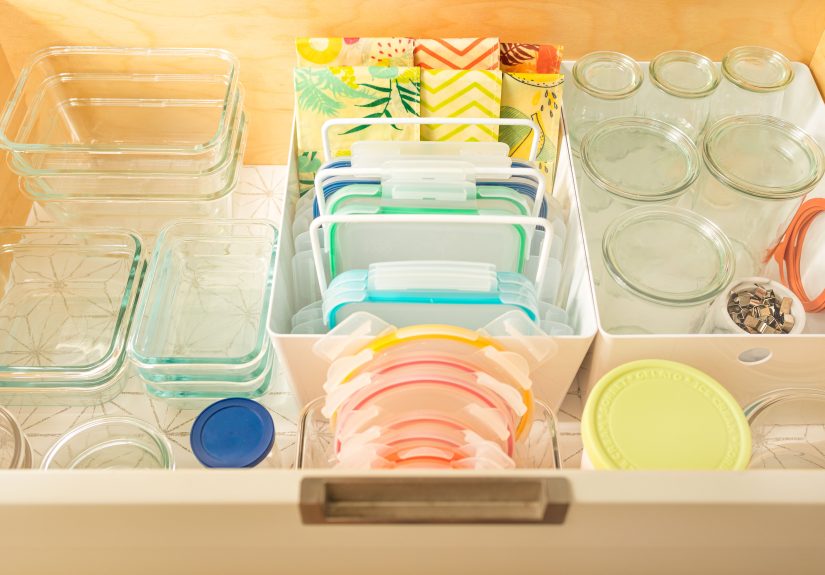
- Use an adjustable lid organizer or vertical dividers in a drawer/cabinet.
- Sort lids by size: small, medium, large (or by brand/type if you standardized).
- Store lids upright so you can flip through them like files.
Best for
Anyone with a deep drawer or a cabinet shelf where lids currently live in a tragic heap.
Pro tip
If you have round lids, choose a system that prevents rolling. Otherwise, you’ll be chasing lids like runaway coins.
4) Use a Tiered Shelf Riser for Flat Lids and Shallow Pieces
Flat lids and shallow containers love to stack into an unhelpful pancake tower.
A simple three-tier shelf riser turns that tower into organized, visible layers.
How to do it
- Place the riser in the cabinet where you store lids (or shallow containers).
- Sort by size from bottom to top.
- Keep the most-used lid sizes on the easiest-to-reach tier.
Why it’s genius
You can see everything at once, grab what you need without unstacking the world, and stop accidentally
turning lids into a percussion instrument at 11 p.m.
5) Create a “Container Corral” With Bins (So Everything Has a Job)
Bins aren’t just for pantriesthey’re a powerhouse for cabinet organization. Think of a bin as a designated parking
spot for a specific category of containers.
Smart bin categories
- Everyday leftovers (your MVP set)
- Meal prep (same size, stackable)
- Big stuff (family-size, potluck, batch cooking)
- Odd-shaped specialty items (only if you truly use them)
Best for
Wide cabinet shelves where stacks drift and mingle like they’re at a party.
Pro tip
Choose bins that slide out easily. If you have to remove five things to reach one container, you’ll stop using the system.
6) Mount Lid Storage on the Cabinet Door (Hello, Free Space)
Cabinet doors are underused real estate. Adding a slim organizer to the inside of a cabinet door creates instant lid storage
without stealing shelf space.
What to use
- A wall file or mounted file holder for lids
- Command-style adhesive strips (for lightweight setups) or screws (for sturdier installs)
Best for
Small kitchens and anyone who’s out of shelf space but has door space to spare.
Pro tip
Store lids from largest to smallest so you can identify the size instantlylike a neat little lid library.
7) Turn a Drawer Into Lanes With Dividers or Tension Rods
If you have a deep drawer, you can create “lanes” that stop lids and containers from migrating.
The goal is to keep stacks upright and separated.
Two easy lane options
- Drawer dividers: create sections by size or type.
- Tension rods: place them strategically to form compartments or to prop lids upright.
Best for
Deep drawers where you want a clean, built-in look without permanent installation.
Pro tip
Give lids their own lane and bases their own lane. When both live together in one pile, the pile always wins.
8) Use a Dish Rack or Cooling Rack Hack for Upright Lids
This is the scrappy, brilliant trick that feels like you’re getting away with something (legally).
A simple dish rackor even a cooling rack placed in a bincreates instant vertical slots for lids.
How to do it
- Grab a small bin that fits your cabinet or drawer.
- Set a cooling rack inside the bin (or place a compact dish rack in the space).
- Slide lids upright into the “slots.”
Why it works
Vertical storage prevents lids from stacking into a slippery mess. It also makes sizes easier to scan at a glance.
Best for
Households with mixed lid shapes who need a flexible, low-cost solution.
9) Label by Size (So Your Family Stops “Guessing”)
You may know exactly which lid matches which container. Other people in your house may treat lids like optional accessories.
Labeling turns “best guess” into “obvious answer.”
Simple labeling ideas
- Size labels on bins: “Small,” “Medium,” “Large.”
- Brand/type labels if you keep two systems: “Glass,” “Plastic,” “Meal Prep.”
- Color dots (a tiny sticker on lid + matching sticker on base) for stubborn mismatches.
Best for
Busy households, shared kitchens, and anyone who’s tired of hearing, “I couldn’t find the right lid… so I used foil.”
10) Adopt the 60-Second Reset Routine (The Secret to Staying Organized)
The real difference between a tidy container setup and a messy one isn’t perfectionit’s a tiny maintenance habit.
A 60-second reset keeps your system from slowly melting back into chaos.
The reset routine
- After unloading the dishwasher: match lids immediately (don’t “set aside” a lidthis is how lid myths are born).
- Once a week: do a quick straighten and re-stack by size.
- Once a month: purge “orphans” (lonely lids and bases) and re-home anything you stopped using.
Pro tip
Keep a small “orphan bin.” If a lid or base is unmatched, it goes there. If it’s still unmatched after a month,
it’s probably time to let it go.
A Quick Cheat Sheet: Pick Your Best 3 Solutions
You don’t need to do all 10. Choose the three that match your space and habits. Here’s a quick guide:
| Solution | Best For | Effort Level |
|---|---|---|
| Standardize your set | Everyone | Medium (one-time purge) |
| Store with lids on | Small collections | Low |
| Vertical lid filing | Deep drawers/cabinets | Low–Medium |
| Tiered shelf riser | Flat lids | Low |
| Bins (“container corral”) | Wide shelves | Low |
| Door-mounted lid storage | Small kitchens | Medium |
| Drawer lanes | Deep drawers | Low–Medium |
| Dish rack/cooling rack hack | Mixed lid shapes | Low |
| Labels by size/type | Shared kitchens | Low |
| 60-second reset | Everyone | Low |
Conclusion: Your Future Self Deserves Better Than “Lid Roulette”
Organizing food storage containers isn’t about making your cabinet look like a showroom. It’s about making leftovers
easy, lunches faster, and your kitchen less annoying. Start with the 10-minute audit, pick three solutions that fit your
space, and protect your progress with the 60-second reset routine.
Because the only thing that should be unpredictable in your kitchen is whether tonight’s leftovers will become tomorrow’s
lunch… not whether you can find a lid.
Real-Life Experiences: What It’s Like After You Finally Organize the Container Chaos (500+ Words)
Once you set up a real system, the first thing most people notice is a weird, delightful quiet. Not literal quietalthough
you may stop clattering through a cabinet like you’re auditioning for a one-person drumline. It’s more like mental quiet.
You open the cabinet and your brain doesn’t immediately start calculating risk. You just… grab a container. With a lid.
On the first try. It feels suspiciously easy, like you must have forgotten something.
In many households, the “container problem” is really a “decision fatigue problem.” When containers are a mess, every step
takes micro-decisions: “Does this lid fit? Where’s the matching base? Is this one stained? Why do we own twelve lids that
fit nothing?” After organizing, those questions disappear. You stop negotiating with your kitchen at the exact moment you
have the least patienceafter cooking, when everyone’s hungry, and you’re trying to clean up before the food cools into a
cement-like layer.
Another common experience is realizing how much space you were losing to “air gaps.” Mixed stacks create wasted voids, and
piles of lids spread out like they’re trying to colonize the shelf. When you switch to vertical lid storage or store your
everyday set with lids on, you suddenly see a whole extra patch of cabinet you didn’t know existed. People often use that
reclaimed space for the things that actually make life easier: a lunchbox bin, a snack basket, a small tray for spices,
or even just nothingwhich is underrated and oddly calming.
Families also tend to notice a shift in how the kitchen runs. When lids are filed like folders and bins are labeled by size,
it becomes “self-serve.” Kids (and adults who act like kids around kitchen chores) can put containers away without turning it
into a guessing game. That matters because the system that only one person understands will fail the second that person is
tired, busy, or not home. The best container organization isn’t the prettiest oneit’s the one a sleepy teenager can follow
without asking where everything goes.
Meal prep feels different, too. With a standardized set, packing lunches becomes a routine instead of a scavenger hunt.
You might notice you’re more likely to save leftovers properly, which means less food waste and fewer “mystery takeout boxes”
shoved into the back of the fridge. When containers are easy to access, using them becomes the default choice. And when you
can see all your sizes at a glance, you’re less likely to overpack or underpack and end up with sauce leaking through a lid
that didn’t quite fit (an experience nobody misses).
Finally, there’s the emotional experience: the tiny win of opening a cabinet that used to annoy you and feeling… fine. Not
thrilled, not stressedjust fine. That sounds small, but kitchens are daily spaces. Fixing a daily friction point can make
the whole home feel smoother. And if your container cabinet used to be your personal nemesis, organizing it is a surprisingly
satisfying “I did that” momentespecially when the system holds up a month later.






 Close
Close