
Table of Contents >> Show >> Hide
- What Was the 2025 One Hertz Challenge?
- Why One Hertz Is Weirdly Hard (and Weirdly Fun)
- Meet the Build: An Ancient Transistor That Counts Seconds
- Phase-Shift Oscillator, Explained Like You’re Holding a Soldering Iron
- Why Use a Germanium Transistor at All?
- Accuracy Talk: From “Blinky” to “Bring a Spreadsheet”
- The One-Hertz Toolbox: Common Ways to Make a Second
- 1) Watch Crystal + Divider (The Timekeeping Workhorse)
- 2) 555 Timer (The Venerable Shortcut That Still Teaches You Things)
- 3) Discrete Transistor Multivibrators (Minimalist, Educational, Surprisingly Emotional)
- 4) Microcontrollers and Internal Oscillators (Convenient, Not Always Honest)
- 5) “The Rules Never Said It Had to Be Electronics”
- What This Ancient-Transistor Build Teaches (Even If You Never Copy It)
- Practical Tips If You Want to Chase One Hertz Yourself
- Conclusion: One Second, Many Ways
- Builder Experiences: What It Feels Like to Live at One Hertz (Extra Notes from the Trenches)
One hertz sounds harmless. Cute, even. It’s just one event per second. A polite little blink. A respectful tick. A rate so slow your oscilloscope can take a coffee break between edges.
And yet… a clean, steady, believable one-hertz signal is where a lot of projects go to discover new emotions. Mostly “confusion,” “betrayal,” and “why is my finger a variable capacitor.”
That’s exactly why the 2025 One Hertz Challenge became such a fun engineering playground: it takes a simple constraint (do something once per second) and turns it into a choose-your-own-adventure between physics, component tolerances, and the cruel passage of time.
What Was the 2025 One Hertz Challenge?
The premise was delightfully strict and beautifully open-ended: build a device where something happens once per second. “Something” could be a blink, a click, a gear step, a pulse, a measurement, a beep, a plot pointwhatever you want. The challenge wasn’t just making a 1 Hz signal, but owning it: explain your design, document your build, andif you claim wild accuracybring receipts.
Like any good constraint-based contest, it encouraged both the obvious (clocks) and the unexpected (art, games, sensors, chaos machines). There was even a wink-and-nod lane for the inevitable: “Could Have Used a 555.”
Why One Hertz Is Weirdly Hard (and Weirdly Fun)
If you’re thinking, “I can make a microcontroller toggle a pin every second,” you’re not wrong. But the challenge is rarely the idea of one secondit’s the definition of one second in your build.
Option A: Divide Down From Something Stable
The classic strategy is to start with a stable high-frequency reference and divide down until you land on 1 Hz. This is why so many real-time clocks use a 32.768 kHz watch crystal: it divides cleanly by 2 fifteen times (32,768 = 215) to become one pulse per second. It’s timekeeping Lego.
Option B: Generate 1 Hz Directly
The “pure” approach is to build an oscillator that naturally runs at 1 Hz. That sounds elegant until you do the math and realize your RC time constants are now enormous. That means megaohm resistors, big capacitors, leakage currents that suddenly matter, and a circuit that can be thrown off by humidity, flux residue, or the mere presence of a curious cat.
Option C: Cheating (But in a Fun, Educational Way)
“Cheating” in this context means borrowing time from a better clockGPS pulse-per-second outputs, rubidium standards, or other sources that are basically time’s overachieving cousins. It’s valid engineering, but it shifts the challenge from “make time” to “use time well.” Still fun. Different flavor.
Meet the Build: An Ancient Transistor That Counts Seconds
Among the contest entries, one stood out for its old-school charm: a project that uses a vintage germanium transistor to help create a 1 Hz oscillatorliterally making an “ancient” device mark out seconds in the modern world.
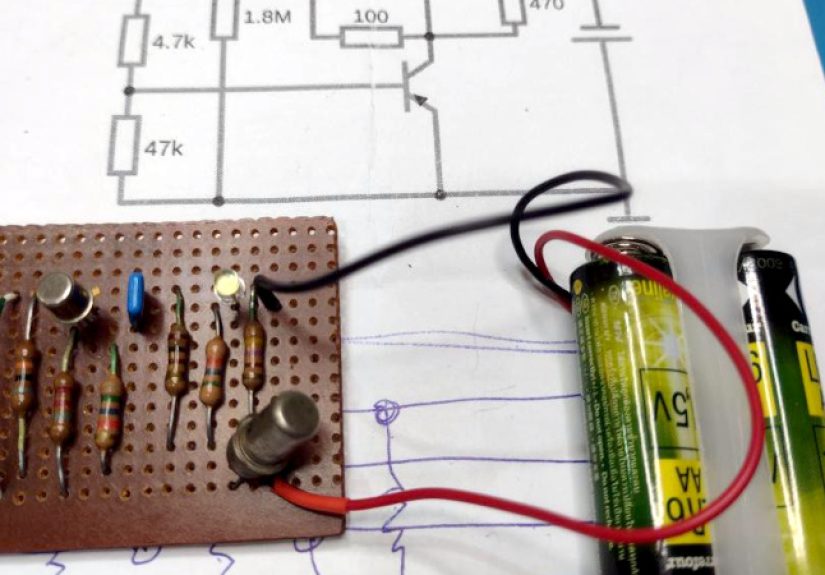
The heart of the build is a phase-shift oscillator that flashes a white LED once per second. The amplifier stage is built from two transistors: a vintage germanium device paired with an older (but more modern than germanium) silicon transistor. The feedback network is an RC phase-shift chain, and because the frequency target is so low, the resistors climb into the megaohm rangenumbers that make your multimeter pause and your breadboard quietly reconsider its life choices.
Power is pleasingly simple: a pair of AA cells. No lab supply. No bench-grade timebase. Just a slow, steady attempt to convince a handful of passive parts and a transistor from another era to agree on what “one second” should feel like.
Phase-Shift Oscillator, Explained Like You’re Holding a Soldering Iron
A phase-shift oscillator is basically a feedback loop with manners. Here’s the simplified story:
- You build an amplifier that inverts the signal (adds 180° of phase shift).
- You add an RC network that contributes another 180° of phase shift at one specific frequency.
- At that frequency, the signal comes back around “in phase” overall (360°), and the loop sustains oscillation.
The RC network is typically three sections, each contributing roughly 60° of phase shift at the oscillation frequency. If the sections are equal (same R and C), a common approximation for the oscillation frequency is:
Here’s the funny part: at 1 Hz, you can’t hide from R and C. Suppose the design uses something like a 1.8 MΩ resistor value in the phase-shift network. Solving the approximation for C gives:
That’s a perfectly normal capacitor valuebut paired with megaohm resistors, the circuit becomes sensitive to all the unglamorous realities: leakage currents, surface contamination, board humidity, and even measurement technique. At high impedances, your circuit is basically a tiny electromagnetic gossip network. It hears everything.
Why Use a Germanium Transistor at All?
Part of the answer is simply: because it’s cool. Germanium transistors are historical artifacts you can still make do real work. Using one in a 1 Hz oscillator is an almost poetic flexlike using a rotary phone to order a pizza via Morse code.
But there’s also an engineering angle. Older germanium transistors are often associated with lower usable frequencies in practice, and at 1 Hz you’re not asking for speed. You’re asking for behavior. You’re asking for predictable biasing in a circuit where resistor values are huge and currents can be tiny.
Germanium devices can be more temperature-sensitive and leakier than silicon in many practical contexts, which makes them both challenging and educational in slow oscillators. At one hertz, a small bias shift can mean your “second” stretches or shrinks in a way you can literally watch.
Accuracy Talk: From “Blinky” to “Bring a Spreadsheet”
The phrase “one hertz” has a spectrum of seriousness:
- Casual 1 Hz: roughly once per second. Looks right. Feels right. Great for art, demos, and clocks you don’t trust with your rent payment.
- Trimmed 1 Hz: adjustable and calibratable. You can tune it to match a reference and keep it decent under stable conditions.
- Serious 1 Hz: derived from a crystal, temperature-compensated, or locked to an external reference. You may start saying things like “ppm” at parties.
What Does “20 ppm” Actually Mean?
Timekeeping discussions love ppm (parts per million) because it’s compact and intimidating. But the real-world impact is simple. If your clock drifts by ±20 ppm, that’s about:
Over a month, you’re late by roughly a minute. Over a year, you’re late by enough to miss a meeting you didn’t want to attend anyway. (But now you have a data point to justify it.)
Meanwhile, an RC oscillator can drift far more depending on capacitor type, resistor tolerance, temperature changes, supply voltage, and whether the universe is feeling mischievous that day.
The One-Hertz Toolbox: Common Ways to Make a Second
1) Watch Crystal + Divider (The Timekeeping Workhorse)
If you want a clean second, a 32.768 kHz tuning-fork crystal is the standard move. Divide it down digitally and you get 1 Hz. Many RTC chips can output a 1 Hz square wave directly, which is basically the “easy mode” that still teaches you good habits about grounding, layout, and crystal handling.
2) 555 Timer (The Venerable Shortcut That Still Teaches You Things)
The 555 can absolutely do 1 Hz, and it’s a great way to learn about RC timing, thresholds, duty cycle, and practical oscillator behavior. But if your goal is stable timekeeping, a basic RC-timed 555 oscillator is more like a “suggested second” than a “certified second.” Trimmers can help, and careful component choice helps more, but physics still collects its fee.
3) Discrete Transistor Multivibrators (Minimalist, Educational, Surprisingly Emotional)
A two-transistor astable multivibrator can be tuned down to slow rates with large RC values. It’s a beautiful circuit to build because it’s transparent: you can watch capacitors charge and discharge, see bias points matter, and learn that symmetry is a suggestion, not a law.
4) Microcontrollers and Internal Oscillators (Convenient, Not Always Honest)
A microcontroller can blink at 1 Hz easily, but the accuracy depends on its clock source. Internal RC oscillators are convenient, but they can drift with temperature and voltage. Some systems calibrate RC clocks against crystals or references, which can close the gap, but it becomes a whole design storyexactly the kind of story the One Hertz Challenge loved.
5) “The Rules Never Said It Had to Be Electronics”
Mechanical escapements, gear trains, pendulums, thermal oscillators, flames, falling sandonce you accept that a “tick” can be any repeatable event, you start seeing one hertz everywhere. The challenge turned time into a design material.
What This Ancient-Transistor Build Teaches (Even If You Never Copy It)
The charm of the “ancient transistor counts the seconds” approach isn’t that it beats an RTC in accuracy. It’s that it makes the invisible visible.
- Low frequency forces honesty. You can’t “average out” sloppiness when each cycle takes a full second.
- High impedances expose reality. Leakage, humidity, and layout stop being footnotes and become plot twists.
- Component choices become storytelling. Stripboard, period passives, and vintage semiconductors turn a circuit into a time capsule.
In a world where time is usually a library call, this project reminds us that time can be hand-made slightly imperfect, deeply charming, and stubbornly physical.
Practical Tips If You Want to Chase One Hertz Yourself
Measure Like You Mean It
A cheap counter, a scope, or even audio-recording “ticks” can help. If you’re tuning an oscillator, measure over a long interval. Ten seconds of measurement tells you almost nothing. Ten minutes tells you a story.
Mind Your Leakage
Once you’re in megaohm territory, board cleanliness matters. Flux residue can become a resistor you didn’t order. Fingerprints become a humidity sensor you didn’t design.
Pick Capacitors With Intent
For timing networks, capacitor type matters. Some dielectrics drift with temperature, voltage, and age far more than others. The circuit can “work” and still be a liar. Your job is deciding how honest it needs to be.
Decide What “Accurate Enough” Means Up Front
If you need a pleasing blink, don’t overbuild. If you need real timekeeping, consider a crystal-based approach. If you want to learn, build it the hard way firstthen upgrade. Pain is just education with dramatic lighting.
Conclusion: One Second, Many Ways
The 2025 One Hertz Challenge was a reminder that “one per second” isn’t just a frequencyit’s a design philosophy. You can get there with a watch crystal and a divider chain. You can get there with a 555 and a trimmer. Or you can get there with a vintage germanium transistor, a handful of RC parts, and a stubborn refusal to let the modern world have all the fun.
And that’s the real win: building something that doesn’t just use time, but reveals itone tick at a time.
Builder Experiences: What It Feels Like to Live at One Hertz (Extra Notes from the Trenches)
If you’ve never built a 1 Hz oscillator from “honest” analog parts, here’s the part nobody tells you: it’s not a circuit, it’s a relationship. You don’t just assemble componentsyou negotiate with them. You learn their moods. You learn what they do when the room gets warmer, when the batteries sag, and when you lean in close like a hopeful houseplant trying to photosynthesize your confidence.
The first experience is usually optimism. You do the math, pick an R and C, wire it up, and think, “Great, it’ll blink once a second.” Then it blinks twice per second. Or once every three seconds. Or it doesn’t blink at all, but it does generate a warm feeling in the resistor that says, “Nice try.” That’s when you learn the second experience: interpretation. Your multimeter says one thing, your scope says another, and your eyeballs say, “That’s… close-ish?” At one hertz, human perception becomes a surprisingly decent instrumentuntil you try to compare “close-ish” across five minutes and realize your brain is an unreliable intern.
Then comes the classic analog plot twist: the Touch Effect. You reach in to tweak a trimmer or reposition a wire, and suddenly the timing changes. Not because you’re cursed (although we can’t rule it out), but because at high impedances your body is part of the circuit. You are capacitively coupled to everything. You are a bag of salty water with opinions. The oscillator may slow down when you hover your hand over it, then speed up when you back awaylike a shy animal that only performs when you stop watching.
If the design uses megaohm resistorslike many low-frequency RC networks doyou also discover the experience of environmental realism. A little flux residue can become a leakage path. A humid day can shift timing. A slightly dirty board can act like it’s got an invisible parallel resistor. You clean the board, the frequency changes. You clean it again, it changes again. At this point you start narrating your life in engineering terms: “My oscillator is currently in a high-humidity emotional state.”
And then, if you persist, you arrive at the most satisfying experience: calibration. You stop trying to win against physics and start collaborating with it. You measure the blink period over long spans (minutes, not seconds), adjust gently, wait for it to settle, adjust again. You learn patience. You learn that “stable” is a behavior, not a switch. You also learn that battery voltage is a sneaky variableyour circuit might be perfect at 3.2 V and a little dramatic at 2.6 V. That’s not failure; that’s design insight you only get by building.
Finally, there’s the emotional payoff that makes the One Hertz Challenge so addictive: the moment it locks in. The LED blink becomes calm and confident. The tick feels “right.” You glance at a clock, count along, and it matches. It’s not atomic, and it doesn’t need to be. You made a second happen on purpose, using parts you can point to. For a brief moment, time isn’t an abstractionit’s a little pulse you built with your own hands (and probably a few new gray hairs).





 Close
Close