
Table of Contents >> Show >> Hide
- Why the earliest days hit different
- Burgers and drive-thrus: when speed met swagger
- 1. White Castle: The tiny “castle” built to look clean
- 2. McDonald’s: The kitchen that ran like a stopwatch
- 3. Burger King: Built around a machine (and a big idea)
- 4. Wendy’s: Square patties, old-school signs, and a new kind of fast food
- 5. In-N-Out: A drive-thru the size of “barely there”
- 6. Whataburger: The “two hands required” flex
- 7. Five Guys: The “start a business or go to college” moment
- 8. Shake Shack: A hot dog cart that accidentally launched a burger era
- 9. A&W: The root beer stand that basically invented the vibe
- 10. Jack in the Box: The drive-thru idea that never wanted to slow down
- 11. Sonic: The drive-in that turned your car into a table
- Chicken legends: crisp, craveable, and surprisingly strategic
- Tacos and bowls: fast food gets bold (and portable)
- Pizza pioneers: from borrowed cash to delivery empires
- Sandwiches and bakery-cafés: fast food learns to “lunch”
- Sweets and caffeine: the “treat economy” starts early
- What these early stories reveal about fast-food history
- Extra: of fast-food experiences you’ll recognize
- Conclusion
Fast food didn’t start as a monolith of drive-thrus, apps, and “limited-time offers” that somehow last longer than some relationships.
It started as a handful of scrappy ideas: a tiny stand, a borrowed loan, a clever cooking gadget, a menu so short it could fit on a napkin,
and founders who were absolutely convinced America needed their specific brand of delicious convenience right now.
The funniest part? The “earliest days” of these chains weren’t polished. They were experimental, occasionally chaotic, and often shaped by
one very practical question: How do we feed people fast without serving sadness? The answers became the fast-food history
we still taste today.
Why the earliest days hit different
Early fast food was basically a national science fairexcept the judges were hungry and the prize was survival. Chains that made it didn’t just
invent iconic items; they invented systems: assembly-line kitchens, recognizable buildings, franchising playbooks, and the “we can do this in
three minutes” kind of confidence that still powers modern quick-service restaurants.
Burgers and drive-thrus: when speed met swagger
1. White Castle: The tiny “castle” built to look clean
In 1921, White Castle sold small square burgers for a nickel and wrapped them in a building design that screamed “trust us.” The castle motif and
spotless vibe weren’t just branding; they were reassurance in an era when people were suspicious of ground beef. The slider wasn’t just a burgerit
was a PR strategy you could eat.
2. McDonald’s: The kitchen that ran like a stopwatch
The McDonald brothers didn’t just sell burgersthey engineered a method. Their “Speedee Service System” stripped the menu down and rebuilt the
kitchen around efficiency. It was less “restaurant” and more “burger ballet,” where every movement had a purpose and every second mattered.
3. Burger King: Built around a machine (and a big idea)
Burger King’s origin story includes a very specific obsession: cooking burgers quickly and consistently. The “Insta-Broiler” wasn’t a background detail;
it was the point. The early brand leaned into flame-grilled identity as a technical advantagelike saying, “Yes, we’re fast, and also… we brought fire.”
4. Wendy’s: Square patties, old-school signs, and a new kind of fast food
When Wendy’s opened its first restaurant in 1969, it didn’t try to out-McDonald’s McDonald’s. It went “different”: square burgers that literally
don’t cut corners, plus comfort-food energy (hello, baked potato) that made the place feel like fast food with a handshake.
5. In-N-Out: A drive-thru the size of “barely there”
In 1948, In-N-Out started in a tiny spaceabout 100 square feetthen did something quietly revolutionary: a drive-thru setup that helped customers
order without leaving the car. It was the early blueprint for the California drive-thru culture that would eventually become… basically California.
6. Whataburger: The “two hands required” flex
Whataburger’s early claim was simple: the burger was so big you’d blurt out “What a burger!” Whether you buy the legend or just appreciate the
vibe, the chain leaned into generous size earlyturning “bigger” into a brand personality long before social media made portion discourse a sport.
7. Five Guys: The “start a business or go to college” moment
Five Guys began as a small carry-out spot in 1986, rooted in family and simplicity: burgers, fries, done well. The early story reads like a
motivational posterexcept it smells like peanut oil and comes with extra napkins.
8. Shake Shack: A hot dog cart that accidentally launched a burger era
Shake Shack started as a hot dog cart in Madison Square Park to raise funds for public art. Then it evolved into something bigger: a modern
fast-casual icon that proved “quick” could still feel speciallike fast food put on a clean hoodie and good sneakers.
9. A&W: The root beer stand that basically invented the vibe
A&W began in 1919 as a roadside root beer stand in California. The early magic wasn’t complicated: cold, fizzy, nostalgic goodness and the
realization that a recognizable drink could anchor a whole food experience. Fast food didn’t just grow from burgersit grew from beverages, too.
10. Jack in the Box: The drive-thru idea that never wanted to slow down
Jack in the Box grew out of mid-century drive-thru culture, when convenience wasn’t optionalit was the selling point. Early drive-thru innovation
(including ordering systems) wasn’t just a gimmick; it was the promise: “You can eat now and still make it to wherever you’re rushing.”
11. Sonic: The drive-in that turned your car into a table
Sonic traces its roots to a 1950s drive-in concept that leaned into the joy of eating in your car like it’s your personal dining room. The earliest
Sonic-era energy was pure American roadside: speakers, snacks, and the feeling that a Tuesday night could be a tiny event.
Chicken legends: crisp, craveable, and surprisingly strategic
12. KFC: A gas station meal that became a global recipe
KFC’s origin story includes roadside cooking, a signature spice blend, and the leap into franchising that turned “this chicken is great” into
“this chicken is everywhere.” The Colonel’s early success was built on consistencybecause chicken is unforgiving when it’s rushed and sad.
13. Chick-fil-A: The “test kitchen” was a tiny diner
The Dwarf Grill (now The Dwarf House) is where Chick-fil-A’s story begins. Truett Cathy used real customers as the earliest taste-test panel,
refining a boneless chicken sandwich until it felt inevitable. It’s the kind of origin that reminds you: iconic menu items often start as
“Try this and tell me if it’s weird.”
14. Popeyes: A reboot fueled by New Orleans flavor
Popeyes began in the early 1970s as “Chicken on the Run,” then pivoted. The lesson: sometimes your first idea is the rough draft.
The brand’s Louisiana identity wasn’t a late add-onit was the point of the comeback, turning regional flavor into a national craving.
Tacos and bowls: fast food gets bold (and portable)
15. Taco Bell: From “Tay-Kohs” to a whole movement
Taco Bell started in 1962, and the earliest days included a simple menu and a strong sense of placethose early Mission-style buildings became
part of the chain’s myth. The bigger innovation was making Mexican-inspired flavors feel fast, friendly, and repeatable across locations.
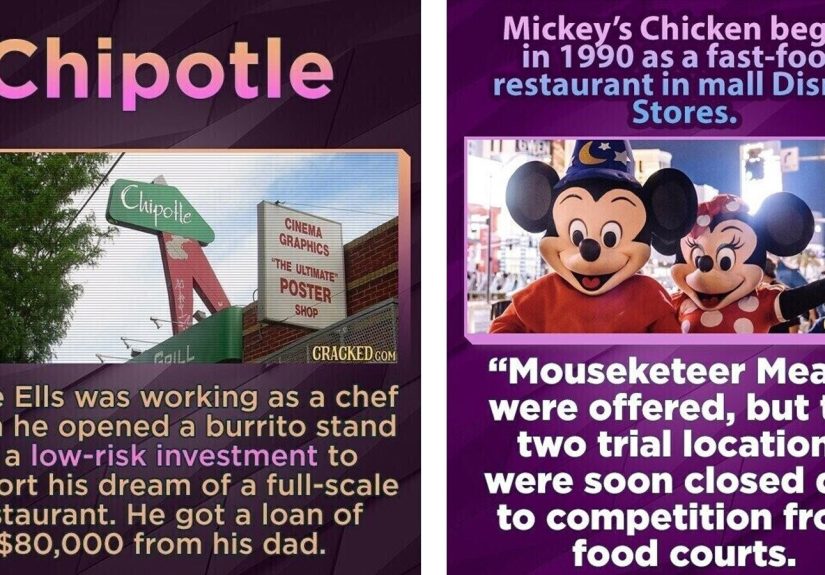
16. Chipotle: A single shop near campus with a big plan
Chipotle’s first restaurant opened in Denver in 1993, building a fast-casual model around assembly-line customization. The earliest vibe wasn’t
“massive chain”; it was “focused concept”: a tight menu, fresh ingredients, and a format that made lunch feel like you were in control of the plot.
17. Panda Express: Mall food court beginnings, nationwide impact
Panda Express opened its first location in the early 1980s at Glendale Galleria, adapting Chinese-American favorites into quick-service form.
Its early success wasn’t magicit was translation: turning a familiar restaurant experience into something fast, consistent, and snackable between errands.
Pizza pioneers: from borrowed cash to delivery empires
18. Pizza Hut: The sign only had room for eight letters
Pizza Hut’s founding story includes a small loan and a small signliterally. The chain began in Wichita in 1958, and the earliest “Hut” was less
corporate and more neighborhood hangout. It’s hard to overstate how much early pizza chains normalized the idea that a “casual meal” could be a ritual.
19. Domino’s: One store, one town, one very scalable idea
Domino’s began in Ypsilanti, Michigan, in 1960small start, big delivery destiny. Early Domino’s momentum came from treating pizza like a system:
make it reliably, move it quickly, repeat. When you can promise dinner without a stove, you’re not just selling pizzayou’re selling time.
20. Little Caesars: A family investment that turned into “Pizza! Pizza!” culture
Little Caesars started in 1959 near Detroit, built by a husband-and-wife team who bet their savings on a pizza shop. The early story is classic:
start local, nail the basics, then scale. It’s also proof that “affordable” can be its own kind of luxury on a weeknight.
Sandwiches and bakery-cafés: fast food learns to “lunch”
21. Subway: 312 sandwiches on day one
Subway began in 1965 as “Pete’s Super Submarines,” and the earliest days were all about the grind: opening a small shop, selling hundreds of subs,
and building a brand that turned customization into a routine. Subway’s big early insight: people love a menu that lets them feel like co-author.
22. Panera: A sourdough starter with ambition
Panera started in 1987 as St. Louis Bread Company, built around fresh-baked bread and a bakery-café atmosphere. The early idea was comforting:
make fast dining feel a little calmerlike the food equivalent of a deep breath and a decent chair.
23. Jimmy John’s: The original “fast” in fast sandwich
Jimmy John’s began in the 1980s with a simple promise: quick sandwiches that don’t waste your whole afternoon. Early growth came from doing one thing
relentlessly wellspeed plus consistencybecause hunger does not enjoy waiting while you “circle back.”
Sweets and caffeine: the “treat economy” starts early
24. Dairy Queen: Soft serve becomes a destination
Dairy Queen’s early story is tied to soft serveand the idea that dessert could be the main event, not the afterthought. The earliest DQ era helped
normalize quick treats as a regular joy, not a special-occasion splurge. (In other words: it professionalized the post-dinner “just one more thing.”)
25. Baskin-Robbins: “Let’s offer 31 flavors” was a bold choice
Founded in 1945, Baskin-Robbins made variety the brand. In an era when most places played it safe, it leaned into abundance and discovery.
The early lesson was simple and brilliant: if you give people enough options, they’ll argue about favorites… and then come back to “try just one more.”
26. Dunkin’: A coffee-and-doughnut routine becomes a chain
Dunkin’ dates back to 1950 in Massachusetts, built around a daily ritual: quick coffee, quick bite, keep moving. The early success wasn’t just taste;
it was timingserving what people wanted on the way to somewhere else. Dunkin’ helped make “grab-and-go” a lifestyle, not a compromise.
27. Krispy Kreme: The hot sign that made patience impossible
Krispy Kreme’s early magic was sensory: the smell, the glaze, the moment you realize “one” is never the real number. The brand built a cult of
freshnessbecause when something is warm and shiny, your self-control becomes a rumor.
28. Starbucks: A single store selling beans, not lattes
Starbucks began in 1971 at Pike Place Market selling coffee beans, tea, and spices to take home. The earliest Starbucks wasn’t a “café vibe” machine;
it was a specialty shop. That origin matters because it explains the brand’s long-running obsession with coffee identitybefore the world knew it
needed a name for its milk choices.
What these early stories reveal about fast-food history
Under all the nostalgia and neon signage, the “earliest days” share a few patterns:
founders solved a specific problem (speed, cleanliness, portability, consistency), used a simple menu to perfect execution, and built a system
that could travel. In other words, fast food didn’t win because it was loud. It won because it was repeatable.
And the real reason these origin stories stay fascinating? They’re proof that “iconic” is usually born from something unglamorous:
a tiny building, a borrowed loan, a single recipe, and a stubborn belief that people will love it if you do it rightover and over and over.
Extra: of fast-food experiences you’ll recognize
If you’ve ever eaten fast food and felt oddly sentimental afterward, congratulationsyou have experienced the secret ingredient: memory.
Fast-food joints don’t just sell meals; they sell moments that happen to include fries. The earliest days of these chains weren’t only about
founders and first locations; they were about the first time customers made them part of life.
Think about the classic road-trip stop: someone announces they “just need a bathroom,” but everyone knows the real mission is a drive-thru bag that
smells like victory. You crack the window, the car fills with warm, salty air, and suddenly the backseat is negotiating sauce packets like it’s a
high-stakes business deal. The music is too loud, the GPS is confused, and somehow this becomes the story you repeat for years: “Remember when we
took that wrong exit and ended up at the best fast-food stop?”
Or the after-school hangout, where the menu is less important than the booth. Somebody gets the same thing every timebecause consistency is comfort
and somebody else “tries something new” and regrets it loudly for comedic effect. There’s always a friend who claims they aren’t hungry, then steals
fries like a professional. And there’s always that one person who can identify the order by smell alone, like a snack sommelier: “That’s definitely
nuggets… and someone got onion rings.”
Fast food also has a talent for showing up when life is messy. The late-night run after a long shift. The quick bite between errands when you’ve
been adulting too hard. The celebration meal that’s not fancy, but feels right because it’s familiar. Even the “we forgot to defrost anything”
dinner that turns into a tiny family tradition. These places become landmarks in the geography of your week.
And yesthere’s a specific kind of joy in walking into an old-school location that still looks like an earlier era: a retro roofline, a classic sign,
a dining room that feels like it was designed for high school reunions and Sunday cravings. It’s like time travel, but you can order dessert.
That’s the real power behind “stories from the earliest days”: they’re not just brand history. They’re a reminder that the food is wrapped in
familiarity, and familiarity is delicious.
Conclusion
The earliest days of America’s favorite fast-food joints weren’t sleekthey were bold, practical, and sometimes gloriously weird. But those origins
explain why these chains still matter: they created systems that made food fast, consistent, and accessible, then layered on identitysignature items,
memorable buildings, and rituals people repeat for decades.
Next time you’re in a drive-thru line, you’re not just waiting for dinner. You’re participating in a century-long experiment in convenience,
culture, and cravingsone small story (and one large order) at a time.






 Close
Close