
Table of Contents >> Show >> Hide
- From Dungeness B to Bletchley: Why This Computer Matters
- What Was the Ferranti Argus 500?
- Why Old Computers Survive in Critical Systems
- The Restoration Challenge: Cables, Cabinets, and Patience
- Why Bletchley Is the Perfect New Home
- The Beauty of a Machine That Was Built to Be Useful
- Lessons for Today’s Digital World
- Why This Story Captures Public Imagination
- Experience Section: Visiting, Learning, and Thinking Beside an Ancient Nuclear Plant Computer
- Conclusion
Some museum pieces arrive in velvet-lined boxes. Others arrive as several hulking cabinets, a small mountain of cables, and enough Cold War engineering charm to make a modern laptop feel like a nervous intern. That is the story behind the Ferranti Argus 500, an ancient nuclear plant computer that once served at Dungeness B nuclear power station and later found a second life at The National Museum of Computing in Bletchley.
At first glance, the phrase “ancient nuclear plant computer” sounds like the beginning of a science-fiction thriller in which somebody presses the wrong glowing button. In reality, this machine is less villain and more veteran: a rugged industrial control computer from a time when reliability mattered more than sleek design, and when memory was measured in kilowords rather than gigabytes. The Argus 500 did not stream music, recognize faces, or ask whether you wanted to update now or be annoyed again in 30 minutes. It monitored serious industrial processes, including one of the most safety-conscious environments on Earth: a nuclear power station.
From Dungeness B to Bletchley: Why This Computer Matters
Dungeness B, located on the south coast of England in Kent, was the first commercial Advanced Gas-cooled Reactor station to begin construction in the United Kingdom. It started generating electricity in 1983 and eventually moved into defueling in 2021 after an extended outage that began in 2018. During its long operating life, the station became a landmark of British nuclear engineering, producing low-carbon electricity and supporting the local economy for decades.
The Ferranti Argus 500 associated with Dungeness B belongs to a generation of computers built not for offices, homes, or games, but for monitoring and controlling real-world systems. These machines lived in the background of industrial life. They watched temperatures, alarms, signals, and processes. They were the digital equivalent of a calm engineer with a clipboard, a thermos of tea, and absolutely no interest in drama.
When the Argus 500 was removed from the decommissioned plant and taken to The National Museum of Computing, it did not become a silent relic. Museum volunteers worked to bring it back to life. That restoration matters because computing history is not only the story of famous names and shiny consumer gadgets. It is also the story of machines that quietly made factories, power stations, defense systems, hospitals, and transport networks work.
What Was the Ferranti Argus 500?
The Ferranti Argus family began in the late 1950s, when digital computers were moving from scientific calculation into real-time process control. Ferranti’s engineers designed the Argus line for jobs that required fast, dependable interaction with physical equipment. The earlier Argus machines were used in settings such as chemical plant control and military systems. By the time the Argus 500 appeared, the family had become a serious name in industrial automation.
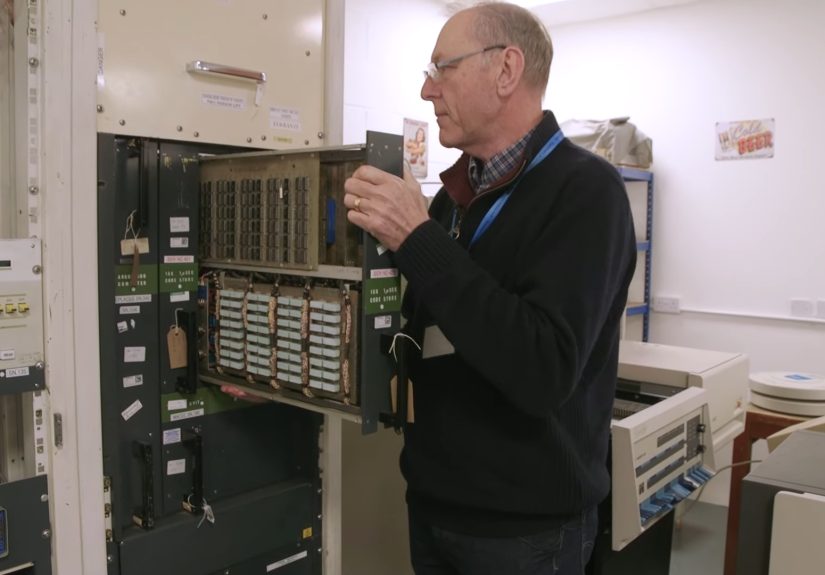
The Argus 500 was not a personal computer. Nobody was editing family photos on it, and it was not waiting for someone to install Minesweeper. It was a cabinet-based industrial machine using diode-transistor logic, large circuit boards, magnetic core memory, and punched-tape-style program loading. The Dungeness B system reportedly included 32 kilowords, or about 96 kilobytes, of magnetic core memory. Today, that sounds tiny. A single modern smartphone photo can be dozens of times larger. Yet in its proper context, this was enough to monitor complex plant signals and support demanding industrial operations.
Magnetic core memory is one of those older technologies that feels almost magical once you see it up close. Instead of microscopic silicon memory cells, it used tiny magnetic rings threaded with wires. Each ring stored a bit. It was durable, non-volatile, and remarkably suited to serious work. If modern RAM is a hummingbird, core memory is a brick wall that learned arithmetic.
Why Old Computers Survive in Critical Systems
People often wonder why safety-critical industries continue using old technology. The answer is simple: proven systems are hard to replace. In a nuclear plant, the question is not “Can we install the newest thing?” The question is “Can we prove, document, test, regulate, maintain, and safely operate the replacement under every required condition?” That is a much bigger mountain to climb than plugging in a new router and hoping the Wi-Fi reaches the kitchen.
Nuclear instrumentation and control systems are deeply tied to safety cases, maintenance procedures, operator training, spare parts, and regulatory approval. International nuclear guidance recognizes that aging and obsolescence of instrumentation and control equipment can raise maintenance costs and create challenges when replacement parts become difficult to source. At the same time, modern digital upgrades require careful planning because new software-based equipment introduces different design, testing, and failure considerations.
This explains why machines like the Argus 500 could remain important for so long. They were understandable, documented, stable, and familiar to the people who maintained them. In high-risk engineering, boring reliability is not a flaw. It is the goal. A nuclear plant computer is not supposed to impress your friends at a coffee shop. It is supposed to work correctly, repeatedly, and predictably while everyone else gets on with their day.
The Restoration Challenge: Cables, Cabinets, and Patience
Moving an old industrial computer is not like moving a desktop PC. The Argus 500 consisted of large cabinets packed with circuit boards and wiring. Removing it from the power station meant disconnecting hundreds of cables and preserving enough context to understand how everything went back together. Any restorer who has ever found one mystery connector behind a television can appreciate the scale of this problem. Now imagine that the television is several cabinets wide and once belonged to a nuclear power station.
The museum’s volunteer engineers relied on surviving documentation, specialist knowledge, and hands-on experience. One of the most valuable restoration ingredients was not a rare chip or a custom tool, but human memory: people who understood Ferranti systems and the practical habits of older industrial computing. In restoration work, documentation tells you what should happen. Experienced engineers tell you what actually happened after 20 years of field modifications, clever fixes, and “temporary” workarounds that somehow became permanent.
The result is more than a successful repair. It is a recovered conversation between generations of engineers. Visitors can see not only an old computer, but also the design decisions and maintenance culture that kept such machines alive.
Why Bletchley Is the Perfect New Home
The National Museum of Computing is located at Bletchley Park, a site already famous for codebreaking and early computing history. The museum houses working historic computers and tells the story of computing from wartime machines through mainframes, minicomputers, personal computers, and beyond. Its collection includes the rebuilt Colossus, associated with World War II codebreaking, and the Harwell Dekatron, also known as WITCH, one of the world’s oldest working digital computers.
That makes Bletchley a fitting home for the Argus 500. Colossus shows how electronic computing helped break encrypted wartime messages. WITCH shows how early digital machines supported scientific calculation. The Argus 500 adds another chapter: computers entering the industrial world, taking on real-time monitoring, and helping operate infrastructure that ordinary people depended on without ever seeing the machine behind the curtain.
It also sits comfortably beside another nuclear-related machine in the museum’s story: the Marconi Transistorised Automatic Computer, or TAC. The Marconi TAC was used at Wylfa nuclear power station in North Wales and ran for decades. Together, these machines show how early and mid-century computer engineering became part of the nuclear agenot as flashy robots, but as dependable monitoring and control tools.
The Beauty of a Machine That Was Built to Be Useful
Modern technology often hides its workings. Phones are sealed rectangles. Cloud computing sounds weightless, even though it depends on enormous data centers. Software updates arrive silently, unless they choose the most inconvenient possible moment, as tradition demands. By contrast, the Argus 500 is gloriously physical. It has cabinets, boards, wiring, switches, and memory you can almost imagine tracing with your finger.
That physicality makes it educational. A visitor can see that computing was not always invisible. The machine’s architecture teaches important ideas: input and output, memory, logic, timing, redundancy, and maintenance. It also reminds us that software has always depended on hardware, people, procedures, and context. A program is not just code. In industrial computing, it is part of a living system involving sensors, operators, alarms, power supplies, spare parts, and careful documentation.
Lessons for Today’s Digital World
The Argus 500’s new life in a museum is not just nostalgia. It offers practical lessons for today’s technology culture. First, it shows that reliability is a design philosophy. Many modern products chase speed, convenience, and constant novelty. Critical systems chase confidence. They ask whether the machine can keep doing its job year after year, even when parts age, engineers retire, and the original manufacturer has moved on.
Second, it highlights the hidden cost of obsolescence. A system can continue working perfectly while becoming harder to support. Spare parts disappear. Documentation becomes fragile. Specialist knowledge retires. Interfaces that once seemed normal become strange artifacts. Anyone who has tried to open an old file format knows this problem in miniature. In nuclear and industrial settings, the stakes are much higher.
Third, the restoration proves the value of museums that keep machines working. A static display can show what an object looked like. A working exhibit shows what it did. The clicks, lights, rhythms, and quirks of an old machine communicate history in a way that a label cannot. The difference is like reading a recipe versus smelling bread in the oven.
Why This Story Captures Public Imagination
Part of the fascination comes from contrast. Nuclear power stations feel futuristic and intimidating. Ancient computers feel charming and slightly absurd. Put them together and the result is irresistible: a giant old machine with a serious past, rescued from a place where mistakes were not invited to the meeting.
There is also something emotionally satisfying about preservation. The Argus 500 was not simply scrapped. It was recognized as historically important. Volunteers spent time understanding it, moving it, cleaning it, reconnecting it, and demonstrating it. That care tells us something about how society values engineering heritage. Not every important machine is beautiful in the traditional sense. Some are beige, bulky, and full of cables. But they still deserve their curtain call.
Experience Section: Visiting, Learning, and Thinking Beside an Ancient Nuclear Plant Computer
Standing near a restored industrial computer like the Ferranti Argus 500 is a very different experience from looking at a modern gadget. A smartphone invites you to swipe. A machine like this invites you to slow down. It asks you to notice the scale of the cabinets, the neat severity of the boards, and the fact that every physical part had a job. There is no decorative minimalism here. Everything exists because somebody needed it to solve a problem.
For students, the experience can be especially powerful. Computing often arrives in classrooms as abstract code on a screen. The Argus 500 turns computing back into machinery. It shows that logic once had weight, heat, smell, and sound. It helps explain why early programmers and engineers had to understand timing, memory limits, input devices, and hardware behavior with unusual intimacy. When memory is measured in kilowords, efficiency is not a fashionable preference. It is survival.
For engineers, the machine is a reminder that elegance and endurance are not always the same thing. A modern system may be elegant because it is compact and fast. An older industrial system may be elegant because it is traceable, modular, repairable, and understandable. The Argus 500 represents an engineering culture in which maintenance mattered. A technician could remove boards, follow signals, consult manuals, and reason about the machine’s behavior. That kind of transparency is increasingly rare.
For general visitors, the best part may be the sense of personality. Big historic computers have presence. They do not vanish into a pocket or hide behind a touchscreen. They occupy space with confidence, like a grandparent who remembers when everything was harder and is only slightly smug about it. Seeing the Argus 500 in a museum setting makes the past feel less like a timeline and more like a room you can walk into.
The experience also encourages reflection on infrastructure. Most people use electricity, transportation, communication networks, and medical systems without thinking about the machines that support them. The Argus 500 points to that hidden layer of civilization. Behind every light switch and every industrial process is a chain of design decisions. Some are new. Some are decades old. Many are still quietly doing their jobs.
Finally, the restored computer offers a hopeful lesson about technological aging. Old does not always mean useless. Sometimes old means understandable, proven, and worth preserving. The Argus 500 no longer needs to monitor a live nuclear power station, and that is probably best for everyone’s blood pressure. But as a working museum exhibit, it has a new mission: teaching visitors how computers became part of the physical world, and why the history of technology is much richer than the story of faster chips and thinner screens.
Conclusion
The story of the ancient nuclear plant computer finding a new home in Bletchley Museum is more than a quirky technology headline. It is a compact history of industrial computing, nuclear engineering, restoration culture, and public education. The Ferranti Argus 500 represents a time when computers were moving out of laboratories and into the machinery of everyday life. It watched over serious systems, survived decades of service, and now helps visitors understand how digital control became part of modern infrastructure.
In an age obsessed with the newest device, the Argus 500 offers a refreshing counterpoint. It reminds us that good engineering can outlast trends, that maintenance is a form of intelligence, and that museums are not graveyards for machines. At their best, they are workshops of memory, where old technology runs again and teaches the future how it was built.
Note: This article is written for web publication in standard American English and is based on publicly available historical, technical, and museum information about the Ferranti Argus 500, Dungeness B, Bletchley Park, and nuclear instrumentation systems.





 Close
Close