
Table of Contents >> Show >> Hide
For decades, the IBM Selectric typewriter has occupied a very specific corner of the retro-tech universe: too ingenious to forget, too mechanical to fake, and too beloved to leave quietly on a shelf. It was the office workhorse with the famous “golf ball” print element, the machine that made old-school typebars look clumsy and made typists feel like they had upgraded from a bicycle to a jet. And yet, for all its elegance, the Selectric had one nagging modern problem: replacement typeballs were finite. Once the originals wore out, disappeared, cracked, or became harder to source, even a beautifully restored machine could end up stuck in typographic limbo.
That is why the arrival of practical DIY typeballs feels like such a big deal. It is not just a quirky maker headline. It is a meaningful shift for collectors, repairers, writers, tinkerers, and typography nerds who have been trying to keep these iconic machines alive. Thanks to better resin printing, smarter modeling workflows, and a community willing to obsess over tiny letterforms until their eyeballs nearly filed a complaint, IBM Selectric typewriters have finally crossed into a new era: one where custom, home-produced typeballs are possible.
And no, that does not mean every garage now has a magical font factory humming next to the lawn mower. But it does mean the Selectric revival just got a lot more interesting.
Why the IBM Selectric Still Matters
To understand why DIY typeballs are exciting, it helps to remember what made the IBM Selectric such a legend in the first place. Introduced in 1961, the Selectric ditched the familiar tangle of individual typebars and replaced them with a spherical type element that rotated and tilted into place before striking the ribbon and paper. That change solved one of the biggest frustrations of traditional typewriters: jammed bars when a fast typist got a little too enthusiastic. In other words, the Selectric was not just sleek. It was a genuine engineering flex.
The machine also changed how people thought about typing itself. Instead of being locked into one permanent typeface, users could swap typeballs and change fonts, sizes, and even character sets without buying a whole new machine. Today that sounds obvious, because we live in a world where fonts breed like rabbits. Back then, it felt wonderfully futuristic. One machine could move from office memo to polished manuscript to specialized symbol set with a quick change of the element. That made the Selectric feel less like a typewriter and more like a platform.
IBM’s success with the Selectric was massive for a reason. It improved speed, reduced mechanical headaches, and looked modern enough to earn its place as a design icon. It also became a bridge to later word-processing systems, appearing in specialized terminals, early office automation tools, and publishing workflows. In short, this was not some niche office gadget. It was one of the great transitional machines of the 20th century, standing with one foot in the age of manual typing and the other in the world of digital text processing.
The genius of the “golf ball” design
The Selectric’s removable type element is the star of this story. It packed characters around a small sphere, allowing the machine to rotate and tilt to the right symbol almost instantly. That compact design produced crisp text, supported multiple type styles, and helped make the machine faster and tidier than older basket-style competitors. If the traditional typewriter was a cabinet full of tiny hammers, the Selectric was more like a precision turret.
Collectors still love that design because it sits at the perfect intersection of mechanics and typography. The machine is tactile, audible, and gloriously physical. It clicks, snaps, hums, and returns with authority. Typing on a good Selectric does not feel soft or vague. It feels decisive, as if every sentence has been approved by a very strict mechanical editor.
Why replacement typeballs became a problem
Here is the catch: the Selectric’s brilliance depends on the typeball. No typeball, no magic. Original IBM elements were once widely available in different fonts and specialized variants, but the supply has aged along with the machines. Many surviving elements are decades old. Some are common. Some are scarce. Some are priced like they were handcrafted by monks on a mountain. And if you want something unusual, such as a novelty font, a rare symbol set, or a custom language solution, the hunt gets harder fast.
That scarcity turned the typeball from a convenient interchangeable part into a bottleneck. You could restore the motor, clean the mechanism, replace worn components, and still end up limited by whatever old elements you could find online. For a machine built around flexibility, that was an oddly inflexible ending.
What Changed: DIY Typeballs Become Real
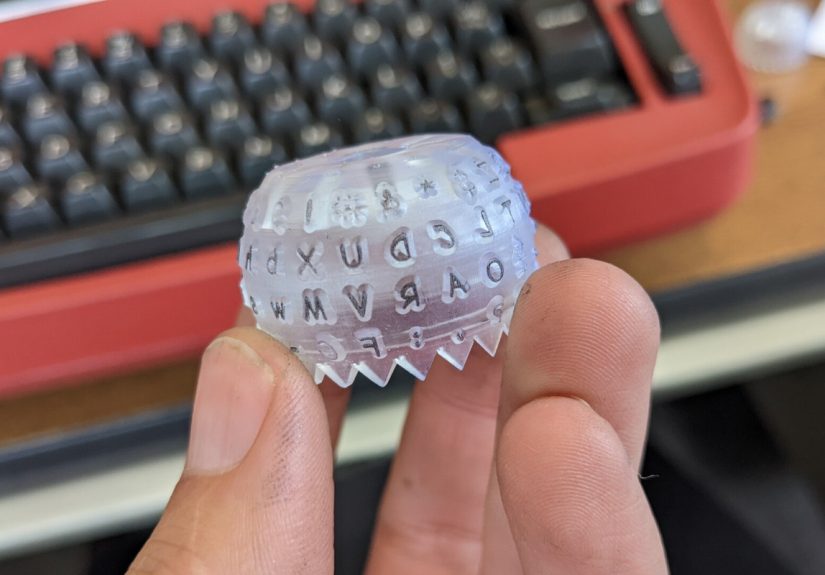
The headline that IBM Selectric typewriters finally got DIY typeballs is rooted in a breakthrough that is both practical and wonderfully nerdy. Maker Sam Ettinger documented a process for generating 3D-printable typeballs, using OpenSCAD, custom scripting, and high-resolution resin printing to create new elements for Selectric machines. The core challenge was not simply making a ball-shaped object. It was producing letterforms sharp enough to print legibly, durable enough to survive use, and precise enough to sit correctly in the mechanism without damaging a very vintage and very not-cheap machine.
That last part matters. A Selectric is not the kind of machine you casually bully into submission. If a DIY element fits poorly, it can cause alignment issues, weak impressions, or worse, put stress on delicate parts. Early maker notes were honest about these limitations. Even the project’s own documentation later warned that the first published versions should not be treated as the final word. That honesty, oddly enough, is part of why the development matters. This was not hype pretending to be perfection. It was a real technical leap followed by real iteration.
Why DIY typeballs were so hard for so long
For years, the idea sounded simple. “Just 3D-print a replacement.” Famous last words. The problem is that the Selectric’s characters are tiny, sharp, and mechanically demanding. A typeball is not decorative. It is a performance part. Each glyph has to hit ink ribbon and paper with enough definition to produce readable text. Rounded corners, softened edges, or slight geometry errors can turn a page of typing into something that looks like it was produced by a very polite potato.
Older hobbyist printing methods struggled to reproduce the necessary detail. Resin printing changed the game because it could produce finer edges and more consistent small-scale surfaces than many desktop filament printers. Once that manufacturing capability met better modeling methods, the project crossed from “cool experiment” into “hey, this might actually work.”
More than a novelty font stunt
It would be easy to laugh this off as a way to put Comic Sans on a typewriter, and to be fair, that alone is pretty funny. But the real value runs deeper. DIY typeballs open the door to custom character sets, revived specialty elements, uncommon symbols, and scripts that are difficult or impossible to source in original IBM form. The maker documentation around the project also pointed toward broader possibilities, including non-Latin layouts and specialized glyph tables.
That means the Selectric stops being just a restoration target and becomes a creative tool again. Not merely “preserved.” Useful. That is the difference between a museum piece and a living machine.
Why This Matters for Typewriter Restoration
Restoration culture is built on a simple dream: take a machine that should have been retired, ignored, or stripped for parts, and make it sing again. The Selectric has always been a tempting challenge because it is so iconic, but it is also famously intricate. Repairing one is not the same as dusting off a simple manual portable. These machines demand patience, parts knowledge, and a willingness to meet a mid-century engineering masterpiece on its own terms.
DIY typeballs make restoration more viable because they address one of the machine’s core consumable components. Even if a new printed element is not identical to a vintage IBM original in longevity or print crispness, it can still bring a machine back into meaningful use. For restorers, that is huge. A Selectric without available type elements is a beautiful object with limited purpose. A Selectric with reproducible typeballs is a working system again.
There is also an economic angle. Original typeballs can be collectible, and some specialty versions are scarce. Hobbyists with access to the right tools may be able to experiment, prototype, and create custom replacements without waiting for a perfect original to surface. That lowers one barrier to entry for new enthusiasts, which any aging technology desperately needs.
Typography gets a second life
The Selectric was always special because it made typography feel modular. Change the element, change the voice. That idea lands especially well today, when designers, writers, and analog enthusiasts are once again drawn to tools that have texture and personality. DIY typeballs extend that typographic spirit. They let people imagine new fonts, quirky symbol sets, specialized language tools, or artistic projects that IBM itself never anticipated.
In that sense, the modern DIY typeball is not a betrayal of the Selectric concept. It is almost a return to first principles. The Selectric was about flexibility, precision, and the joy of changing what a machine could say. A homemade typeball simply updates that philosophy for the maker era.
The Limits Are Real, and That Is Fine
None of this means a home-printed typeball automatically matches a factory-made original. It probably will not, at least not every time. Original IBM elements were highly refined parts, and the best surviving examples still set a high standard for sharpness, consistency, and durability. Plastic or resin alternatives may wear faster, strike less cleanly, or require tuning. Some users will prefer originals whenever they can get them.
But restoration does not always require perfection. Sometimes it requires an honest, working solution that keeps the machine relevant. Think of DIY typeballs less as a museum-grade replacement for every use case and more as a crucial new lane: good enough to revive, experiment, customize, and preserve access. For many owners, that is more than enough. It is the difference between typing and merely reminiscing.
There is also something refreshingly appropriate about the imperfect edges of this revival. The Selectric itself was born from years of engineering effort, not overnight magic. So it feels fitting that its modern rescue involves community iteration, testing, tweaking, and the occasional “well, that did not go as planned” moment. Progress, in other words, remains gloriously mechanical.
The Broader Legacy of the IBM Selectric
The Selectric’s importance goes beyond office nostalgia. It helped shape later computing, keyboard expectations, and document production. Specialized Selectric-based terminals were used in time-sharing systems. IBM’s Magnetic Tape Selectric Typewriter and related Composer systems pushed the machine into early word-processing territory. Special typeballs supported unusual symbol sets, including those used in technical and programming contexts such as APL.
The machine also left a cultural footprint. It became shorthand for competence, office modernity, and a certain brand of serious typing. Even later keyboard design has been linked, at least in spirit, to the expectations set by the feel of Selectric-era hardware. If you have ever met someone who talks lovingly about “real key travel” with the intensity of a sports commentator, you are hearing an echo of this lineage.
That is why DIY typeballs are about more than parts availability. They reconnect the Selectric to its larger legacy as a machine built around adaptable output. They turn a closed historical supply chain into an open-ended conversation between old engineering and new fabrication.
Experiences From the DIY Typeball Revival
What does this development actually feel like in practice? The most interesting part of the DIY typeball story is that it changes the day-to-day experience of owning a Selectric. Before, many owners approached these machines with a mix of affection and caution. You could restore one, admire one, maybe type on it with the elements you had, but you were always aware that the ecosystem was shrinking. Every missing ball felt like one more tiny door closing.
Now the experience feels more open-ended. The moment a Selectric owner realizes, “Wait, I may not be limited to whatever IBM shipped half a century ago,” the machine changes emotionally. It stops being a relic and starts acting like a workshop companion. That is a major shift. It is the difference between preserving the past and collaborating with it.
Enthusiasts describe a particular thrill in seeing a fresh custom element drop into place, even when the result is not flawless. There is suspense in that first line of text. Will the impression be crisp? Will alignment hold? Will the letters come out charmingly analog or suspiciously haunted? That suspense is part of the fun. The Selectric has always been mechanical theater, and DIY typeballs add a brand-new act.
There is also the tactile side. A good Selectric has a sound and rhythm that modern devices simply do not imitate well. It hums with intent. The ball snaps into position, the mechanism advances, and the page fills with text that feels physically earned. Using a DIY typeball in that context can feel oddly moving. You are watching a machine designed in the early 1960s accept help from 21st-century fabrication and keep going without complaint. That is not nostalgia alone. It is continuity.
For makers, the experience includes a second layer: design ownership. You are not just typing. You are thinking about glyph geometry, printer settings, support structures, resin behavior, and the tiny engineering drama of sharp corners. It is typography with grease under its fingernails. The process rewards patience, precision, and curiosity. In a world full of invisible software, that kind of visible problem-solving is deeply satisfying.
Writers and artists may find a different kind of appeal. A DIY typeball can make the Selectric feel less like an office machine and more like a printmaking instrument. A custom font changes the mood of the page immediately. A rare symbol set makes the machine feel specialized and personal. Even the minor imperfections can become part of the aesthetic. Slight wobble, softer edges, or quirky impressions do not always read as flaws. Sometimes they read as character, the same way film grain or letterpress bite can add texture rather than subtract quality.
Then there is the community experience, which may be the most important of all. The Selectric revival is not powered by one corporation reissuing official parts. It is powered by enthusiasts documenting methods, sharing files, refining designs, warning others about fragile spindles, testing print quality, and generally behaving like a volunteer R&D department for one of the most iconic typewriters ever built. That collaborative energy gives the whole story its heart. DIY typeballs are not just printed objects. They are proof that a machine can remain culturally alive when people keep building around it.
So yes, the experience is sometimes fiddly. Yes, it may involve calibration, iteration, and a little humility. But that is almost the perfect Selectric ending, or rather, non-ending. Instead of fading into nostalgia, the machine gets what every great tool deserves: one more chance to make itself useful, surprising, and a little bit glorious.
Conclusion
IBM Selectric typewriters finally getting DIY typeballs is one of those rare retro-tech developments that is both charming and genuinely important. It matters because the Selectric was never just a pretty office artifact. It was a modular writing machine built around the idea that type could change. The modern DIY breakthrough restores that principle in the most fitting way possible: with new tools, open experimentation, and a lot of stubborn cleverness.
Are homemade typeballs perfect? Not always. Are they enough to change the future of Selectric restoration and creativity? Absolutely. They give owners new options, extend the life of aging machines, and reopen a typographic playground that once seemed permanently fenced off. Best of all, they remind us that old technology does not stay alive by being admired from a distance. It stays alive when people keep using it, improving it, and occasionally teaching it a few new tricks.






 Close
Close