
Table of Contents >> Show >> Hide
- What Makes O’Lampia Studio Stand Out?
- The Bowery DNA: Why New York Still Matters Here
- A Design Language That Balances History and Modernity
- Why Designers Keep Using O’Lampia
- Signature Pieces and the Studio’s Visual Personality
- How to Decorate with O’Lampia Without Making Your Room Look Overdressed
- The Experience of O’Lampia in New York
- Final Thoughts
- SEO Tags
If New York apartments had a group chat, lighting would be the friend who either saves the entire vibe or ruins it before dinner arrives. That is exactly why O’Lampia Studio has held onto a special kind of design respect for decades. In a city obsessed with reinvention, the studio has managed to stay relevant by doing something surprisingly unfashionable: making things carefully, by hand, and with enough restraint to let the workmanship do the talking.
Founded in 1993 by lighting designer and fine artist Kwang Sung Lee, O’Lampia is one of those rare New York brands that feels rooted rather than manufactured for a trend cycle. Its fixtures are made to order, handcrafted in Manhattan, and often built around a simple but persuasive formula: strong line, warm metal, glowing glass, and just enough personality to make a room feel finished instead of fussy. In other words, O’Lampia does not scream for attention. It glows with confidence. There is a difference, and your dining room absolutely knows it.
What Makes O’Lampia Studio Stand Out?
O’Lampia Studio sits in New York’s historic Bowery lighting district, which already gives it a certain local authority. But location alone does not explain why interior designers, editors, and design lovers keep coming back to the brand. What makes O’Lampia memorable is its ability to bridge old-world craft and modern practicality without sliding into cliché. Some lighting brands lean aggressively industrial. Others go full jewelry box. O’Lampia tends to land in a more livable middle ground.
The studio’s work is often described as handcrafted, custom, and made to order, but those phrases can get tossed around so much they start sounding like decorative filler. Here, they actually mean something. O’Lampia produces chandeliers, sconces, pendants, and table lamps in-house, and many pieces can be adjusted for size, finish, and project-specific needs. That flexibility helps explain why the brand appears in homes, hotels, restaurants, and polished commercial spaces alike. Designers are not just buying a fixture; they are buying a starting point with real customization baked in.
The Bowery DNA: Why New York Still Matters Here
A lighting studio with genuine local roots
Plenty of companies like to borrow New York attitude for marketing. O’Lampia actually belongs to the city. Its downtown studio and showroom on Bowery ties the brand to one of Manhattan’s traditional lighting corridors, and that context matters. The Bowery has long been a place where utility and aesthetics collide: restaurant supply shops, old trade businesses, design studios, and the occasional dose of glorious chaos all rubbing shoulders together. It is not a sterile luxury backdrop, and O’Lampia benefits from that energy.
There is something deeply New York about a brand that makes elegant fixtures while remaining practical enough to handle custom orders for real spaces with real constraints. A ceiling is too low? A finish needs to be warmer? A designer wants a chandelier that feels dramatic without turning the room into a stage set? This is the kind of challenge that suits O’Lampia. The studio’s identity is not based on fantasy alone. It is built around problem-solving with style.
Made-to-order lighting in an age of mass sameness
That approach feels especially refreshing now, when so much home design is flattened by algorithm-friendly sameness. Scroll long enough and every room starts looking like it was assembled by a very tasteful robot with a beige addiction. O’Lampia resists that flattening. Because the fixtures are made to order, they keep a sense of individuality. Even when the lines are minimal, the result does not feel generic.
This is also where the studio’s New York manufacturing story becomes part of its appeal. “Made in NYC” is not just a charming label to slap onto a box. It signals proximity between design, fabrication, and revision. The people making the fixture are not half a world away from the people specifying it. That closeness can lead to better customization, more thoughtful finishing, and a product that feels more deliberate from start to finish.
A Design Language That Balances History and Modernity
One of the most interesting things about O’Lampia is that its style is not trapped inside a single historical lane. The brand has been described as spanning Gothic, Colonial, Art Nouveau, and modern references, yet its work rarely looks costume-y. That is a tricky design trick to pull off. Plenty of fixtures borrow historical cues. Far fewer translate them into forms that still feel at home in a contemporary interior.
O’Lampia often does this with silhouette rather than decoration. You might see a ring form, a graceful arm, an arched profile, a cluster of spheres, or a structure that hints at antique precedent without copying it outright. The result can feel sculptural without becoming impossible to live with. That matters because lighting is one of the few categories in design where “statement piece” can quickly become code for “something you’ll be tired of by Thanksgiving.”
Materials play a big role in that balance. Brass and glass show up again and again in the O’Lampia vocabulary, and for good reason. Brass brings warmth, history, and patina. Glass adds lightness and diffusion. Together, they create fixtures that feel substantial but not heavy. O’Lampia’s emphasis on hand-painted patinas, plating, and powder-coating also helps each design move between moods. A piece in old brass can feel soulful and rooted; the same basic form in a crisp finish may read more architectural and modern.
Why Designers Keep Using O’Lampia
You can tell a lot about a lighting brand by where it shows up. O’Lampia has appeared in projects featured by major American design publications, including spaces published by Architectural Digest, ELLE Decor, House Beautiful, Interior Design, and 1stDibs’ editorial platform. That range is revealing. This is not a brand confined to one narrow aesthetic tribe.
In some homes, O’Lampia reads tailored and quietly glamorous. In others, it acts as a modern foil inside rooms with traditional bones. A custom chandelier can hang above a botanical dining room in Brooklyn and feel perfectly at ease. Glass ring lights can sharpen up a colorful cottage kitchen. Sconces can add calm to a spa-like bathroom. A single brand managing to fit all those contexts is not an accident. It happens because the studio’s designs are disciplined enough to adapt.
Designers also love lighting that solves multiple problems at once. O’Lampia fixtures often deliver illumination, mood, material contrast, and architectural punctuation in one move. That efficiency is gold in interiors. Instead of layering three separate decorative gestures, one good fixture can organize the room. It is like hiring one employee who can also do accounting, diplomacy, and somehow fix the printer.
Signature Pieces and the Studio’s Visual Personality
Some O’Lampia designs are memorable because they are elegantly restrained. Others are memorable because they flirt with whimsy in a way that still feels grown-up. The Neo Gothic chandelier, for example, shows how the studio can reinterpret historical language without drifting into theme-park territory. The Ophelia chandelier, highlighted in recent design coverage, leans more expressive and surreal, with a sense of motion that gives a room instant life.
Then there are the pieces that reveal O’Lampia’s everyday charm: the Swing Hat Sconce, the Cylinder Lamp, picture lights, glass ring lights, and custom chandeliers adapted to a project’s exact needs. These are not just decorative objects; they show the studio’s range. It can produce lighting that reads intimate and domestic, as well as lighting that commands a room from overhead.
That range helps explain why the studio’s portfolio feels cohesive without feeling repetitive. Across categories, there is a recognizable commitment to line, proportion, and finish. O’Lampia does not rely on visual gimmicks. It relies on shape and glow. In lighting, that is a smart bet.
How to Decorate with O’Lampia Without Making Your Room Look Overdressed
In dining rooms
Dining rooms are a natural home for O’Lampia chandeliers because the brand understands how to create drama without visual noise. A well-scaled fixture above a table can provide structure, warmth, and conversation-starting appeal, especially in spaces that combine antique furniture with cleaner contemporary lines. If your room already has wallpaper, carved details, or bold art, choose a fixture with a simpler silhouette and let the finish do the seducing.
In kitchens
O’Lampia’s cleaner forms work beautifully in kitchens where utility can sometimes flatten personality. Glass ring lights or refined pendants can bring in softness without fighting with stone, cabinetry, and hardware. Because many pieces feel architectural, they can add polish while still respecting the kitchen’s hardworking character.
In bathrooms
Bathrooms often benefit from O’Lampia’s understated glamour. A pair of sconces in a warm finish can make a bath feel more tailored and less builder-basic. The key is balance. Let the light fixture be the jewelry, not the entire outfit. Good lighting should flatter faces, yes, but it should also flatter tile, paint, and whatever level of self-care ambition you are currently pretending to have.
In living spaces
Custom ceiling fixtures and sconces from O’Lampia are especially effective in living rooms and libraries that need visual anchoring. If the furniture is plush, textural, or layered with vintage pieces, a more geometric O’Lampia design can bring clarity. If the room is minimal, a fixture with slightly more flourish can keep the space from feeling emotionally unavailable.
The Experience of O’Lampia in New York
To understand O’Lampia, it helps to think beyond catalogs and product shots. The experience surrounding the brand is part of the appeal. In New York, where design often gets filtered through speed, scarcity, and square-foot anxiety, O’Lampia offers a different rhythm. It represents the slower, more tactile side of the city’s creative life.
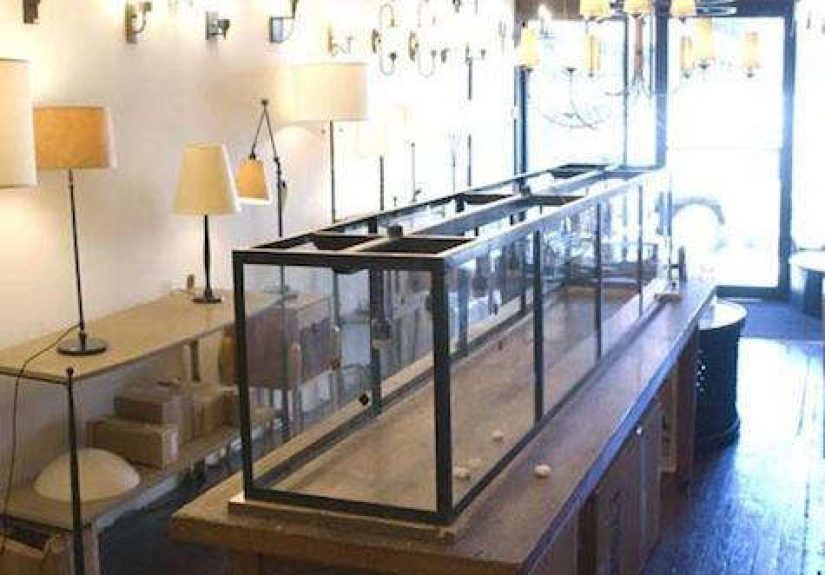
Imagine walking into the Bowery showroom after spending the morning dodging delivery bikes, side-eyeing scaffolding, and wondering why every coffee in lower Manhattan now costs approximately the price of a small chandelier finial. Then suddenly, there is light everywhere, but not the harsh retail kind. Instead, you are surrounded by illumination with shape, shadow, and intention. Fixtures hang at different heights. Glass glows softly. Brass catches the room without blinding it. The atmosphere feels less like shopping and more like stepping into a studio where light is treated as material, not just electricity with ambition.
That is the kind of experience O’Lampia seems built for. The brand does not push a one-note fantasy of luxury. It gives off something better: an impression of craft under control. You notice the quiet confidence first. Nothing feels rushed. Even the more expressive fixtures seem grounded by proportion. The room encourages you to look up, then closer, then sideways. A curve in a sconce arm suddenly makes sense. A finish that looked simple in a photograph starts revealing depth. The glass diffuses light in a way that feels calm rather than clinical.
For homeowners, designers, and plain old lighting nerds, that can be a surprisingly emotional encounter. Lighting changes how a room works, but it also changes how a room feels in your body. O’Lampia’s pieces often suggest intimacy rather than spectacle. You can picture them in real life: over a dining table where conversations stretch long after dessert, in a hallway that deserves better than a forgettable flush mount, next to a soaking tub where the ambition is “European hotel” but the budget is “let’s be strategic.”
There is also something satisfying about the studio’s connection to New York labor and making. In a city full of polished surfaces, the idea that a fixture is still being handcrafted nearby carries weight. It reminds you that good design is not magic. It is skill, repetition, revision, and the willingness to care about details that most people might never consciously notice. The correct curve on an arm. The right warmth in the metal. The balance between ornamental and clean. All the tiny decisions that separate a fixture you tolerate from one you love for years.
And that may be the real O’Lampia experience: the realization that great lighting is not just decorative punctuation. It is atmosphere architecture. It shapes mood before you sit down, before you speak, before you even fully register the room. In New York, a city that asks a lot from its interiors, that kind of lighting is not a bonus. It is survival with style.
Final Thoughts
O’Lampia Studio in New York succeeds because it understands a truth that many lighting brands miss: people do not just want fixtures; they want rooms that feel better to live in. The studio’s made-to-order approach, handcrafted production, brass-and-glass sensibility, and ability to move between traditional and modern design languages have made it a lasting presence in American interiors.
In a market crowded with fast trends and mass-produced lookalikes, O’Lampia still feels personal. It has local roots, editorial credibility, designer loyalty, and a visual language that values grace over gimmicks. If you are looking for lighting with warmth, intelligence, and serious New York character, this is a studio worth knowing. Not because it is loud, but because it knows exactly when to let the light speak for itself.







 Close
Close