
Table of Contents >> Show >> Hide
- What Is a 90-Degree Angle?
- Tools You Need
- Main Method: Construct a 90-Degree Angle at a Point on a Line
- Why This Construction Works
- Alternative Method: Construct a 90-Degree Angle at the End of a Ray
- Common Mistakes to Avoid
- How to Check Your 90-Degree Angle
- Where This Skill Is Used
- Example: Constructing the Corner of a Square
- Tips for a Cleaner Construction
- Practice Exercise
- Experiences and Practical Lessons From Constructing a 90-Degree Angle
- Conclusion
A 90-degree angle sounds simple. It is the clean corner of a square, the upright meeting of a wall and floor, the turn your notebook makes when it tries to escape your desk, and the angle geometry teachers love almost as much as they love saying “show your construction marks.” But here is the fun part: you do not need a protractor to make one.
In classical geometry, you can construct a 90 degrees angle using compass and ruler with nothing more than arcs, straight lines, and a little patience. The compass gives you equal distances. The ruler, used as a straightedge, gives you clean lines. Together, they let you create a perpendicular line, which automatically forms a right angle. No guessing. No “close enough.” No secretly lining up your protractor under the table like a math outlaw.
This guide explains how to construct a 90-degree angle step by step, why the method works, what mistakes to avoid, and how to make your final drawing neat enough for homework, exams, diagrams, or your own geometry practice.
What Is a 90-Degree Angle?
A 90-degree angle, also called a right angle, is formed when two lines meet perfectly perpendicular to each other. In other words, one line stands straight up from another line, creating four equal quarter-turns around the intersection point. Each quarter-turn measures 90 degrees.
You see right angles everywhere: book corners, window frames, graph paper, tiles, doors, boxes, computer screens, and most buildings that have not decided to become modern art. In geometry, right angles are essential because they help create squares, rectangles, perpendicular bisectors, coordinate axes, triangles, and many proofs.
Tools You Need
Before learning how to construct a 90 degrees angle using compass and ruler, gather these simple tools:
- A compass
- A ruler or straightedge
- A sharp pencil
- Paper
- An eraser for cleaning extra construction lines
In formal compass-and-straightedge construction, the ruler is not used for measuring. It is only used to draw straight lines through points. The compass is used to transfer equal distances and create arcs. That is the heart of geometric construction: you build the shape logically instead of measuring it directly.
Main Method: Construct a 90-Degree Angle at a Point on a Line
This is the most common method. You start with a straight line and a point on that line. Then you construct a perpendicular line through the point. The angle between the original line and the new line is exactly 90 degrees.
Step 1: Draw a Straight Line
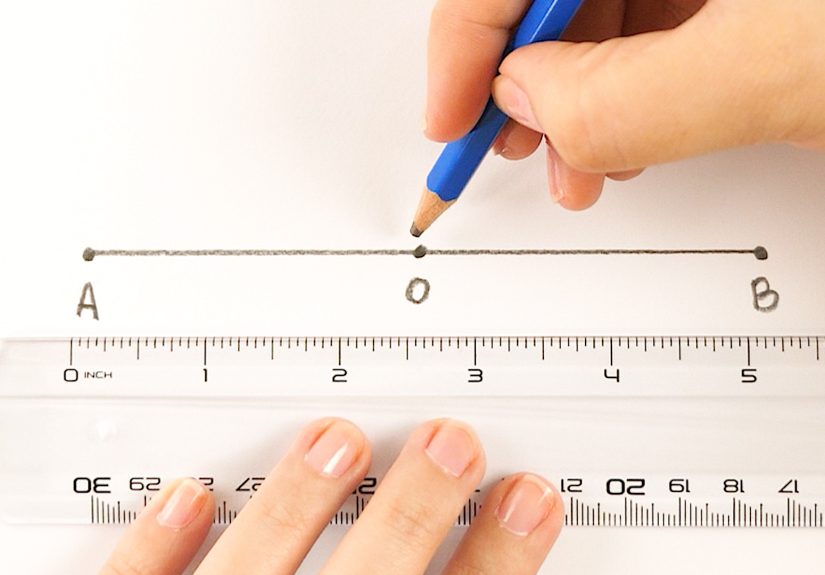
Use your ruler to draw a horizontal line across your paper. Label it line AB. The line does not have to be perfectly horizontal, but keeping it level makes the drawing easier to follow.
Choose a point on the line where you want the 90-degree angle to begin. Label this point P. Point P will become the vertex of your right angle.
Step 2: Place the Compass Point on P
Open your compass to any comfortable width. The exact size does not matter, as long as the opening is not too tiny. If your compass opening is too small, your arcs may crowd together and make the construction harder to see.
Put the sharp point of the compass on point P. Keep it steady. If the compass slips, the construction will still be emotionally meaningful, but mathematically suspicious.
Step 3: Mark Two Equal Points on the Line
With the compass point still on P, draw an arc that crosses the line on both sides of P. The arc should meet the line at two points. Label the left intersection C and the right intersection D.
Because both C and D were made using the same compass opening from P, the distances PC and PD are equal. This is important. You have now created a segment CD with P as its midpoint.
Step 4: Open the Compass Wider
Now increase the compass opening. Make it wider than the distance from C to P. This matters because your next arcs need to cross each other above or below the line. If the compass is not opened wide enough, the arcs may only touch lightly or fail to intersect.
A good rule of thumb: open the compass more than halfway across segment CD. You do not need to measure it; just make it obviously wider than CP.
Step 5: Draw an Arc from Point C
Place the compass point on C. Draw an arc above the line. You can also draw it below the line, but above the line is usually easier for beginners. Make the arc long enough to cross the arc you will draw from point D in the next step.
Do not change the compass width after drawing this arc.
Step 6: Draw an Arc from Point D
Without changing the compass opening, place the compass point on D. Draw another arc above the line so it intersects the arc from C. Label the intersection point E.
Point E is equally distant from C and D because it was made using the same compass radius from both points. That means E lies on the perpendicular bisector of segment CD.
Step 7: Draw a Straight Line Through P and E
Use your ruler to draw a straight line passing through P and E. This line is perpendicular to line AB. The angle formed between line AB and line PE is a 90-degree angle.
Congratulations. You have constructed a right angle using only a compass and ruler. No protractor. No measuring. No geometry goblin stole your points.
Why This Construction Works
This method works because it creates a perpendicular bisector. When you marked points C and D on the original line using the same compass width from P, you made PC equal to PD. That means P is the midpoint of segment CD.
Then, by drawing equal arcs from C and D, you found a point E that is the same distance from both C and D. A point that is equidistant from the endpoints of a segment lies on the perpendicular bisector of that segment. Since both P and E lie on the perpendicular bisector of CD, the line through P and E is perpendicular to CD.
Because CD lies on the same straight line as AB, line PE is also perpendicular to AB. Perpendicular lines form right angles, so the angle at P is exactly 90 degrees.
Alternative Method: Construct a 90-Degree Angle at the End of a Ray
Sometimes you do not need a right angle in the middle of a line. You may need one at the endpoint of a ray, like when drawing the corner of a rectangle or building the first side of a square. Here is a clean method that works well.
Step 1: Draw a Ray
Draw a ray starting at point A and extending to the right through point B. Point A will be the vertex of your 90-degree angle.
Step 2: Choose a Point on the Ray
Pick a point C somewhere on ray AB. The distance from A to C can be any convenient length. Keep your drawing large enough so your arcs will be clear.
Step 3: Create a Circle or Arc Using C as Center
Place the compass point on C and set the compass opening to reach A. Draw a circle or a large arc that passes through A and crosses the ray again at another point. Label the second intersection D.
Step 4: Connect D to a New Arc Point
Using the same circle idea, you can use the diameter relationship to locate a point that creates a right angle at A. One classical explanation comes from the theorem that an angle inscribed in a semicircle is a right angle. In simpler classroom terms, when you use a diameter of a circle correctly, the angle formed from a point on the circle can produce an exact 90-degree angle.
This method is slightly more advanced than the perpendicular-bisector method, so beginners usually find the first method easier. For homework, tests, and general practice, constructing a perpendicular line at a point on a line is the safest and clearest approach.
Common Mistakes to Avoid
Changing the Compass Width Too Soon
When drawing arcs from C and D, the compass width must stay exactly the same. If you change it between arcs, point E may not be equidistant from C and D, and your “right angle” may lean like it has had a long day.
Making the Arcs Too Small
If your arcs do not intersect clearly, open the compass wider and try again. The arcs must cross at a visible point so you can draw an accurate line through P and E.
Using the Ruler to Measure Instead of Draw
In true geometric construction, the ruler is used only as a straightedge. You should not measure inches or centimeters to create the right angle. The compass handles equal distances, and the logic of the construction creates the 90 degrees.
Drawing Thick or Messy Lines
A sharp pencil makes a huge difference. Thick pencil marks can shift your intersection points and make the final line inaccurate. Keep your pencil sharp, draw lightly, and darken the final answer after the construction is complete.
Forgetting to Label Points
Labels make your construction easier to explain. Use simple letters like A, B, C, D, P, and E. If your teacher asks for steps, labels help prove you know what you are doing instead of just performing mysterious compass choreography.
How to Check Your 90-Degree Angle
After constructing the angle, you can check it in several ways. The most formal way is to explain the reasoning: the line you drew is the perpendicular bisector of a segment, so it forms a right angle. If you are practicing at home, you may place a corner of a sheet of paper or a set square against the angle to see whether it matches.
You may also use a protractor after the construction is finished, but only as a checking tool. The angle should read 90 degrees. If it is a little off, the most likely causes are slipping compass points, uneven arcs, or a ruler that was not lined up exactly through P and E.
Where This Skill Is Used
Learning how to construct a 90 degrees angle using compass and ruler is not just a classroom trick. It builds the foundation for many geometric constructions. Once you can draw a perpendicular line, you can construct squares, rectangles, perpendicular bisectors, altitudes of triangles, coordinate axes, right triangles, and more accurate diagrams.
This skill also helps students understand why geometry works. Instead of memorizing that a right angle is 90 degrees, you see how equal distances and intersecting arcs can force a perfect perpendicular relationship. That is a powerful idea: geometry is not just about drawing shapes; it is about proving that the shapes must behave a certain way.
Example: Constructing the Corner of a Square
Suppose you are asked to construct a square with side AB. First, draw segment AB. Then construct a 90-degree angle at point A using the perpendicular construction method. Next, use your compass to copy the length AB onto the new perpendicular line, creating point C. Repeat the process at point B or use parallel construction methods to complete the square.
The entire square depends on that first right angle. If the 90-degree angle is accurate, the square has a strong start. If it is crooked, the square becomes a fashionable parallelogram with commitment issues.
Tips for a Cleaner Construction
Use light construction marks at first. Your arcs are part of the process, but they do not need to dominate the final drawing. Once the right angle is constructed, darken only the original line and the perpendicular line if your assignment requires a clean final answer.
Keep the compass tight. A loose compass can slowly change width while you draw, which ruins equal-distance construction. If your compass has a screw adjustment, tighten it before making important arcs.
Draw large enough. Tiny constructions are difficult to control. A larger diagram makes arc intersections easier to see and reduces small errors. Geometry rewards neatness, but it also rewards giving your pencil enough room to breathe.
Practice Exercise
Try this simple exercise to master the process:
- Draw a line and mark a point P on it.
- Use your compass to mark two equal points C and D on either side of P.
- Open the compass wider and draw equal arcs from C and D.
- Label the arc intersection E.
- Draw line PE.
- Mark the right angle at P with a small square symbol.
Repeat the construction three times: once with a horizontal line, once with a slanted line, and once with a vertical line. This helps you understand that a 90-degree angle does not depend on the line’s position on the paper. A perpendicular relationship works in any direction.
Experiences and Practical Lessons From Constructing a 90-Degree Angle
The first time many students try to construct a 90-degree angle using compass and ruler, they expect it to feel harder than it really is. The instructions may look long, but the action is simple: make equal marks, draw matching arcs, connect the correct points. The challenge is not the idea; the challenge is accuracy. A compass construction is a bit like cooking pancakes. The recipe is easy, but the first one may look emotionally complicated.
One useful experience is learning to slow down at the arc stage. Students often rush the arcs from C and D, especially if they already know the final line should go “straight up.” But guessing the direction defeats the purpose of the construction. The arcs are not decoration. They are the evidence. They tell you exactly where the perpendicular line belongs. When the arcs cross clearly, the construction almost draws itself.
Another practical lesson is that bigger drawings are usually better for beginners. When the construction is too small, the compass point can tear the paper, the arcs overlap in messy ways, and the ruler may cover the exact point you need to connect. A larger construction gives you more control. It also makes your reasoning easier to show if you are submitting the work for a grade.
Many learners also discover that the compass needs more care than expected. If the pencil side is dull, the arcs become thick. If the metal point slips, the center changes. If the hinge is loose, the radius changes while drawing. Any of these problems can turn a perfect method into a slightly wobbly angle. The solution is simple: check the compass before starting, press gently, and draw smooth arcs instead of forcing the tool across the page.
In real classroom practice, labeling points makes a big difference. A construction without labels can look like a collection of random moon phases. With labels, the logic becomes clear: P is the vertex, C and D are equally spaced from P, E is where the equal arcs meet, and PE is the perpendicular line. The labels turn the drawing into an explanation.
There is also a confidence boost that comes from constructing a right angle without measuring. At first, it may feel strange not to use a protractor. But once you see the perpendicular line appear from equal arcs, geometry becomes less about memorizing numbers and more about understanding relationships. The 90-degree angle is not guessed; it is forced by the construction.
This skill becomes especially useful when drawing squares, rectangles, right triangles, perpendicular bisectors, and coordinate axes. If you can construct one accurate right angle, you can build many larger shapes from it. That is why teachers emphasize this construction early in geometry. It is a small tool with a big future.
The best advice from experience is to keep your construction marks visible until the end. Do not erase the arcs too early. They prove how the angle was made. Once the construction is checked and complete, you can clean the drawing if needed. Until then, let the arcs stay. They are not mess; they are the math footprints.
Conclusion
Constructing a 90-degree angle using compass and ruler is one of the most important skills in basic geometry. By using equal arcs and a straightedge, you can create a perpendicular line without measuring degrees. The key steps are simple: mark equal points on a line, draw equal arcs from those points, connect the original point to the arc intersection, and you have a right angle.
This construction teaches more than drawing. It shows how geometry uses logic, symmetry, and equal distances to create exact results. Once you master it, you can move confidently into squares, rectangles, perpendicular bisectors, right triangles, and more advanced compass-and-straightedge constructions. And yes, your protractor can take a small vacation.
Note: This article is written from established Euclidean geometry construction principles and standard classroom methods for constructing perpendicular lines and right angles with a compass and straightedge.





 Close
Close